In this article
- 01MBA Business Analytics Semester-Wise Syllabus Breakdown 2026
- 02Core Subjects in MBA Business Analytics Curriculum 2026 Explained
- 03Elective Courses for MBA Business Analytics Specialization 2026
- 04Recommended Books and Study Materials for MBA Business Analytics 2026
- 05Key Tools and Software Covered in Business Analytics MBA 2026
- 06Frequently Asked Questions
As organizations shift from intuitive decision-making to AI-driven strategy, an MBA in Business Analytics has become one of the most high-value graduate degrees of 2026. While foundational coursework equips you with essential statistics, SQL, and predictive modeling, second-year electives allow candidates to customize their capabilities toward niche industry tracks or cutting-edge technical architecture. Whether your goal is leading enterprise AI strategy or managing data-driven products, choosing the right curriculum path is critical. Here is your comprehensive guide to the top 2026 Business Analytics electives, complete with a strategic framework on how to choose electives for an MBA in Business Analytics 2026 to maximize your post-graduation ROI.
MBA Business Analytics Semester-Wise Syllabus Breakdown 2026
The MBA Business Analytics program spans two years, divided into four semesters. The first year focuses on theoretical fundamentals of business management, while the second year applies these concepts to real-world business outcomes, including specializations and internships.
| Semester 1 | Semester 2 |
| Accounting for Business Decisions | Business Research Methods |
| Organizational Behaviour & HRM | Financial Management |
| Operations & Supply Chain Management | International Business Environment |
| Marketing Management | Fundamentals of Programming for Analytics |
| Business Analytics Foundation | Visual Analytics |
| Managerial Economics | Data Mining |
| Legal & Business Environment | Modern Data Management Systems |
| Aptitude Proficiency – I | Aptitude Proficiency – II |
| Business Communication Skills | Business Analytics using R |
| Decoding AI (IU Module) | Social, Web & Text Analytics |
| Indian Knowledge System (IU) | Dashboard Design & Data Analysis with Excel |
| SOUL (IU) | Essentials of Sustainability (IU) |
| Generic Electives | Field Project (Specialization Core) |
The initial semesters establish a strong foundation in both management principles and core analytics techniques, preparing students for advanced topics.
| Semester 3 | Semester 4 |
| Strategic Management | Research Project |
| Decision Science | ETL, Data Profiling & Data Modelling |
| Big Data Analytics & Introduction to PySpark | Natural Language Processing & AI Advancements |
| Machine Learning using Python | MLOps: Managing Machine Learning in Business |
| Artificial Intelligence in Business Applications | Cognitive Computing |
| Data Warehousing Project Life Cycle Management | Retail & E-Commerce Analytics |
| SQL Essentials & Advanced SQL | Business Intelligence Platforms for Analytics |
| Advanced Statistical Methods using Python | Unstructured Data Analytics |
| Predictive Modelling | Business Applications of Blockchain Technologies |
| Time Series Analysis & Forecasting | Big Data Analytics |
| Internet of Things (IoT) | — |
| On-the-Job Training (OJT) / Internship | — |
Also Read: Top MBA Specialisations in India for 2026: High Demand & Career Scope
Core Subjects in MBA Business Analytics Curriculum 2026 Explained
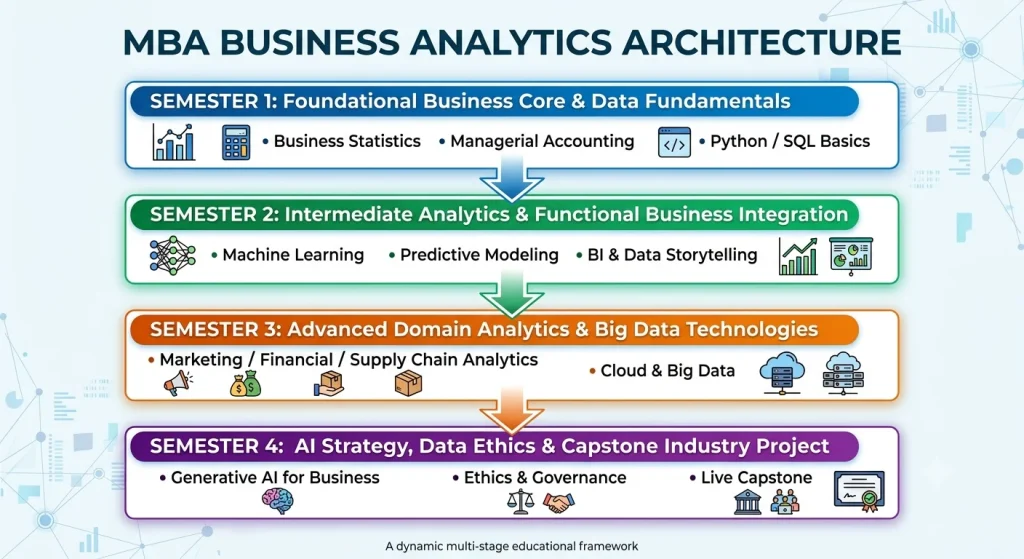
The MBA in Business Analytics curriculum is specifically engineered to bridge the gap between technical data engineering and executive decision-making. Delivered over 4 semesters (or 6 trimesters) across major Indian B-Schools like IIM Bangalore, IIM Calcutta (PGDBA), MDI Gurgaon, and NMIMS, the program equips managers to translate complex quantitative output into actionable enterprise strategy.
| Semester | Core Subject Area | Primary Focus & Learning Outcomes | Key Software Tools & Languages |
| Semester 1 | Business Statistics & Probability | Descriptive/inferential statistics, probability distributions, hypothesis testing, ANOVA, and regression fundamentals. | MS Excel (Data Analysis Toolpak), R. |
| Semester 1 | Data Management & SQL | Relational Database Management Systems (RDBMS), ER modeling, writing complex SQL queries, and database architecture. | MySQL, PostgreSQL, Oracle SQL. |
| Semester 1 | Programming for Analytics | Fundamentals of data structures, data cleaning, web scraping, and exploratory data analysis (EDA). | Python (Pandas, NumPy, Matplotlib). |
| Semester 2 | Predictive Modeling & ML | Supervised/unsupervised algorithms: Decision Trees, Random Forests, Logistic Regression, K-Means Clustering, and Time Series Forecasting. | Python (Scikit-Learn, Statsmodels), R. |
| Semester 2 | Business Intelligence & Visualization | Extract, Transform, Load (ETL) pipeline design, interactive dashboard development, and executive data storytelling. | Tableau, Microsoft Power BI, Looker. |
| Semester 2 | Optimization Analytics & Operations | Mathematical programming, linear/integer programming, network models, and queuing theory for resource allocation. | Excel Solver, LINGO, Python (SciPy). |
| Semester 3 | Big Data & Cloud Analytics | Processing unstructured data at scale, distributed computing, data warehousing, and cloud-based analytical pipelines. | PySpark, Hadoop, AWS S3/Redshift, Snowflake. |
| Semester 3 | Domain-Specific Analytics | Functional application of analytical models across core business verticals (Marketing, Finance, HR, Supply Chain). | Python, R, specialized enterprise platforms. |
| Semester 4 | AI Strategy, LLMs & Data Governance | Deploying Enterprise AI, Large Language Models (LLMs) in business, data privacy regulations (DPDP Act, GDPR), and bias mitigation. | OpenAI APIs, Hugging Face, LangChain. |
| Semester 4 | Capstone Industry Project | Solving an end-to-end real-world corporate problem using empirical dataset execution and presenting to senior management. | Full technical & business analytical stack. |
Also Read: Online MBA Fees in India 2026: Top Universities & Payment Options
Deep-Dive: Core Specialization Modules
A. Predictive Analytics & Machine Learning for Managers
Rather than deriving pure mathematical proofs, this module concentrates on algorithmic business application:
- Classification Models: Customer churn prediction, credit risk scoring, and fraud detection using Logistic Regression and Decision Trees.
- Clustering & Segmentation: Market basket analysis, customer lifetime value (CLTV) segmentation using K-Means and Hierarchical Clustering.
- Time-Series Forecasting: Demand sensing, revenue projection, and stock movement analysis using ARIMA and Exponential Smoothing models.
B. Marketing Analytics & Customer Insights
Teaches managers to convert digital touchpoints into actionable marketing strategy:
- A/B Testing & Experimentation: Setting up conversion experiments, sample sizing, and hypothesis validation.
- Attribution Modeling: Multi-touch attribution modeling across paid, organic, and referral marketing channels.
- Price & Promotion Elasticity: Optimizing dynamic pricing structures using econometric regression models.
C. Financial & Risk Analytics
Focuses on data-driven decision-making within corporate finance and banking ecosystems:
- Credit Risk & Default Modeling: Building probability of default (PD) and loss given default (LGD) models under Basel frameworks.
- Portfolio Optimization: Markowitz mean-variance optimization, Value at Risk (VaR) computation, and Monte Carlo stress testing.
- Algorithmic & Fraud Analytics: Anomaly detection in transaction flows using unsupervised machine learning.
D. Supply Chain & Operations Analytics
Applies analytical frameworks to streamline global supply networks and production lines:
- Inventory & Demand Optimization: Safety stock calculations, reorder point optimization, and economic order quantity (EOQ) under uncertainty.
- Logistics & Route Optimization: Vehicle routing problems (VRP) and network flow models for fleet management.
The Tech Stack Taught in 2026
- Programming & Query Languages: Python (Pandas, NumPy, Scikit-Learn) and SQL are taught as fundamental, non-negotiable prerequisites.
- Business Intelligence Platforms: Tableau and Power BI are utilized for rapid executive reporting and C-suite visual dashboards.
- Big Data & Cloud Infrastructure: Exposure to Snowflake, PySpark, and AWS/Azure cloud environments for enterprise data pipelines.
- GenAI & Business Automation: Integration of LLMs, prompt engineering, and automated workflow design for enterprise operational efficiency.
Elective Courses for MBA Business Analytics Specialization 2026
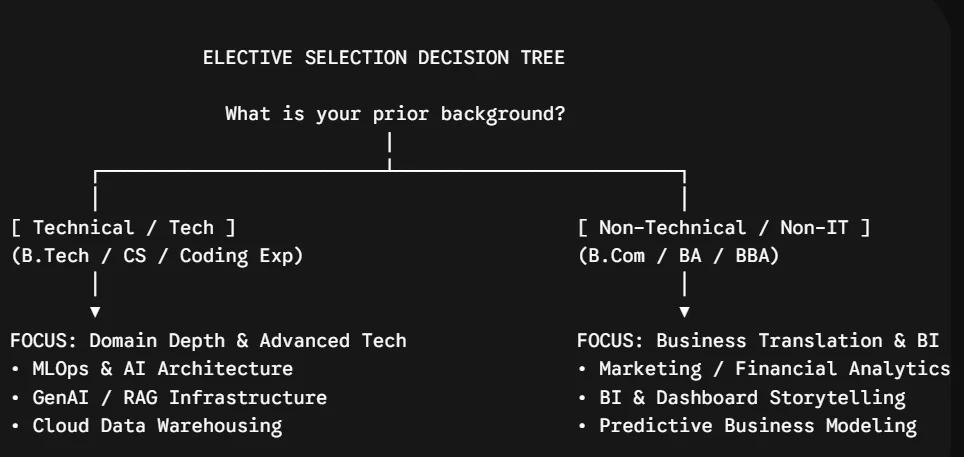
While the core curriculum establishes the foundation in stats, SQL, and predictive modeling, second-year electives allow candidates to tailor their technical capabilities toward specific industry domains or advanced technical tracks.
Top B-Schools structure electives into two primary tracks: Domain-Specific Analytics (applying data within functional units like Finance or Marketing) and Advanced Technical/Methodological Analytics (deep-diving into emerging technologies like Generative AI, MLOps, and Cloud Architecture).
A. Financial Analytics & FinTech
- Fraud Detection & Anomaly Analytics: Building unsupervised ML models to detect anomalous credit card transactions and anti-money laundering (AML) patterns in real-time.
- Credit Risk & Rating Models: Developing Probability of Default (PD) and Loss Given Default (LGD) models under Basel III/IV regulatory frameworks.
- Algorithmic Trading & Portfolio Analytics: Quantitative trading strategies using Python, high-frequency data streaming, and Black-Scholes pricing models.
B. Marketing & Customer Analytics
- Customer Lifetime Value (CLTV) & Churn Modeling: Survival analysis and logistic regression to predict customer attrition and lifetime revenue potential.
- Digital Attribution & Web Analytics: Multi-touch attribution modeling across paid, organic, and referral channels using Google Analytics 4 (GA4) and SQL.
- Price & Promotion Elasticity: Econometric modeling to optimize dynamic pricing and trade promotion spending in retail/e-commerce.
C. Operations & Supply Chain Analytics
- Demand Sensing & Inventory Optimization: Advanced ARIMA and prophet models for forecasting stock-keeping unit (SKU) level demand under market volatility.
- Network & Logistics Optimization: Mixed-integer linear programming (MILP) for warehouse location selection and real-time vehicle routing problems (VRP).
D. People & HR Analytics
- Predictive Attrition & Flight-Risk Modeling: Survival analysis to identify key drivers of employee turnover before resignation notices are submitted.
- Workforce Capacity & Performance Planning: Optimization models to balance headcount, shift allocations, skill mix, and overtime costs.
Advanced Technical & Emerging Tech Electives
| Elective Course Title | Focus & Core Methodologies Taught | Key Software & Frameworks | Target Corporate Roles |
| Generative AI & LLMs for Enterprise | Fine-tuning open-source LLMs, Retrieval-Augmented Generation (RAG) architecture, and prompt engineering for corporate knowledge engines. | OpenAI APIs, LangChain, Hugging Face, Vector DBs (Pinecone, Chroma). | AI Product Manager, Enterprise AI Consultant. |
| MLOps & Analytics Pipeline Engineering | Deploying, monitoring, and scaling machine learning models in production environments while preventing model drift. | Docker, Kubernetes, MLflow, Airflow, CI/CD pipelines. | Machine Learning Engineer, Analytics Engineer. |
| Text Mining & Natural Language Processing (NLP) | Sentiment analysis on customer feedback, topic modeling, named entity recognition (NER), and web-scraping unstructured data. | Python (NLTK, SpaCy, Transformers), BERT. | NLP Specialist, Market Intelligence Lead. |
| Cloud Data Warehousing & Architecture | Building scalable cloud data lakes, ETL pipeline orchestration, and cost-effective cloud query execution. | Snowflake, AWS Redshift, Google BigQuery, dbt. | Cloud Data Architect, BI Solutions Manager. |
| Social Media & Web Network Analytics | Graph theory, network centrality metrics, viral coefficient modeling, and influencer identification algorithms. | Gephi, NetworkX, Python. | Social Media Strategist, Network Analyst. |
How to Choose Electives for an MBA in Business Analytics 2026?
Recommended Books and Study Materials for MBA Business Analytics 2026
A well-rounded MBA Business Analytics stack requires a mix of foundational textbooks, applied technical guides, strategic management frameworks, and interactive online platforms. Modern MBA programs place equal weight on technical execution and executive communication.
Strategic & Conceptual Foundations
- Data Science for Business by Foster Provost & Tom Fawcett
- Why It’s Essential: Taught at NYU Stern, this is the gold-standard text for framing business problems analytically before writing code. It bridges management intuition with data mining logic.
- Competing on Analytics: The New Science of Winning by Thomas H. Davenport & Jeanne G. Harris
- Why It’s Essential: Crucial for strategy courses, explaining how market leaders (like Amazon, Netflix, and Capital One) build competitive advantages around institutional data assets.
- Data Strategy: How to Profit from a World of Big Data, Analytics and AI by Bernard Marr
- Why It’s Essential: Focuses on corporate governance, data monetization, and developing infrastructure alignable with C-suite priorities.
B. Quantitative Modeling & Decision Science
- Business Analytics: Data Analysis and Decision Making by S. Christian Albright & Wayne L. Winston
- Why It’s Essential: Standard textbook across top business schools for decision trees, simulation, sensitivity analysis, and optimization models in Excel/R.
- Naked Statistics: Stripping the Dread from the Data by Charles Wheelan
- Why It’s Essential: Ideal pre-MBA or First-Term primer to build deep statistical intuition behind regression analysis, central limit theorem, and inference without getting bogged down in proofs.
C. Data Storytelling & Executive Communication
- Storytelling with Data: A Data Visualization Guide for Business Professionals by Cole Nussbaumer Knaflic
- Why It’s Essential: Teaches clutter-eliminating design principles and narrative framing needed to pitch data insights to non-technical stakeholders.
Practical Technical & Programming Manuals
| Book Title | Author | Primary Tech Stack | Core MBA Learning Outcome |
| Python for Data Analysis (3rd Ed.) | Wes McKinney | Python, Pandas, NumPy, Jupyter | Industry standard for data manipulation, cleaning, and exploratory analysis. |
| SQL for Data Analytics | Upom Malik et al. | SQL (PostgreSQL, MySQL) | Database querying, complex joins, window functions, and data transformations for analytics. |
| Practical Statistics for Data Scientists | Peter Bruce, Andrew Bruce, & Peter Gedeck | R & Python | Hands-on application of hypothesis testing, A/B testing, and predictive modeling algorithms. |
| Designing Data-Intensive Applications | Martin Kleppmann | Cloud Architecture, NoSQL, Kafka | Understanding modern backend enterprise architecture for candidates moving into Tech Product Management. |
Real-World Datasets for Portfolio Projects
- Kaggle & UCI Machine Learning Repository: Essential for domain-specific projects (e.g., credit card fraud, retail store sales forecasting, employee attrition datasets).
- Google Dataset Search & AWS Open Data Registry: Access to large-scale public datasets (finance, spatial data, healthcare trends) for cloud computing practice.
Digital Platforms & Interactive Practice Tools
- DataCamp / Coursera (Specializations): Recommended for bridging technical gaps before semester tracks begin (specifically SQL, Python, and Tableau/Power BI tracking).
- LeetCode (Database Section) / StrataScratch: Best for practicing advanced SQL queries and data engineering logic for corporate recruitment coding rounds.
- Weights & Biases / Hugging Face Documentation: Key technical study materials for second-year electives focusing on Generative AI, RAG architectures, and fine-tuning models.
Key Tools and Software Covered in Business Analytics MBA 2026
The MBA Business Analytics syllabus for 2026 emphasizes practical skills using industry-standard software. You will gain proficiency in essential tools for data manipulation, visualization, and advanced analytics, preparing you for a successful career in the field.
- Foundational Data Engine: Microsoft Excel
- Leader in Data Visualization: Tableau
- Database Standard: SQL (Structured Query Language)
- For Predictive & Advanced Analytics: Python
- Corporate Intelligence Hub: Power BI
- Other popular tools: SAS Business Analytics (SAS BA), QlikView, Board
Beyond these core offerings, the curriculum also integrates various other popular business analytics tools for 2026, including Splunk, Sisense, Microstrategy, KNIME, Dundas BI, and TIBCO Spotfire. These tools provide a full understanding of the diverse software area in business analytics.
| Category | Tools |
| Data Visualization and Analysis | – Microsoft Excel – Tableau – R and Python |
| Collaboration and Communication | – Slack – Google Meet or Zoom – Microsoft Office Suite or Google Workspace |
| Project Management | – Asana – Trello |
| Research and Writing | – Notion – Grammarly – PaperPass – Zotero or BibGuru |
| Utility Tools | – Evernote – HubSpot – Google Analytics – Canva – Calendly – Dex – MindMeister – Dropbox or Google Drive |
Frequently Asked Questions
What Core Subjects Are Covered in the MBA Business Analytics First Semester?
The first semester of an MBA Business Analytics program covers core management theory, economics, finance, organizational behavior, Business Statistics, Managing People & Organizations, and Business Leadership.
How Does the MBA Business Analytics Curriculum Differ from a Traditional MBA Program?
The MBA Business Analytics curriculum combines managerial education with analytical skills, unlike a traditional MBA which focuses on building cross-functional skills.
What Electives Are Typically Offered in the MBA Business Analytics Program?
Electives typically include Marketing Analytics, Financial Analytics, Human Resource Analytics, AI and Machine Learning Applications, Big Data & Web, Data Visualization, and Operation Research Models. Programming with R and Python and Database Management are also offered.
When Are the Typical Application Deadlines for MBA Business Analytics Programs?
Application deadlines for MBA Business Analytics programs vary, but frequently occur for the Summer Semester 2027. Check specific program timelines for key dates.
How Does the MBA Business Analytics Curriculum Differ from a Traditional MBA?
The MBA Business Analytics curriculum combines managerial education with analytical skills, unlike a traditional MBA which focuses on building cross-functional skills.
What Electives Are Typically Available in an MBA Business Analytics Program?
Typical electives include Marketing, Financial, and Human Resource Analytics, along with Data Visualization, Operation Research Models, and AI/Machine Learning Applications.