
In this article
- 01Most In-Demand MBA Specialisations in India for 2026
- 02MBA Specialisations: Who They’Re Best for (Marketing, Finance, Analytics)
- 03Top 10 High Demand MBA Specialisations in India 2026
- 04MBA in Business Analytics vs Finance vs Marketing: Career Growth 2026
- 05MBA Specialisations-wise Best Job Roles & Salary Projection and Growth
- 06MBA Specialisation Wise Best Tier-Wise Colleges with Fees
- 07Choosing the Best MBA Specialisation: Factors to Consider for 2026
- 08Frequently Asked Questions
MBA specialisations in India significantly impact career trajectories and earning potential, with their framework governed by the All India Council for Technical Education (AICTE), the statutory body for technical education. A focused area of study within business administration, an MBA specialisation equips graduates with targeted skills for specific industries or roles. Graduates with specialised MBAs can expect 20–65% higher salary growth compared to general MBA graduates; early professionals in MBA Marketing average ₹6–10 LPA, MBA Finance ₹7–12 LPA, and MBA in Big Data Analytics ₹8–14 LPA.
Most In-Demand MBA Specialisations in India for 2026
Business Analytics and Finance are the highest-paying MBA specialisations in India for 2026, reflecting strong demand across various sectors. India’s digital economy is projected to reach $1 trillion by 2028, creating significant opportunities for graduates in these and other in-demand fields.
| MBA Specialisation | Key subjects | Career opportunities | Industries hiring | Market outlook |
| Finance | Financial modelling, investment analysis, corporate finance, risk management, derivatives | Investment banking, financial planning & analysis, corporate treasury, private equity | BFSI, NBFCs, fintech, consulting | Finance continues to be the most consistently hireable MBA domain. As India’s fintech market is projected to reach $1 trillion in AUM by 2030, the demand for finance-trained MBAs continues to rise. |
| Marketing | Consumer behaviour, brand management, digital marketing, market research, pricing strategy | Brand manager, product marketer, growth strategist, marketing analytics lead | FMCG, e-commerce, media, D2C brands | LinkedIn’s Workforce Report shows that marketing analytics and digital strategy are among the fastest-growing skills in the Asia-Pacific region and marketing MBAs with data skills are in demand. |
| Business Analytics | Data visualisation, predictive modelling, machine learning for business, SQL, Python for analytics | Business analyst, data strategist, analytics consultant, product analyst | Technology, consulting, banking, e-commerce, healthcare | The World Economic Forum’s Future of Jobs Report 2025 lists data and AI roles among the fastest-growing jobs globally and Business Analytics can easily be termed the most future-proof MBA specialisation currently. |
| Human Resource Management (HRM) | Organisational behaviour, talent acquisition, HR analytics, labour laws, compensation management | HR business partner, talent strategist, DEI lead, L&D manager | Across all industries — IT, manufacturing, consulting, healthcare | With organisations investing more and more into employee experience and people analytics, HR has come a long way from an administrative function to a strategic decision-maker role. |
| Operations & Supply Chain Management | Logistics, procurement, lean management, demand forecasting, operations research | Supply chain analyst, operations manager, procurement lead, logistics head | Manufacturing, retail, e-commerce, automobile, FMCG | The post-pandemic supply chain disruptions have placed this among the strategically important domains. McKinsey estimates that the firms that focus on supply chain resilience will generate 40% more value over the next decade. |
| International Business | Cross-border trade, global marketing, foreign exchange management, international law | Trade analyst, global operations manager, export-import manager, international consultant | Multinational corporations, trade consulting firms, government bodies | As the Indian companies venture out globally and MNCs expand in India, professionals adept at managing international business operations are becoming indispensable. |
| Digital Business | Digital transformation, e-commerce strategy, platform economics, UX for business, tech product management | Digital product manager, e-commerce strategist, digital transformation lead, tech business analyst | Technology, retail, banking, media | India’s digital economy is expected to be worth $1 trillion by 2028 and MBA graduates in digital business can lead the digital transformation within organisations. |
| Entrepreneurship | Venture capital, startup ecosystem, design thinking, business model innovation, growth hacking | Founder, startup product manager, business development lead, VC analyst | Startups, VCs, innovation labs, corporate accelerators | With India being the world’s third-largest startup ecosystem, entrepreneurship-focused MBA specialisations are attracting interest from aspiring entrepreneurs as well as companies seeking intrapreneurial skills within the organisation. |
Also Read: Top 10 Cheapest Online MBA Programs in India with Fees 2026
MBA Specialisations: Who They’Re Best for (Marketing, Finance, Analytics)
Selecting an MBA specialisation aligns core analytical strengths and career goals with specific domain demands. The right specialisation determines long-term recruitment channels, functional toolstacks, and compensation trajectories.
Deep Dive: Major MBA Specialisations
- MBA in Marketing & Digital Strategy
- Ideal Candidate Profile: Creative strategists, brand builders, and professionals combining consumer psychology with quantitative campaign metrics. Ideal for entering fast-moving consumer goods (FMCG), e-commerce, media, and digital branding sectors.
- Core Subjects: Consumer Behaviour & Insights, Integrated Marketing Communications (IMC), Digital & Performance Marketing, Product Management, Pricing Strategy, Market Research.
- Key Skills Developed: Multi-channel campaign planning, go-to-market (GTM) strategy, customer acquisition cost (CAC) optimization, and brand equity building.
- Career Roles & Salary Expectation: Brand Manager, Product Marketing Manager, Growth Hacker, Digital Strategy Lead.
- Freshers (0–2 yrs): ₹6.0 – ₹10.0 LPA
- Mid-Level (3–5 yrs): ₹12.0 – ₹20.0 LPA
- MBA in Finance & Financial Analytics
- Ideal Candidate Profile: Quantitative thinkers, detail-oriented strategists, and professionals with a strong grasp of economics, corporate valuation, capital allocation, or financial markets.
- Core Subjects: Corporate Finance, Investment Banking, Equity Valuation, Portfolio & Wealth Management, FinTech & Blockchain, Derivatives & Risk Management.
- Key Skills Developed: Financial modeling, M&A valuation, capital budgeting, regulatory compliance, and risk mitigation.
- Career Roles & Salary Expectation: Investment Banking Analyst, Corporate Finance Manager, Equity Research Associate, Risk Consultant.
- Freshers (0–2 yrs): ₹7.0 – ₹14.0 LPA
- Mid-Level (3–5 yrs): ₹14.0 – ₹25.0+ LPA
- MBA in Business Analytics & Data Leadership
- Ideal Candidate Profile: Technical professionals (B.Tech, BCA, B.Sc) or data analysts aiming to move into managerial roles by leveraging data engineering, business intelligence, and strategic decision frameworks.
- Core Subjects: Predictive Analytics, Data Visualization (Tableau/Power BI), Machine Learning for Business, SQL/Python for Decision Making, Big Data Architecture, Supply Chain Analytics.
- Key Skills Developed: Data storytelling, statistical hypothesis testing, data-driven revenue optimization, and dashboard architecture.
- Career Roles & Salary Expectation: Business Analytics Manager, BI Consultant, Product Analyst, Data Strategy Lead.
- Freshers (0–2 yrs): ₹7.0 – ₹13.0 LPA
- Mid-Level (3–5 yrs): ₹15.0 – ₹28.0+ LPA
- MBA in Entrepreneurship & Venture Development
- Ideal Candidate Profile: Startup founders, next-generation leaders of family businesses, and self-starters who need multi-functional mastery across capital raising, operations, and business scaling.
- Core Subjects: Venture Capital & Private Equity, New Business Creation, Lean Startup Methodology, Intellectual Property Rights, Franchise Management, Corporate Governance.
- Key Skills Developed: Seed-stage pitching, cap table management, operational agility, and product-market fit evaluation.
- Career Scope & Compensation: Startup Founder, Venture Partner, Business Development Director, Family Enterprise Successor. Compensation varies by capital raised and equity valuation.
Also Read: Integrated MBA After 12th: Eligibility, Pathways & Top Programs 2026
MBA Specialisations Comparison Matrix 2026
| Specialisation | Target Candidate Profile | Core Toolstack & Frameworks | Top Recruiting Sectors | Average Salary Range (Freshers vs Mid-Career) |
| Business Analytics | Data-driven decision makers, engineers, quantitative analysts | SQL, Python, Tableau, Power BI, Advanced Excel | IT Services, E-commerce, FinTech, Management Consulting | Freshers: ₹7–13 LPA
Mid-Career: ₹15–28 LPA |
| Finance & Investment | Analytical minds focused on capital allocation & markets | Financial Modeling, Bloomberg Terminal, DCF Valuation | Investment Banking, BFSI, Corporate Treasury, PE/VC | Freshers: ₹7–14 LPA
Mid-Career: ₹14–25+ LPA |
| Marketing & Growth | Creative strategists, brand builders, digital marketers | Google Analytics 4, Hubspot, SEO/SEM, CRM Platforms | FMCG, FMCD, EdTech, D2C Brands, Ad Agencies | Freshers: ₹6–10 LPA
Mid-Career: ₹12–20 LPA |
| Human Resource (HR) | People strategists, talent architects, organizational leads | HRIS tools (Workday, SAP SuccessFactors), People Analytics | IT/ITeS, Manufacturing, Global In-house Centers (GICs) | Freshers: ₹5–8 LPA
Mid-Career: ₹10–16 LPA |
| Operations & Supply Chain | Process optimizers, logistics leads, systems thinkers | Six Sigma (Green/Black Belt), ERP (SAP), Lean Systems | E-Commerce, Logistics, Manufacturing, Automotive | Freshers: ₹6–11 LPA
Mid-Career: ₹12–22 LPA |
Top 10 High Demand MBA Specialisations in India 2026
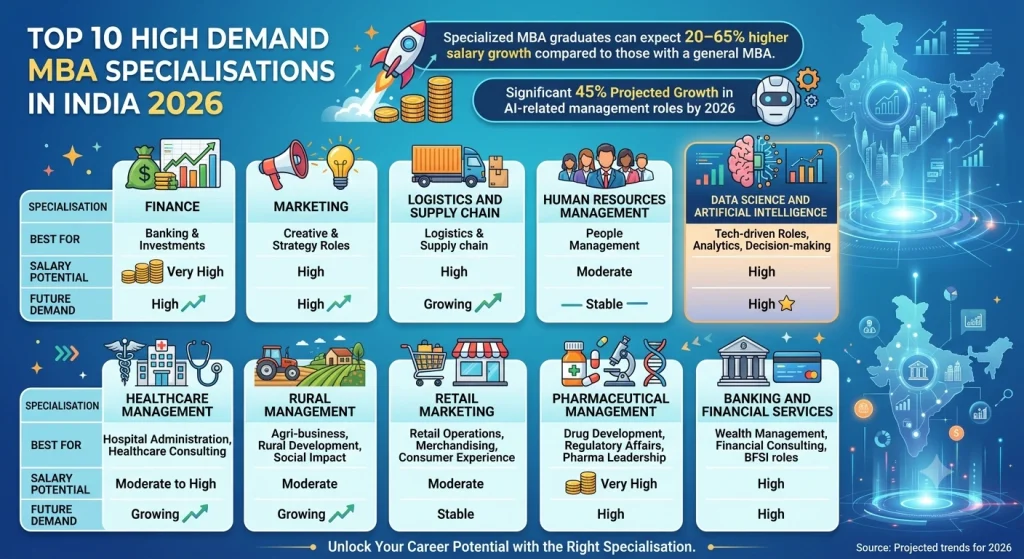
Specialized MBA graduates can expect 20–65% higher salary growth compared to those with a general MBA. This section compares various specialisations, highlighting their suitability for different career paths, salary potential, and future demand, including a significant 45% projected growth in AI-related management roles by 2026.
| Specialisation | Best For | Salary Potential | Future Demand |
| Finance | Banking & Investments | Very High | High |
| Marketing | Creative & Strategy Roles | High | High |
| Logistics and Supply Chain | Logistics & Supply chain | High | Growing |
| Human Resources Management | People Management | Moderate | Stable |
| Data Science and Artificial Intelligence | Tech-driven Roles, Analytics, Decision-making | High | High |
| Healthcare Management | Hospital Administration, Healthcare Consulting | Moderate to High | Growing |
| Rural Management | Agri-business, Rural Development, Social Impact | Moderate | Growing |
| Retail Marketing | Retail Operations, Merchandising, Consumer Experience | Moderate | Stable |
| Pharmaceutical Management | Drug Development, Regulatory Affairs, Pharma Leadership | Very High | High |
| Banking and Financial Services | Wealth Management, Financial Consulting, BFSI roles | High | High |
MBA in Business Analytics vs Finance vs Marketing: Career Growth 2026
The business and financial occupations sector projects a 7% overall employment growth by 2031, indicating a stable future for professionals in this field. The global Big Data and Business Analytics market shows a strong 10.9% Compound Annual Growth Rate (CAGR), with a projected value of $420 billion by 2027, highlighting the strong demand for analytical skills.
| Job Role | Key Skills Required | Industry Demand | Growth Potential | Typical Employers |
| Financial Analyst | Financial modeling, Excel | High | Strong | Banks, Corporates |
| Quantitative Analyst | Statistics, Python | Very High | Excellent | Investment Firms |
| BI Manager | Data visualisation, SQL | High | Strong | IT, Consulting |
| Data Scientist in Finance | Machine learning, analytics | Very High | Excellent | FinTech, Startups |
| Risk Management Consultant | Risk analysis, reporting | High | Strong | Banks, Consulting Firms |
This table illustrates diverse career paths within finance and business analytics, showing high demand and strong growth potential across various roles, from financial analysis to data science in finance.
| Comparison Factor | Online MBA in Business Analytics | Online MBA in Finance |
| Primary Focus | Focuses on analyzing large datasets to support informed business decision-making processes | Focuses on managing financial resources, investments, and corporate financial performance effectively |
| Learning Approach | Emphasizes data-driven insights, predictive modeling, and analytical problem-solving techniques | Emphasizes financial theories, valuation methods, and strategic financial decision-making processes |
| Tools & Techniques | Uses analytics tools, dashboards, and visualization platforms for actionable business insights | Uses financial models, accounting principles, and investment tools for financial analysis |
| Decision Framework | Decisions are based on patterns, trends, and data-driven predictive analysis models | Decisions rely on financial statements, risk evaluation, and market performance indicators |
| Business Application | Applicable across industries for optimizing operations, marketing strategies, and customer experience | Applied in banking, corporate finance, and investment sectors for financial planning |
This comparison highlights the focus and applications of an online MBA in Business Analytics versus an online MBA in Finance, showing how each program prepares you for different aspects of business decision-making.
| Role | Average Salary (LPA) |
| Business Intelligence Specialist | ₹13.5 |
| Business Analyst | ₹8 |
| Data Analyst | ₹6 |
| Marketing Analyst | ₹6 |
| Financial Analyst | ₹6 |
The average salaries after an online MBA in Business Analytics vary, with Business Intelligence Specialists earning the highest at ₹13.5 LPA.
| Role | Average Salary (LPA) |
| Project Portfolio Manager | ₹20.8 |
| Corporate Finance Manager | ₹17 |
| Investment Banker | ₹13 |
| Credit Analyst | ₹7 |
| Risk Analyst | ₹6 |
Average salaries after an online MBA in Finance show strong earning potential, particularly for roles like Project Portfolio Manager and Corporate Finance Manager.
- Average starting salaries in India for freshers (MBA in Finance and Business Analytics): ₹6 LPA to ₹12 LPA
- Average starting salaries in India from top colleges (MBA in Finance and Business Analytics): ₹12 LPA to ₹25 LPA
These figures indicate that graduates from top colleges in both MBA specialisations can command significantly higher starting salaries in India.
MBA Specialisations-wise Best Job Roles & Salary Projection and Growth
Career progression and earning benchmarks post-MBA vary significantly depending on functional specialization, employer tier, and industry alignment. While specialized data and strategy roles command premium starting packages, core operational and functional disciplines provide high hiring volume and steady long-term compensation growth.
| MBA Specialisation | High-Demand Job Roles | Entry-Level Salary (0–2 Yrs) | Mid-Career Salary (3–6 Yrs) | Senior / CXO Level (7+ Yrs) | 5-Year Salary Growth Trajectory |
| Business Analytics & Data Science | Product Analyst, Analytics Manager, BI Consultant, AI Strategy Lead | ₹7.0 – ₹13.0 LPA | ₹16.0 – ₹28.0 LPA | ₹35.0 – ₹65.0+ LPA | 20% – 25% CAGR (Driven by AI adoption & data infrastructure demand) |
| Finance & Investment Banking | Investment Banker, Corporate Finance Manager, Equity Analyst, Risk Manager | ₹8.0 – ₹15.0 LPA | ₹18.0 – ₹32.0 LPA | ₹45.0 – ₹1.2+ Cr | 18% – 22% CAGR (High variable bonuses & capital market growth) |
| Strategy & Management Consulting | Strategy Consultant, Engagement Manager, Corporate Development Lead | ₹12.0 – ₹22.0 LPA | ₹22.0 – ₹42.0 LPA | ₹50.0 – ₹1.5+ Cr | 22% – 28% CAGR (Highest compensation ceiling across industries) |
| Marketing & Product Management | Brand Manager, Digital Growth Manager, Product Marketing Lead | ₹6.5 – ₹12.0 LPA | ₹14.0 – ₹25.0 LPA | ₹35.0 – ₹80.0+ LPA | 15% – 20% CAGR (Driven by e-commerce, D2C, and tech product expansion) |
| Operations & Supply Chain | Supply Chain Manager, Logistics Head, Plant Operations Director | ₹6.0 – ₹11.0 LPA | ₹12.0 – ₹20.0 LPA | ₹28.0 – ₹50.0+ LPA | 12% – 16% CAGR (Steady demand in manufacturing, retail, and logistics) |
| Human Resource Management | Talent Acquisition Manager, HR BP, Compensation & Benefits Lead | ₹5.0 – ₹9.0 LPA | ₹10.0 – ₹16.0 LPA | ₹22.0 – ₹40.0+ LPA | 10% – 14% CAGR (Consistent corporate stability with moderate growth) |
Key Industry Drivers Shaping Compensation Growth
- Data & Product Premium: Business Analytics and Tech Product Management yield the fastest initial salary scaling due to global talent shortages in data engineering and AI-product integration.
- Consulting & Finance High Ceilings: Strategy Consulting and Investment Banking feature the highest pay ceilings. While starting packages at Tier-1/2 institutes begin around ₹12–22 LPA, mid-career growth scales rapidly through equity, performance bonuses, and partner-track profit sharing.
- Digitalization of Core Functions: Traditional roles like Marketing and Operations now incorporate automated CRM, performance analytics, and automated supply-chain optimization, raising median pay bands for tech-enabled managers.
MBA Specialisation Wise Best Tier-Wise Colleges with Fees
Targeting the right business school requires matching functional specializations with institutional tiers, tuition investment, and post-MBA return on investment (ROI).
Top Business Schools by Specialisation & Institutional Tier
| MBA Specialisation | Tier 1 (Top National / Elite) | Tier 2 (High-Growth / Regional Leaders) | Tier 3 / Accessible (Mid-Tier & Specialized) |
| Finance & Banking | • IIM Ahmedabad / Calcutta / Bangalore (₹26.3L – ₹27.5L)
• FMS Delhi (₹2.0L) • SPJIMR Mumbai (₹22.5L) • JBIMS Mumbai (₹6.0L) |
• NMIMS Mumbai (₹24.0L)
• TAPMI Manipal (₹18.5L) • NIBM Pune (₹16.0L) • K J Somaiya Mumbai (₹20.8L) |
• FORE School of Management (₹17.0L)
• Christ University Bangalore (₹9.5L) • Jagdish Sheth (JAGSoM) (₹15.9L) |
| Marketing & Brand Strategy | • IIM Ahmedabad / Bangalore (₹26.5L – ₹27.5L)
• MDI Gurgaon (₹26.4L) • XLRI Jamshedpur (₹28.0L) • IIM Kozhikode (₹23.5L) |
• IMT Ghaziabad (₹21.5L)
• XIMB Bhubaneswar (₹20.0L) • GIM Goa (₹21.5L) • IMI New Delhi (₹21.0L) |
• BIMTECH Greater Noida (₹14.0L)
• UPES Dehradun (₹15.5L) • Amity University (₹12.0L) |
| Business Analytics & AI | • IIM Calcutta (PGDBA) (₹27.0L)
• IIM Bangalore (₹26.3L) • SCMHRD Pune (₹23.5L) • IIM Lucknow (₹20.75L) |
• Great Lakes Chennai / Gurgaon (₹19.2L)
• LBSIM New Delhi (₹15.5L) • NMIMS Mumbai (₹22.0L) • Loyola (LIBA) Chennai (₹17.0L) |
• SCIT Pune (₹15.0L)
• Welingkar (WeSchool) Mumbai (₹14.0L) • MIT-WPU Pune (₹10.5L) |
| Operations & Supply Chain | • IIM Mumbai (formerly NITIE) (₹21.0L)
• SPJIMR Mumbai (₹22.5L) • IIM Bangalore (₹26.3L) • XLRI Jamshedpur (₹28.0L) |
• SIOM Nashik (₹16.2L)
• TAPMI Manipal (₹18.5L) • Symbiosis (SIBM) Pune (₹24.0L) • IIT Kharagpur (VGSOM) (₹12.5L) |
• BIMM Pune (₹12.5L)
• Integral University / Alliance (₹10.0L – ₹15.0L) • Jaipuria Institute (₹11.5L) |
| Human Resources (HR) | • XLRI Jamshedpur (₹28.0L)
• TISS Mumbai (₹2.5L) • MDI Gurgaon (PGDM-HR) (₹26.4L) • IIM Indore (₹23.0L) |
• SCMHRD Pune (₹23.5L)
• XIMB Bhubaneswar (₹20.0L) • IMI New Delhi (₹21.0L) • XISS Ranchi (₹9.0L) |
• ISBR Bangalore (₹11.0L)
• Christ University (₹9.5L) • NL Dalmia Mumbai (₹14.5L) |
Tier Classification Criteria & Selection Guidance
- Tier 1 (High ROI & National Brand): Require 98+ CAT/XAT percentile scores. Public ROI leaders like FMS Delhi (₹2.0L fee, ~₹34 LPA average CTC) and TISS Mumbai (₹2.5L fee, ~₹27 LPA average CTC) provide immediate cost recovery, alongside established setups like IIM Ahmedabad, XLRI, and SPJIMR.
- Tier 2 (Industry Integration & Mid-Career Growth): Target candidates scoring between 85 and 95 percentile. These institutes feature strong recruiter networks across IT, consulting, and BFSI sectors, delivering average starting packages from ₹12 LPA to ₹20 LPA.
- Tier 3 / Accessible Tiers: Best suited for candidates with 60–80 percentile scores or those seeking direct entrance options. They offer specialized domain credentials (such as FinTech, digital marketing, or retail supply chain) at lower tuition tiers, facilitating early-career entry into corporate roles.
Choosing the Best MBA Specialisation: Factors to Consider for 2026
Choosing the best MBA specialisation for 2026 requires careful consideration of your personal strengths, career aspirations, and market demands. You must align your skills and interests with available options, ensuring your choice supports your long-term professional goals and offers real-world exposure.
- Audit Your Strengths and Interests: Map your skills, interests, and undergraduate background to functional areas.
- Understand the Options: Deep-dive into what each specialization covers and who it suits.
- Match to Industry Demand: Align your choice with sectors actively hiring in 2026.
- Think 10 Years Ahead: Project your career trajectory; where does this specialisation take you at 35?
- Evaluate the Programme: The specialisation is only as good as the curriculum, faculty, and placements behind it.
Frequently Asked Questions
What Is an MBA Specialization and Why Is It Important?
An MBA specialization allows you to choose a specific field, like Finance or Marketing, aligning your studies with your career goals. There are various specializations available, covering areas from general management to entrepreneurship.
How Do I Choose the Best MBA Specialization for My Career Goals?
Align your MBA specialization with career goals, strengths, and interests, considering industry trends like AI and analytics for high-demand fields.
Which MBA Specializations Are Most In-Demand for International Students?
General Management, Finance, and Business Analytics are highly in-demand MBA specializations for international students, with Marketing and Human Resources also expected to remain strong in 2026.
What Are the Key Differences Between Finance and Marketing MBA Specializations?
Finance MBAs focus on analytics, investments, assets, and risk, leading to wealth management. Marketing MBAs center on products, services, and brand, excelling in business development.
What Career Opportunities Open UP After a Specialized MBA?
A specialized MBA opens doors to high-paying roles like Program Director ($175k average salary), Business Analyst, Marketing Manager, and Consultant across tech, finance, and healthcare.
Which MBA Specialization Pays the Highest?
MBA in Finance, particularly Investment & Corporate Finance, consistently pays the highest. Senior Product Managers can earn $130,344 per year, while Management Analysts average $85,547.