In this article
- 01MBA Marketing Subjects 2026: Semester-Wise Subjects & Core Courses
- 02Download MBA Marketing Subjects PDF
- 03Online MBA Marketing Subjects in India 2026: Key Differences & Structure
- 04MBA Marketing Specializations-wise Subjects 2026: Data Analytics, Cybersecurity, Project Management
- 05MBA Marketing Curriculum 2026: Building Job-Ready Skills & Industry Focus
- 06How to Choose MBA Marketing Elective Subjects for Career Goals 2026
- 07Frequently Asked Questions
The MBA Marketing curriculum reflects a permanent shift from traditional business strategy to tech-enabled, data-first execution. As brands navigate complex consumer behavior, cookie-less tracking, and fast-evolving AI tools, business schools have overhauled their core and elective frameworks. Today’s syllabus balances classic brand management and consumer psychology with high-demand disciplines like performance marketing, predictive analytics, MarTech architecture, and data privacy compliance. Whether pursued through an intensive full-time campus program or a flexible UGC-DEB online format, a modern MBA in Marketing equips graduates with actionable software skills, industry-recognized vendor certifications, and cross-functional expertise necessary to lead high-growth corporate campaigns and secure top-tier leadership roles.
MBA Marketing Subjects 2026: Semester-Wise Subjects & Core Courses
An MBA in Marketing remains one of the most dynamic business degrees, continually adapting to rapid changes in consumer behavior, digital platforms, and data analytics. The 2026 curriculum balances foundational management frameworks with advanced martech, AI-driven customer analytics, and multi-channel performance marketing.
Core MBA Marketing Subjects (Semesters 1 & 2)
The initial year provides a comprehensive foundation across business functions before introducing core marketing principles.
| Subjects | Core Syllabus Focus | Practical Skill & Tool Application |
| Marketing Management I & II | 4 Ps & 7 Ps framework, segmentation, targeting, positioning (STP), consumer buying behavior models. | Case studies (Harvard/Ivey), market positioning maps. |
| Consumer Behavior & Psychology | Perception, motivation, cognitive processing, decision-making units, behavioral economics. | Focus group design, customer journey mapping. |
| Marketing Research & Insights | Qualitative & quantitative research design, sampling methods, survey construction, focus groups. | SPSS, Qualtrics, survey analysis. |
| Brand Management | Brand equity frameworks (Keller’s CBBE model), brand architecture, positioning strategies, re-branding. | Brand audit projects, perceptual mapping. |
| Managerial Economics & Accounting | Demand elasticity, cost-volume-profit analysis, marketing budgeting, financial reporting. | Excel financial modeling, pricing elasticity calculation. |
Also Read: Online MBA Subjects & Specialisations: Complete Syllabus Guide 2026
MBA Marketing Elective Subjects & Domain Tracks (Semesters 3 & 4)
During the second year, students tailor their learning through specialized elective clusters aligned with distinct career pathways.
Track A: Digital Marketing & Performance Growth
- Search Engine Optimization (SEO) & SEM: Keyword research, technical SEO audits, Google Ads, bidding strategies, ad rank optimization.
- Social Media & Performance Marketing: Meta Ads Manager, LinkedIn Campaign Manager, programmatic advertising, customer acquisition cost (CAC) vs. Lifetime Value (LTV) optimization.
- Content Strategy & Inbound Marketing: Content marketing funnels, email marketing automation, lead nurturing pipelines.
- Tools Mastered: Google Analytics 4 (GA4), SEMrush, HubSpot, Meta Business Suite.
Track B: Brand & Product Management
- Strategic Brand Leadership: Brand extensions, brand valuation models, managing brand crisis, global brand management.
- New Product Development (NPD): Stage-gate process, concept testing, conjoint analysis, product launch strategies.
- Integrated Marketing Communications (IMC): Above-the-line (ATL), Below-the-line (BTL), and Through-the-line (TTL) advertising campaigns, media planning and buying.
- Tools Mastered: Nielsen/IRI panel data analysis, conjoint analysis software.
Track C: Sales, Distribution & Retail Management
- Sales & Key Account Management: Consultative selling, sales force structure, quota management, B2B sales pipelines, CRM workflows.
- Channel Management & Logistics: Multi-channel distribution, FMCG sales networks, trade promotion management, retailer-manufacturer relations.
- Retail & E-Commerce Operations: Quick-commerce (q-commerce) logistics, marketplace management (Amazon/Flipkart seller portals), visual merchandising.
- Tools Mastered: Salesforce CRM, HubSpot Sales Hub, Zoho CRM.
MBA Marketing Advanced & Modern Marketing Subjects (2026 Industry Alignment)
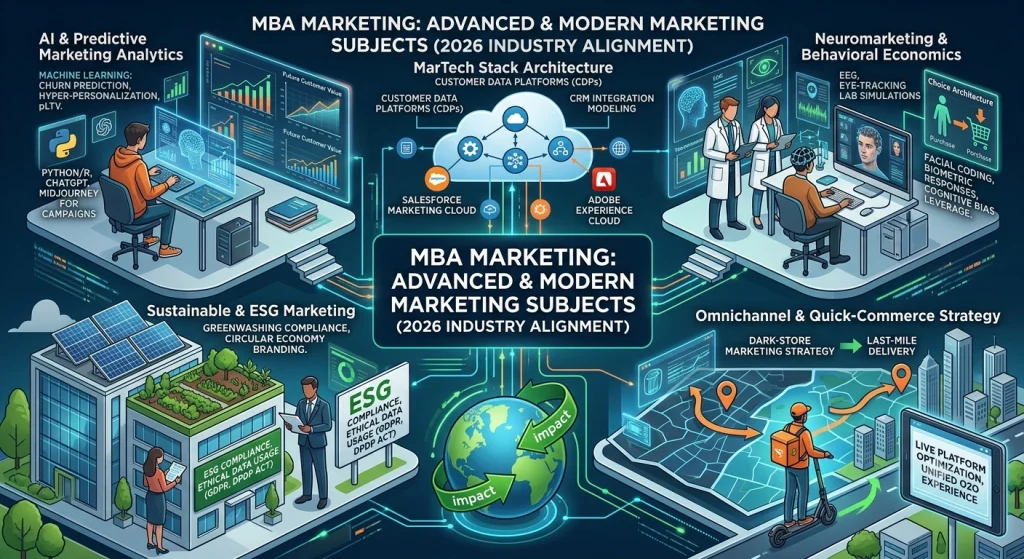
Modern MBA programs integrate emerging technology and data-driven disciplines directly into the syllabus to meet current industry demands.
| Advanced Subjects | Core Topics Covered | Real-World Application |
| AI & Predictive Marketing Analytics | Machine learning applications in churn prediction, automated ad copy generation, hyper-personalization engines, predictive customer lifetime value (pLTV). | Python/R for marketing analytics, ChatGPT/Midjourney for campaign prototyping. |
| MarTech Stack Architecture | Customer Data Platforms (CDPs), Customer Relationship Management (CRM) integration, marketing automation workflows, attribution modeling. | Salesforce Marketing Cloud, Adobe Experience Cloud setup. |
| Neuromarketing & Behavioral Economics | Eye-tracking analysis, facial coding, biometric consumer responses, choice architecture, cognitive bias leverage. | EEG and eye-tracking lab simulations. |
| Sustainable & ESG Marketing | Greenwashing compliance, circular economy branding, social impact campaigns, ethical data usage and privacy laws (DPDP Act, GDPR). | Sustainability audit reports, ESG compliance framing. |
| Omnichannel & Quick-Commerce Strategy | Last-mile delivery economics, dark-store marketing strategies, unified offline-to-online (O2O) customer experience. | Live delivery platform optimization case studies. |
Download MBA Marketing Subjects PDF
Below is the reference for MBA marketing subjects. However, do note that the major subjects in MBA marketing will remain the same, with minor alterations from college to college.
Online MBA Marketing Subjects in India 2026: Key Differences & Structure
The rise of UGC-DEB-approved distance and online degrees has created a flexible alternative to traditional campus programs. While an Online MBA in Marketing covers the same core management frameworks as on-campus programs, its curriculum delivery, evaluation models, and practical tool integrations are specifically structured for working professionals and self-paced learners.
| Structural Parameter | Online MBA in Marketing | Traditional On-Campus MBA |
| Delivery Model | Asynchronous recorded modules + Live weekend masterclasses. | Daily full-time classroom lectures, seminars, and group work. |
| Subjects Focused | Immediate, applied digital tools, MarTech, and performance marketing. | Balanced mix of theoretical research, case studies, and corporate exposure. |
| Pedagogy & Assignments | Cloud-based simulation labs, virtual case studies, and online quizzes. | Physical group presentations, live classroom debates, and campus drives. |
| Target Audience | Working professionals, career changers, and remote learners. | Freshers and early-career professionals (0–3 years experience). |
| Capstone Requirement | Virtual industry project or applied digital marketing campaign. | On-site corporate summer internship (6–8 weeks) + Thesis. |
Core Semester-Wise Subject Structure (Online MBA 2026)
Online MBA programs break down the 2-year curriculum into modular, 4-semester credit blocks delivered via Learning Management Systems (LMS) like Canvas or AMIGO.
Semester 1 & 2: Foundational Management Core
- Marketing Management (I & II): Fundamentals of market segmentation, targeting, positioning (STP), and the 7 Ps of service marketing.
- Consumer Psychology: Digital buying behavior, online impulse triggers, and customer journey mapping across e-commerce funnels.
- Marketing Research & Analytics: Basic statistical methods, survey design, data hygiene, and introductory spreadsheet modeling.
- Cross-Functional Essentials: Financial accounting, business law, managerial communications, and organizational behavior.
Semester 3 & 4: Applied Specialization & Digital Execution
- Performance Marketing & Growth Hacking: Hands-on campaign creation using Meta Ads Manager, Google Ads, and programmatic bidding networks.
- MarTech Architecture & CRM: Customer Data Platform (CDP) setup, automated email nurturing pipelines, and CRM integration via HubSpot and Salesforce.
- AI & Predictive Marketing: Practical application of generative AI tools for content generation, sentiment analysis, and predictive customer churn modeling.
- Applied Capstone Project: A mandatory execution-based thesis where students run a live digital campaign, audit an e-commerce platform, or design a complete go-to-market (GTM) strategy for an industry partner.
Key Skill & Software Tool Integrations
Because online programs cater to professionals seeking immediate career mobility, software tool mastery is embedded directly into the curriculum rather than taught as optional workshops.
| Domain Track | Software Tools Embedded in Online Syllabus |
| Digital Analytics | Google Analytics 4 (GA4), SEMrush, Ahrefs, Hotjar |
| Social & Performance Marketing | Meta Business Suite, LinkedIn Campaign Manager, Google Ads |
| Automation & CRM | HubSpot CRM, Mailchimp, Zoho Marketing Automation |
| Design & Content AI | Canva Enterprise, ChatGPT Plus, Midjourney (Prototyping) |
| Data Visualization | Microsoft Power BI, Advanced Excel |
Major Online MBA Providers in India (2026)
- Amity University Online: Features AMIGO LMS, AI-powered mentor support, embedded certifications (HubSpot/Google), and zero-cost EMI payment options.
- Manipal University Online (Online Manipal): Offers an industry-aligned digital marketing curriculum backed by virtual lab simulations and weekend industry webinars.
- NMIMS Global Access (CDOE): Provides a structured marketing management track with a focus on retail, FMCG sales, and corporate brand management.
- LPU Online: Focuses on affordable digital marketing education with integrated software certifications and online placement assistance portals.
MBA Marketing Specializations-wise Subjects 2026: Data Analytics, Cybersecurity, Project Management
Modern MBA programs in 2026 rarely teach marketing in isolation. The shift toward tech-enabled, data-first corporate ecosystems has created cross-functional marketing specializations. Combining marketing strategy with Data Analytics, Cybersecurity, or Project Management equips graduates to manage digital infrastructure, safeguard consumer data, and lead cross-departmental product launches.
Specialization Subjects: Core Focus, Tools & Career Outcomes
| Specialization Track | Core Interdisciplinary Focus | Essential Software & Tool Stack | Primary Target Roles (2026) | Starting CTC Range (India) |
| Marketing & Data Analytics | Predictive customer behavior, attribution modeling, churn reduction, martech optimization. | Python, R, SQL, Power BI, Google Analytics 4 (GA4), Tableau. | Marketing Data Analyst, Growth Marketer, MarTech Specialist, Product Marketing Lead. | ₹8.0 – ₹16.0 LPA |
| Marketing & Cybersecurity | Digital risk management, customer data privacy (DPDP/GDPR), brand safety, secure adtech pipelines. | Data Privacy Compliance Frameworks, IAM tools, Brand Safety Tech (IAS/DoubleVerify). | Chief Privacy Officer Trainee, Brand Risk Analyst, MarTech Security Manager, Trust & Safety Officer. | ₹9.0 – ₹18.0 LPA |
| Marketing & Project Management | Go-to-Market (GTM) strategy execution, cross-functional launch pipelines, Agile campaign workflows. | Jira, Asana, Monday.com, Trello, MS Project, SAFe/Agile Frameworks. | Technical Product Manager, Marketing PMO Lead, Campaign Operations Manager, GTM Lead. | ₹8.5 – ₹15.0 LPA |
Breakdown of Integrated Tracks
Track 1: Marketing + Data Analytics (The Growth & Performance Path)
This track bridges creative marketing with quantitative data science. Marketers use data analytics to replace intuition with evidence-based decisions, measuring return on ad spend (ROAS) in real time.
- Key Subjects: Customer Lifetime Value (CLTV) Modeling, Marketing Mix Modeling (MMM), A/B Testing & Conversion Rate Optimization (CRO), Algorithmic Attribution.
- Real-World Application: Building predictive churn models for D2C brands or configuring automated, personalized email workflows using customer data platforms (CDPs).
Track 2: Marketing + Cybersecurity & Data Governance (The Brand Safety Path)
With strict global and Indian privacy laws (e.g., the Digital Personal Data Protection Act – DPDP), companies cannot separate marketing from data security. This track trains marketers to manage consumer opt-ins, first-party data collection, and brand safety.
- Key Subjects: Data Privacy Laws & Ethics, Secure MarTech Integrations, Crisis Management for Brand Hacking, Consent Management Platforms (CMP).
- Real-World Application: Audit a company’s customer data collection pipeline to ensure compliance while keeping zero-party data acquisition strategies effective.
Track 3: Marketing + Project Management (The GTM Execution Path)
Product launches fail when marketing, engineering, and sales operate in silos. This track applies structured project management methodologies (Agile, Scrum, Lean) to marketing operations, ensuring campaigns hit deadlines and budgets.
- Key Subjects: Agile Campaign Execution, Resource Allocation & Budgeting, Cross-Functional Team Leadership, Risk Mitigation in Product Launches.
- Real-World Application: Managing a multi-market, omnichannel product launch using Scrum sprints to coordinate content, media buying, and product design.
Industry Demand Drivers for Cross-Functional Marketers in 2026
- Transition to First-Party Data: As third-party cookies fade, companies hire analytics-driven marketers to build zero-party and first-party data strategies.
- Automated & AI-Driven MarTech: Managing complex marketing technology stacks requires professionals who understand both the technical infrastructure (Project Management/Cybersecurity) and the campaign goals (Marketing).
- Accountability for Ad Spend: Modern Chief Marketing Officers (CMOs) demand precise performance metrics; cross-functional graduates possess the quantitative skills to validate marketing budgets.
MBA Marketing Curriculum 2026: Building Job-Ready Skills & Industry Focus
The modern corporate landscape demands that business schools shift from purely theoretical frameworks to execution-based pedagogy. By 2026, premier MBA programs are evaluating student competency not through end-of-term exams alone, but through industry certifications, live corporate simulations, and portfolio-worthy capstone projects.
1. Industry Certifications Integrated into the MBA Curriculum
To ensure students graduate with immediately verifiable skill sets, top business schools now embed vendor and platform-specific certifications directly into core and elective modules.
| Specialized Track | Mandatory Vendor Certifications | Skill Competency Verified |
| Digital Performance Marketing | • Google Ads Search & Measurement Certification
• Meta Certified Digital Marketing Associate |
Paid media bidding, ad rank optimization, attribution modeling, and campaign scaling. |
| MarTech & Marketing Automation | • HubSpot Email Marketing & Inbound Certification
• Salesforce Marketing Cloud Associate |
Automated lead nurturing, lifecycle marketing pipelines, and CRM database hygiene. |
| Data Analytics & Insights | • Google Analytics 4 (GA4) Certification
• IBM SQL for Data Science Certificate |
Custom event tracking, conversion funnel diagnostics, and relational database querying. |
| Product & Project Operations | • Agile Certified Practitioner (PMI-ACP) / Scrum Master
• Asana / Jira Workflow Automation |
Sprint planning for GTM launches, cross-functional resource allocation, and backlog grooming. |
Practical Pedagogy: Live Projects, Simulations & Capstones
The shift toward experiential learning ensures students test hypotheses in real-world environments with actual capital and risk constraints.
- Live Digital Campaign Sprints: Students are allocated micro-budgets to design, execute, and optimize live performance campaigns across Google Ads and Meta Ads platforms, evaluating real-world Return on Ad Spend (ROAS) and Customer Acquisition Cost (CAC).
- CapSim & Marketing Strategy Simulations: Computer-based strategic simulations where student cohorts manage virtual companies—competing for market share by adjusting pricing, R&D allocation, channel margins, and media spend in response to dynamic competitor moves.
- GTM Capstone Consulting Projects: In Semester 4, student teams partner with corporate clients or high-growth D2C startups to solve real business challenges, such as auditing an existing omnichannel funnel, launching a green product line, or diagnosing customer churn.
Experiential Capstone Project Framework
4TH SEMESTER CAPSTONE: LIVE CONSULTING PIPELINE
STAGE 1: DIAGNOSTICS
STAGE 2: STRATEGY BUILD
STAGE 3: EXECUTION & DEFENSE • Primary Consumer Audits • Omnichannel Media Mix Modeling • Live Campaign Launch • GA4 Event Hygiene Review • Pricing Elasticity Testing • ROAS & Attribution Audit • Competitor Perceptual Mapping • CDP & Automation Pipeline Setup • Boardroom Presentation
Modern Marketing Tool Stack Mastery
Graduates are expected to be fluent across a multi-layered software stack rather than relying solely on basic spreadsheet processing.
- Data Analytics & BI: Cleaning raw customer data using SQL, running cohort analyses, and visualizing conversion paths in Power BI or Tableau.
- MarTech Infrastructure: Mapping Customer Data Platforms (CDPs) to trigger personalized push communications based on behavioral event flags.
- Generative AI Workflows: Utilizing LLMs and generative image engines to prototype ad copy, run A/B copy variations, and automate preliminary market research synthesis.
How to Choose MBA Marketing Elective Subjects for Career Goals 2026
Choosing the right electives in your MBA program is crucial for shaping your career trajectory and enhancing your professional profile. These choices allow you to tailor your learning beyond the core curriculum, aligning with specific job roles and industry demands, and ultimately strengthening your resume.
- Elective Meaning: A single area of study learners choose from wide options.
- Specialization Meaning: A specific, defined course structure with subjects designed around a field.
- Elective Scope: Pursue study areas beyond your focus study field.
- Specialization Scope: Helps you narrow down to a particular area of learning.
- Elective Choice: Learners choose specific topics aligning with interests and goals.
- Specialization Choice: Follows a defined course structure, offering less freedom.
Electives and specializations serve different purposes in your MBA journey. While electives broaden your learning and add skills, specializations deepen your knowledge and provide specialized skills in a specific field.
| Aspect | Electives | Specialization |
| Purpose | Widen learning or equip with an added skill. | Go deeper, advance knowledge, gain specialized skills. |
The primary goal of an elective is to widen your learning or help equip you with an added skill, whereas a specialization aims to deepen your knowledge and provide specialized skills.
- Career Direction: Electives help you focus on areas matching your desired job roles.
- Profile Attractiveness: Opting for in-demand electives provides highly sought-after industry skills.
- Boost Work Experience: Strengthen your profile by building specialized knowledge and skills.
- Flexibility: Online learning allows you to plan studies around commitments.
- Research Options: Understand what each elective covers and its career relevance.
- Independent Decisions: Your career goals, skills, and plans should guide your choices.
Electives can significantly shape your resume by showing relevant skills, supporting career transitions, and strengthening your professional profile. For example, electives like Business Analytics or Digital Marketing highlight skills pertinent to target roles.
- Skill Gap Audit: Identify missing skills by reviewing job descriptions and choosing electives to address them.
- Industry Signal Check: Assess industry trends and future demand for skills.
- Faculty & Industry Mentor Depth: Evaluate instruction quality by checking faculty profiles and learning formats.
- Understand Market: Choose subjects with increasing demand, like Finance or Human Resource Management.
- Understand Your Interest: Select a stream based on genuine interest, such as healthcare management.
- Chalk Out Life Goals: Evaluate your ten-year vision; operations management suits leadership roles.
To choose a specialization effectively, you must understand the market, your interests, and your long-term career goals. For instance, if you enjoy tracking stock markets, a finance specialization would be suitable.
Frequently Asked Questions
What are the core subjects taught in the first year of an MBA in Marketing?
The first year establishes foundational business and marketing principles. Core subjects include Marketing Management (STP and 4 Ps/7 Ps frameworks), Consumer Behavior & Psychology, Marketing Research & Insights, Brand Management, and Managerial Economics & Accounting, supported by Excel modeling and case studies.
How does an Online MBA Marketing syllabus differ from a traditional on-campus program?
While both cover identical core concepts, the Online MBA syllabus emphasizes self-paced digital execution, applied MarTech tool integration, cloud simulation labs, and asynchronous learning. On-campus programs focus heavily on physical classroom debates, live group presentations, and mandatory on-site summer internships.
Is technical software or coding knowledge required for modern MBA Marketing electives?
Advanced coding is not required, but fluency in analytical and digital tools is essential. The 2026 syllabus integrates software like Google Analytics 4, SQL, Power BI, Meta Business Suite, HubSpot CRM, and Python/R for marketing analytics across specialized elective tracks.
What cross-functional marketing specializations are most in demand for 2026?
High-growth cross-functional tracks include Marketing & Data Analytics (focusing on predictive churn and attribution), Marketing & Cybersecurity (covering data privacy compliance and DPDP Act laws), and Marketing & Project Management (focusing on Agile Go-to-Market launch execution).
Which industry certifications are embedded directly into the 2026 MBA Marketing curriculum?
Top business schools embed platform certifications directly into coursework. Key credentials include Google Ads & Analytics (GA4) certifications, Meta Certified Digital Marketing Associate, HubSpot Email & Inbound Marketing, Salesforce Marketing Cloud Associate, and Certified Scrum Master (CSM) credentials.
What is the difference between an elective and a specialization in an MBA program?
An elective is an individual course chosen to build specific skills or explore secondary interests (e.g., SEO or Business Analytics). A specialization is a structured sequence of advanced subjects focused deeply on a specific field, such as Digital Performance Marketing or Brand Management.
What entry-level starting salary can graduates expect after completing an MBA in Marketing in India?
Starting packages vary by institutional tier and technical skill set. Freshers graduating from Tier-1 and premier campuses average ₹8.0 LPA to ₹16.0+ LPA, while graduates from standard or online MBA programs generally secure entry roles ranging between ₹4.5 LPA and ₹8.5 LPA.