
In this article
- 01MBA First Year Core Subjects: Semesters 1 & 2
- 02Download MBA Syllabus 2026
- 03Semester 1 MBA Subjects 2026: Key Management & Business Fundamentals
- 04Semester 2 MBA Subjects 2026: Advanced Core & Specialisation Foundation
- 05MBA First Year Specialisation-Wise Subject Breakdown 2026: Finance, Marketing, HR, Operations
- 06Frequently Asked Questions
The first year of an MBA program serves as an intensive operational boot camp designed to level the playing field across all professional backgrounds. Structure-wise, top B-schools build the first-year syllabus around 10 to 14 core subjects spread across two foundational semesters. Semester 1 strips away functional biases by focusing on business fundamentals, from financial accounting to managerially driven economics and data analytics. Semester 2 then elevates this framework into cross-functional execution, corporate strategy, and macroeconomic dynamics. Towards the end of Year 1, students encounter domain-specific foundational pathways, preparing them for high-impact summer internships before declaring their final major and minor electives for Year 2.
MBA First Year Core Subjects: Semesters 1 & 2
First-year MBA coursework builds core analytical, operational, and managerial competencies required to lead modern organizations across diverse industries. Semester 1 establishes foundational knowledge in individual functional domains, while Semester 2 expands into macro-environments, data optimization, and cross-functional execution.
MBA Semester 1 Syllabus: Foundational Business Pillars
The first semester provides a comprehensive grounding in core functional areas, emphasizing business fundamentals, basic analytics, and organizational dynamics.
| Core Subject | Key Modules & Syllabus Focus | Managerial Objective / Skill |
| Organizational Behaviour | Individual behavior, motivation models, group dynamics, leadership theories, and structural design. | Understanding workforce dynamics and team management. |
| Data Analysis & Decision Tools | Descriptive statistics, probability distributions, hypothesis testing, regression, and spreadsheet modeling. | Quantitative decision-making and data-driven problem solving. |
| Managerial Economics | Microeconomic theory, demand estimation, production function, cost curves, and market structures. | Resource allocation and marginal analysis for firm-level decisions. |
| Accounting for Managers | Financial accounting standards, balance sheet mechanics, income statements, cash flow analysis, and inventory valuation. | Evaluating company financial statements and financial health. |
| Marketing Management | 4 Ps, Segmentation, Targeting & Positioning (STP), consumer buying behavior, and strategic planning. | Value proposition development and market opportunity analysis. |
| Human Resource Management | Job analysis, talent acquisition, performance systems, compensation, and industrial relations. | Strategic workforce management and employee retention. |
| Business Communication | Executive writing, negotiation tactics, cross-cultural communication, and digital/social media messaging. | High-impact communication across diverse business channels. |
| Information Technology Management | Enterprise tech setup, database systems, software suites, and emerging tech (Cloud, AI, IoT). | Leveraging technology stacks for daily operational efficiency. |
- Core Focus: Establishing a common business language across finance, marketing, economics, and human behavior.
- Analytical Groundwork: Developing proficiency in quantitative tools and financial literacy needed for advanced coursework.
Also Read: Online MBA Subjects & Specialisations: Complete Syllabus Guide
MBA Semester 2 Syllabus: Optimization, Macro Dynamics & Strategic Execution
Semester 2 transitions from foundational concepts to advanced decision-making tools, cross-functional integration, and external macro-environment analysis.
| Core Subject | Key Modules & Syllabus Focus | Managerial Objective / Skill |
| Corporate Finance | Capital budgeting (NPV, IRR), cost of capital (WACC), capital structure theories, dividend policy, and working capital management. | Long-term capital allocation and corporate value creation. |
| Management Accounting | Cost-volume-profit analysis, activity-based costing (ABC), variance analysis, budgeting, and performance metrics. | Internal cost control and strategic managerial accounting. |
| Decision Modelling & Optimization | Network models, Monte Carlo simulation, queuing theory, game theory, and decision trees under uncertainty. | Prescriptive analytics and complex scenario optimization. |
| Economic Environment of Business | Macroeconomic policy, GDP measurement, Solow growth model, IS/LM frameworks, central banking, and international trade. | Navigating macroeconomic shocks, inflation, and global trade dynamics. |
| Production & Operations Management | Facility location, process analysis, inventory models (JIT/Lean), Statistical Process Control (SPC), and Six Sigma. | Optimizing operational processes, quality, and supply chains. |
| Marketing Research | Research design, comparative scaling, qualitative/quantitative data collection, and multivariate data analysis. | Validating market strategies with empirical consumer insights. |
| Management Information Systems (MIS) | ERP/CRM architectures, System Development Life Cycle (SDLC), digital transformation, and competitive IT strategies. | Aligning IT architecture with long-term business goals. |
| Organization Effectiveness & Change | Models of change, organizational culture, power and politics, negotiation, and cross-cultural management. | Managing organizational transformation and change initiatives. |
Academic Evolution: Year 1 Core Progression
| Business Domain | Semester 1 Focus (Foundational) | Semester 2 Focus (Applied & Strategic) |
| Finance & Accounting | Financial Accounting (Reading Statements) | Corporate Finance & Management Accounting (Valuation & Costing) |
| Economics | Microeconomics (Firm & Consumer Level) | Macroeconomics (Global Policy, Trade & Inflation) |
| Quantitative Methods | Descriptive & Inferential Statistics | Decision Modelling, Simulation & Optimization |
| Strategy & Management | Organizational Behaviour & Core HRM | Organizational Effectiveness & Change Management |
| Operations & Tech | IT Infrastructure & Enterprise Software | MIS, Supply Chain & Operations Management |
This progression equips students with the functional tools required during their mandatory summer internship before selecting specialized electives in Year 2.
Download MBA Syllabus 2026
Semester 1 MBA Subjects 2026: Key Management & Business Fundamentals
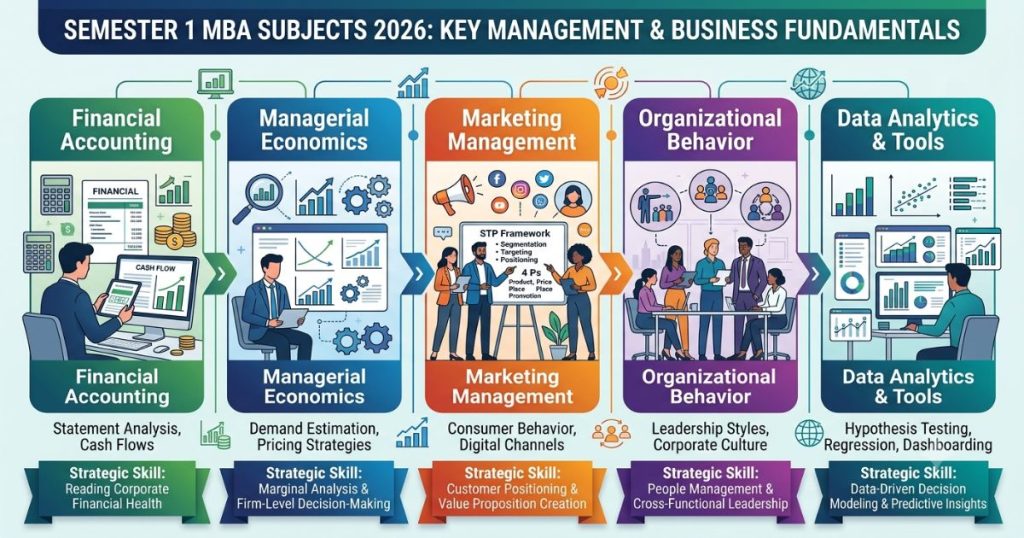
The first year of your MBA focuses on common core subjects, with Semester 1 specifically designed to build a strong foundation in business and management basics. This initial period also aims to enhance your communication and fundamental analytical skills.
Key Subject Focus Areas
Financial Accounting & Corporate Reporting
- Focuses on demystifying income statements, balance sheets, and cash flow operations.
- Teaches how to evaluate liquidity, solvency, and corporate earnings quality without getting bogged down in bookkeeping mechanics.
- Prepares students for equity research, corporate valuation, and financial analysis.
Managerial Economics & Firm Strategy
- Evaluates microeconomic principles applied directly to real-world corporate decisions.
- Teaches pricing elasticity, market structures, and marginal cost optimization.
- Replaces intuitive guesswork with structured economic modeling for revenue optimization.
Marketing Management & Customer Analytics
- Covers Segmentation, Targeting, and Positioning (STP) alongside omnichannel strategy.
- Blends traditional branding principles with modern digital customer acquisition metrics like Customer Lifetime Value (LTV) and Acquisition Cost (CAC).
- Trains managers to align product offerings with evolving market demand.
Organizational Behavior & Executive Leadership
- Examines individual and group dynamics, motivation theories, and corporate culture.
- Focuses on conflict resolution, power structures, and managing change during corporate transformations.
- Builds the human management skills required to lead cross-functional teams.
Quantitative Methods & Data Visualization
- Focuses on practical business statistics, regression modeling, and spreadsheet mastery.
- Incorporates tools like Tableau, Power BI, and AI-assisted data models for rapid executive reporting.
- Equips non-technical managers to evaluate data-driven forecasts with analytical rigor.
Mastering these foundational pillars ensures you can evaluate problems through multiple business lenses before diving into specialized electives in Year 2.
Semester 2 MBA Subjects 2026: Advanced Core & Specialisation Foundation
Semester 2 shifts focus from individual functional fundamentals to macro-level business strategy, cross-functional execution, and introductory pathways into specialized domains.
Core Curriculum Breakdown
| Subject | Primary Topics Covered | Strategic Industry Skill |
| Corporate Finance | Capital budgeting (NPV/IRR), WACC, capital structure, valuation | Long-term capital allocation and strategic financial planning |
| Operations & Supply Chain | Logistics design, Lean/Six Sigma, capacity planning, process mapping | Operational efficiency and end-to-end supply chain optimization |
| Macroeconomics & Environment | Fiscal/monetary policy, inflation, foreign trade, global markets | Navigating macroeconomic shocks and international market risk |
| Business Research Methods | Qualitative/quantitative design, predictive modeling, data sampling | Data-backed insight generation for complex corporate decision-making |
| Strategic Management | Porter’s Five Forces, competitive advantage, M&A basics, corporate governance | Industry positioning, growth strategy, and long-term value creation |
| Specialisation Foundation | Introductory tracks across Finance, Marketing, HR, Operations, or Analytics | Aligning domain preferences with upcoming Year 2 electives and summer internships |
Also Read: MBA After Engineering: Benefits, Specializations, and Career Outlook 2026
Key Subject Focus Areas
Corporate Finance & Financial Management
- Covers capital budgeting models, cost of capital calculation, and optimal capital structure design.
- Teaches how organizations make large-scale capital investments, manage working capital, and assess corporate risk.
- Prepares students for corporate treasury, financial advisory, equity analysis, and valuation roles.
Operations & Supply Chain Optimization
- Focuses on process management, inventory control, quality control frameworks, and logistics architecture.
- Integrates predictive analytics and modern automated tracking into physical and service supply chains.
- Equips future managers to streamline operational workflows, reduce waste, and manage vendor relationships.
Macroeconomics & Global Business Environment
- Analyzes GDP indicators, central bank policies, foreign exchange movements, and inflation cycles.
- Evaluates how regulatory changes, trade agreements, and geopolitical events impact domestic and international firms.
- Trains leaders to build resilient business models capable of withstanding broader market shifts.
Business Research Methods & Decision Models
- Explores primary and secondary research methodologies, survey design, focus groups, and multivariate statistics.
- Leverages empirical data and analytical tools to solve unstructured market problems and test product viability.
- Translates raw consumer and market research into actionable strategic decisions.
Strategic Management & Executive Governance
- Analyzes competitive strategy frameworks, value chain alignment, business model innovation, and industry structures.
- Explores strategic alliances, corporate restructuring, and ethical governance standards.
- Builds the C-suite perspective necessary to navigate industry disruptions and maintain long-term market leadership.
Specialisation Foundation & Pathway Planning
- Introduces core theories within functional streams including Digital Marketing, FinTech, People Analytics, and AI in Operations.
- Allows candidates to test career preferences before declaring major/minor specializations in Year 2.
- Establishes targeted domain readiness ahead of corporate summer internships.
Mastering Semester 2’s cross-functional and strategic frameworks equips candidates to bridge high-level corporate goals with operational execution, setting the stage for specialized study in Year 2.
MBA First Year Specialisation-Wise Subject Breakdown 2026: Finance, Marketing, HR, Operations
Late first-year coursework transitions candidates from broad functional concepts into domain-specific introductory modules, building the domain expertise required for summer internships and Year 2 electives.
Finance Specialisation Foundation
- Core Modules: Financial Risk Management, Corporate Valuation, Investment & Portfolio Analysis, FinTech & Digital Banking.
- Key Focus: Mastering discounted cash flow (DCF) modeling, equity research, derivative valuation, and automated financial technologies.
- Industry Application: Prepares candidates for roles in investment banking, corporate treasury, equity research, and financial risk advisory.
Marketing Specialisation Foundation
- Core Modules: Strategic Brand Management, Consumer Behavior & Insights, Digital Marketing & MarTech, Sales & Distribution Channels.
- Key Focus: Analyzing customer acquisition pathways, managing omnichannel distribution, running performance marketing campaigns, and building brand equity.
- Industry Application: Equips candidates for product management, brand strategy, digital growth, and key account management roles.
Human Resource (HR) Specialisation Foundation
- Core Modules: People Analytics & HR Tech, Talent Acquisition Strategy, Compensation & Total Rewards, Industrial Relations & Labor Law.
- Key Focus: Utilizing data-driven workforce analytics, designing competitive incentive structures, managing labor policy compliance, and deploying modern HR Systems.
- Industry Application: Targets positions in HR Business Partnering (HRBP), corporate talent management, organizational development, and total rewards strategy.
Operations & Supply Chain Foundation
- Core Modules: Supply Chain & Logistics Analytics, Strategic Procurement, Six Sigma & Lean Operations, Project & Quality Management.
- Key Focus: Removing operational bottlenecks, managing inventory velocity, optimizing ERP platforms, and building resilient supply networks.
- Industry Application: Builds readiness for operations consulting, supply chain planning, procurement management, and plant operations.
Specialisation Pillar Comparison
| Specialisation Domain | Core Tech & Tools | Strategic Focus Area | Primary Internship Outcomes |
| Finance | Excel, Python for Finance, Bloomberg Terminals | Asset valuation, financial engineering, and capital structure optimization | Financial Analyst, Investment Banking Associate |
| Marketing | CRM Suites, Web/App Analytics, MarTech Platforms | Omnichannel acquisition, customer lifetime value (LTV), brand equity | Assistant Brand Manager, Growth Lead |
| HR | HRMS Software, People Analytics, Power BI/Tableau | Attrition prediction, talent retention, organizational culture design | HRBP Intern, Talent Acquisition Specialist |
| Operations | SAP/Oracle ERP, Six Sigma DMAIC, Inventory Simulators | Throughput maximization, cost reduction, supply chain resilience | Supply Chain Analyst, Process Consultant |
Mapping these domain pathways early in Year 1 ensures candidates select summer internship roles that directly validate their target career trajectory before locking in Year 2 major and minor electives.
Frequently Asked Questions
What are the core MBA course subjects in the 1st year?
The first-year MBA curriculum covers 10–14 core subjects spanning business fundamentals. Essential topics include Financial Accounting, Managerial Economics, Organizational Behavior, Marketing Management, Corporate Finance, Operations & Supply Chain, Business Research Methods, and Strategic Management. These modules build universal analytical and leadership frameworks required across all industries.
When do students typically declare their MBA specialisation?
Students generally explore foundational tracks during late Semester 2 and declare their official specialization in the final three to six months of Year 1. This timeline ensures candidates test various business functions during core coursework before committing to specific major and minor electives for their second year.
Can I switch specialisations after the first year of my MBA?
Yes, most business schools permit students to adjust or switch their specialization at the end of the first year or early in Semester 3. Because the entire first-year curriculum consists of universal core subjects, switching pathways does not delay graduation or require repeating foundational coursework.
Which MBA specialisations offer a heavy quantitative focus in Year 1?
Finance and Business Analytics offer the strongest quantitative focus, building heavily on statistical tools, regression, and spreadsheet modeling introduced in Semester 1. Dual tracks like Marketing Analytics also heavily emphasize quantitative methods, leveraging data-driven decision tools, predictive modeling, and consumer data analysis.
How do first-year specialisation choices impact summer internships?
Introductory specialization modules in late Semester 2 build the domain-specific skills required for corporate summer internship recruiting. Selecting pathways early allows candidates to tailor their resumes, excel in technical interviews for targeted roles like investment banking or product management, and test career choices risk-free.
What typical elective options are available in the first MBA year?
First-year electives usually appear near the end of Semester 2 as introductory foundation tracks. Popular options include AI for Managers, Brand Management, FinTech & Digital Banking, People Analytics, Corporate Governance, and Supply Chain Logistics, allowing students to preview specialized Year 2 coursework.
How does Semester 1 differ from Semester 2 in an MBA program?
Semester 1 establishes foundational knowledge in individual functional domains like accounting, microeconomics, and basic statistics. Semester 2 transitions to cross-functional integration, macroeconomics, corporate strategy, operations, and advanced decision modeling, shifting the focus from functional basics to complex executive execution.
Why is Financial Accounting mandatory for non-finance specialisations?
Financial Accounting provides the universal language of business, enabling every manager to evaluate balance sheets, income statements, and cash flows. Understanding corporate financial health is essential for evaluating project ROI, managing departmental budgets, and making informed strategic decisions regardless of your functional role.