In this article
- 01MCOM vs MBA: Core Definitions & Academic Philosophy
- 02MCom vs MBA: Difference in Eligibility Criteria & Admission Framework
- 03MCom vs MBA: Fee Structure, Investment & ROI Comparison
- 04MCOM & MBA Career Pathways, Job Roles & Top Recruiters
- 05MCOM vs MBA: Curriculum & Syllabus Comparison
- 06MCOM vs MBA Fees & ROI: a Cost-Benefit Analysis for 2026
- 07Specializations Available: MCOM vs MBA Program Offerings in India 2026
- 08Is an MBA Still Worth It in 2026? Reality of Placements & Jobs
- 09Frequently Asked Questions
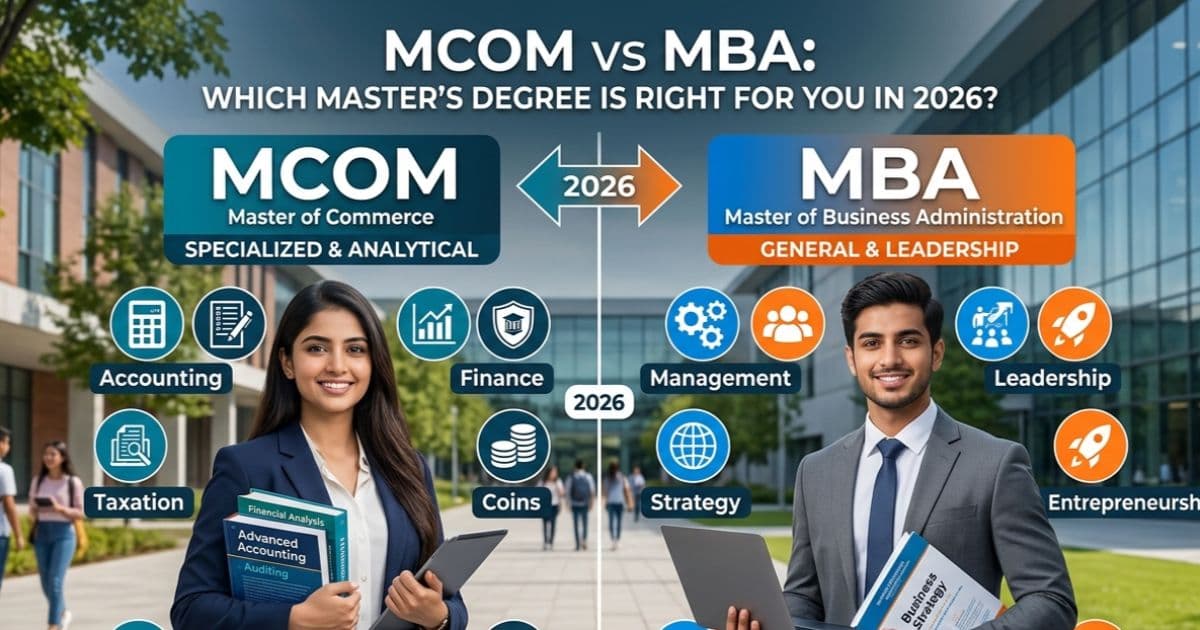
Choosing between a Master of Commerce (M.Com) and a Master of Business Administration (MBA) in 2026 is one of the most pivotal decisions for postgraduate aspirants. While both degrees elevate your corporate standing, their core philosophies, costs, and career outcomes diverge significantly. An M.Com offers deep technical expertise in specialized domains like financial accounting, auditing, corporate taxation, and academic research at a fraction of the cost. Conversely, an MBA focuses on cross-functional leadership, enterprise strategy, business analytics, and executive management. This comprehensive guide compares syllabi, entrance exams, tuition fees, return on investment (ROI), and career pathways to help you choose the right master’s degree for your professional goals.
MCOM vs MBA: Core Definitions & Academic Philosophy
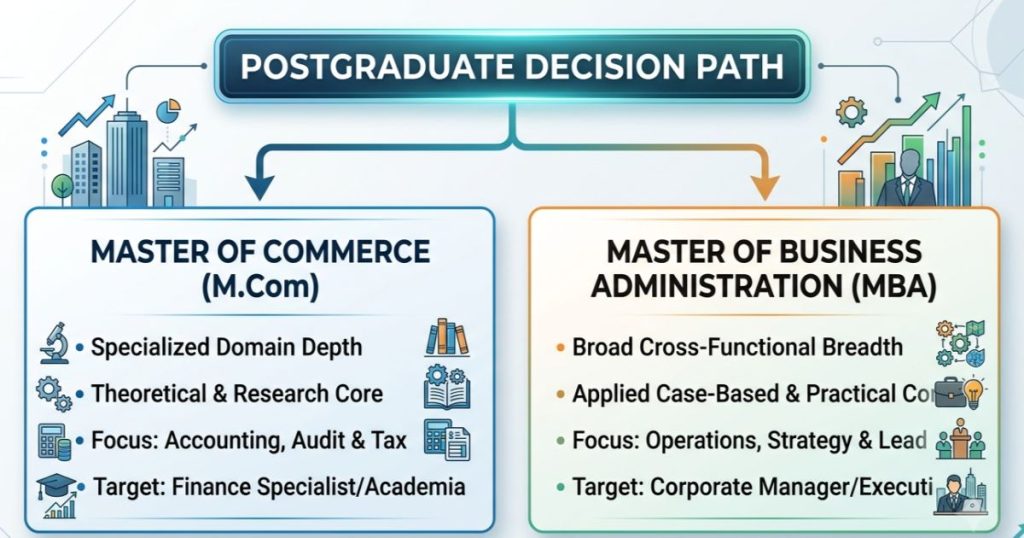
Understanding the fundamental difference between a Master of Commerce (M.Com) and a Master of Business Administration (MBA) requires examining their foundational educational philosophies, academic delivery modes, and primary learning outcomes.
Master of Commerce (M.Com)
- Nature of Degree: Specialized, research-oriented, and academically deep.
- Academic Philosophy: M.Com is built on the principle of vertical domain mastery. It takes fundamental commerce concepts and elevates them into technical, quantitative, and theoretical frameworks. The curriculum prioritizes conceptual precision, regulatory frameworks, statutory compliance, and empirical research methods.
- Primary Objective: To train subject-matter specialists capable of navigating complex accounting, taxation, auditing, and corporate finance challenges, as well as preparing scholars for academic research and teaching careers (via UGC-NET/PhD pathways).
- Ideal Candidate Profile: Commerce and finance graduates (B.Com/BBA Finance) who thrive on detailed technical analysis, wish to pair their post-graduation with professional credentials (CA, CS, ACCA, CFA), or aim for specialized analytical roles in corporate finance, auditing, and academia.
Master of Business Administration (MBA)
- Nature of Degree: Professional, applied, leadership-centric, and cross-functional.
- Academic Philosophy: MBA operates on the principle of horizontal organizational breadth. Rather than focusing on a single functional domain, it views an enterprise as an interconnected system. The pedagogy relies on case-method analysis, live corporate consulting, behavioral simulations, and group decision-making exercises designed to solve unstructured business problems.
- Primary Objective: To train adaptive business leaders, general managers, and entrepreneurs capable of managing cross-functional teams, driving revenue growth, optimizing operations, and formulating corporate strategy.
- Ideal Candidate Profile: Graduates from any background (Engineering, Science, Arts, Commerce) or working professionals seeking upward organizational mobility, corporate career transitions, or general management roles across diverse industries.
Also Read: MBA After BCOM in 2026: Eligibility, Scope, and Career Growth
MCom vs MBA: Difference in Eligibility Criteria & Admission Framework
While both degrees are 2-year (4-semester) postgraduate programs, their admission channels, testing protocols, candidate background requirements, and selection parameters differ significantly across Indian universities and business schools.
| Admission Parameter | Master of Commerce (M.Com) | Master of Business Administration (MBA) |
| Qualifying Graduation Degree | • Bachelor’s in Commerce (B.Com / B.Com Hons)
• BBA (Finance/Banking) or equivalent • Note: Most universities restrict M.Com entry to candidates with prior accounting/commerce coursework. |
• Bachelor’s degree in any discipline (B.Tech, B.Sc, BA, B.Com, BBA, MBBS, B.Des, etc.) from a UGC-recognized university. |
| Minimum Academic Aggregate | • 50% aggregate in graduation for General/OBC categories.
• 45% aggregate for SC/ST/PwD candidates. • (Select elite colleges like SRCC require 55%–60%). |
• 50% aggregate (or equivalent CGPA) in graduation for General/OBC.
• 45% aggregate for SC/ST/PwD categories. |
| Primary National & State Entrance Exams | • CUET-PG: For Central/State Universities (DU, BHU, JNU, Jamia).
• State CETs: MAH-M.Com-CET, AP PGCET, TS CPGET. • University Tests: IPU CET, URATPG, or direct merit lists. |
• National Testing: CAT, XAT, CMAT, MAT, ATMA, GMAT.
• Institute-Specific: NMAT, SNAP, IIFT. • Central/State Universities: CUET-PG (for select university MBAs). |
| Work Experience Mandate | Not required. Designed as an immediate post-graduation academic progression. | Optional for entrance, but highly valued. Top B-schools weight prior relevant work experience (1–3 years ideal) in final composite scoring. |
| Multi-Stage Selection Process | Single or two-stage process:
1. Entrance exam score / Qualifying Merit. 2. Centralized University Counseling / Seat Allocation. (GD/PI rounds are rare for M.Com). |
Multi-stage evaluation:
1. Entrance Exam Percentile Shortlisting. 2. Written Ability Test (WAT). 3. Group Discussion (GD) / Case Discussion. 4. Personal Interview (PI) + Profile Scoring. |
| Final Selection Weightage Focus | 90%–100% weightage placed strictly on entrance test rank/percentile or undergraduate merit scores. | Composite Score Formula: Entrance Score (30–60%) + GD/PI/WAT (20–40%) + Academic Diversity/Past Academics (10–20%) + Work Experience (5–10%). |
Also Read: Top MBA Specialisations in India for 2026: High Demand & Career Scope
MCom vs MBA: Fee Structure, Investment & ROI Comparison
The financial architecture of an M.Com versus an MBA differs significantly. While an M.Com delivers an exceptionally high, low-risk Return on Investment (ROI) due to heavily subsidized or nominal tuition fees, an MBA represents a high-capital investment with exponential salary upside.
| Financial Parameter | Master of Commerce (M.Com) | Master of Business Administration (MBA) |
| Total Tuition Fee Range | • Central / State Govt: ₹10,000 – ₹40,000
• Deemed / Private Universities: ₹1.5 Lakh – ₹4 Lakh |
• Govt Institutes (FMS / JBIMS): ₹2 Lakh – ₹6 Lakh
• Tier-1 Institutes (IIMs / XLRI / ISB): ₹20 Lakh – ₹35 Lakh • Tier-2 / Tier-3 B-Schools: ₹8 Lakh – ₹18 Lakh |
| Additional Costs | Minimal (Standard textbooks, examination fees). | Significant (Global immersion programs, case-study material, laptop, mandatory hostel stay, placement fees). |
| Average Starting CTC (Freshers) | • Govt / Central Universities: ₹3.5 LPA – ₹6 LPA
• Top Private Universities (e.g., NMIMS): ₹8 LPA – ₹10 LPA |
• Tier-1 Institutes: ₹20 LPA – ₹35 LPA
• Tier-2 Institutes: ₹8 LPA – ₹15 LPA • Tier-3 Institutes: ₹4 LPA – ₹7 LPA |
| Payback Period (Calculated) | 1 to 6 Months (Rapid break-even due to low initial tuition fees). | 12 to 36 Months (Depends heavily on education loan debt service and institute tier). |
Institutional Tier-Wise Investment & Salary Matrix
| Institution Category | Representative Colleges | Total 2-Year Program Fee | Average Campus Placement CTC | Realized ROI Ratio (First Year CTC ÷ Total Fee) |
| M.Com: Central / Elite Govt | SRCC (DU), Delhi School of Economics, BHU, Jamia Millia | ₹15,000 – ₹40,000 | ₹4.5 LPA – ₹6.5 LPA | 11.25x – 30.0x (Exceptional) |
| M.Com: Top Private / Deemed | NMIMS Mumbai, Christ University, Symbiosis Pune | ₹2.0 Lakh – ₹3.5 Lakh | ₹6.0 LPA – ₹10.0 LPA | 2.0x – 3.0x (Moderate-High) |
| MBA: Elite Public / Low-Fee | FMS Delhi, JBIMS Mumbai, SIMSREE | ₹2.0 Lakh – ₹6.0 Lakh | ₹23.0 LPA – ₹32.0 LPA | 5.3x – 11.5x (Exceptional) |
| MBA: Tier-1 Premier | IIM A/B/C, XLRI Jamshedpur, ISB, SPJIMR | ₹22.0 Lakh – ₹35.0 Lakh | ₹25.0 LPA – ₹35.0 LPA | 1.0x – 1.2x (High capital yield) |
| MBA: Tier-2 Regional | Top State Colleges, Established Private B-Schools | ₹8.0 Lakh – ₹16.0 Lakh | ₹8.0 LPA – ₹14.0 LPA | 0.8x – 1.1x (Break-even standard) |
MCOM & MBA Career Pathways, Job Roles & Top Recruiters
An M.Com graduate enters the market as a technical or domain specialist, focusing on accuracy, reporting, auditing, and compliance. An MBA graduate enters as a general manager, strategist, or functional head, focusing on revenue generation, organizational execution, and cross-functional leadership.
| Functional Domain | M.Com Graduate Job Roles | MBA Graduate Job Roles |
| Accounting & Audit | • Statutory Auditor
• Cost & Management Accountant • Financial Reporting Specialist (IFRS/Ind-AS) • Forensic Accounting Analyst |
• Finance Controller
• Manager – Internal Audit & Risk • Director of Financial Operations |
| Corporate Finance & Markets | • Credit Risk Analyst
• Treasury Executive • Tax Manager (Direct/Indirect) • Accounts Receivable/Payable Lead |
• Investment Banking Associate
• Corporate Strategist • Equity Research Associate • Mergers & Acquisitions (M&A) Manager |
| Consulting & Strategy | • Tax Consultant (Direct/Indirect)
• Financial Advisory Analyst • Compliance Specialist |
• Management Consultant (MBB / Big 4)
• Strategy & Operations Manager • Business Transformation Lead |
| General & Product Management | (Rarely applicable) | • Product Manager
• Program Manager • Category Manager (E-Commerce) • Management Trainee (Leadership Programs) |
| Academia & Research | • Assistant Professor (via UGC-NET)
• Research Fellow (PhD track) • Financial Data Researcher |
• Executive Educator
• Corporate Trainer |
MCOM vs MBA: Curriculum & Syllabus Comparison
The fundamental divergence between an M.Com and an MBA lies in their curricular depth versus width. An M.Com dives deep into technical, regulatory, and quantitative finance domains, whereas an MBA builds cross-functional general management capabilities in Year 1 before branching into strategic electives in Year 2.
Master of Commerce (M.Com) Syllabus Structure
The M.Com curriculum is built around accounting standards, statutory legal frameworks, direct/indirect taxation, and economic research methodology.
| Semester | Core & Specialization Subjects | Practical / Analytical Pedagogy |
| Semester 1 | • Advanced Management Accounting
• Managerial & Business Economics • Organizational Theory & Behavior • Statistical Analysis for Business Decisions |
• Financial ratio modeling
• Advanced MS Excel spreadsheet labs |
| Semester 2 | • Corporate Financial Management & Policy
• Advanced Cost Accounting & Control • Business & Corporate Laws (Companies Act) • Business Research Methodology |
• SPSS / R for research hypothesis testing
• Capital budgeting simulations |
| Semester 3 | • Direct Taxation & Corporate Tax Planning
• Auditing Practices & Assurance Standards • Strategic Management • Domain Elective I (Finance / Banking / International Business) |
• Income tax return filing workshops
• Audit case study audits |
| Semester 4 | • Indirect Taxation & Goods and Services Tax (GST)
• Security Analysis & Portfolio Management • International Finance / E-Commerce • Master’s Thesis / Research Dissertation Project |
• GST portal compliance simulation
• Empirical research paper submission & viva |
Master of Business Administration (MBA) Syllabus Structure
The MBA curriculum focuses on general management literacy, case analysis, experiential leadership, and cross-functional corporate strategies.
| Semester | Core & Elective Curriculum Tracks | Experiential & Industry Pedagogy |
| Semester 1 | • Principles of Management & Leadership
• Financial Accounting & Reporting • Marketing Management Fundamentals • Managerial Economics • Quantitative Techniques & Business Statistics |
• Harvard Business Publishing case studies
• Managerial communication workshops |
| Semester 2 | • Corporate Financial Management
• Operations & Supply Chain Management • Human Resource Management • Management Information Systems (MIS) • Business Research Methods |
• Business simulation games
• SPSS/Tableau analytics labs |
| Summer Term | Mandatory Corporate Internship (8–12 Weeks) | Full-time live industry project evaluation |
| Semester 3 | • Strategic Management & Corporate Policy
• Legal Aspects of Business • Major Specialization Elective 1 & 2 (e.g., Marketing / HR / Finance / Tech) • Minor Specialization Elective 1 |
• Live corporate consulting projects
• Industry mentorship sessions |
| Semester 4 | • Enterprise Risk Management & Ethics
• International Business Strategy • Major Specialization Elective 3 & 4 • Capstone Business Simulation / Consulting Dissertation |
• Executive pitch presentations
• Comprehensive viva voce & capstone delivery |
Subject-Level Granular Comparison
| Core Domain Area | M.Com Subject Treatment | MBA Subject Treatment |
| Accounting & Reporting | Deep / Technical: Advanced consolidation, IFRS/Ind-AS compliance, forensic accounting, inflation accounting, and cost audit systems. | Managerial / Strategic: Reading income statements, evaluating balance sheets, cost control for decision-making, and budget allocation. |
| Finance & Capital | Quantitative & Regulatory: Security analysis, portfolio mathematics, derivative pricing models, capital market structures, and corporate tax incidence. | Strategic / Executive: Corporate valuation, capital budgeting decisions, M&A strategy, working capital optimization, and investor pitch deck design. |
| Taxation & Compliance | Exhaustive: Detailed computation of income tax, corporate tax planning, GST mechanics, and statutory compliance procedures. | Overview: Conceptual understanding of tax implications on business strategy and cross-border operations. |
| Strategy & Leadership | Theoretical: Corporate governance, business environment analysis, and macro-economic policy frameworks. | Applied: Competitive positioning, blue ocean strategy, organizational change management, cross-functional execution, and team leadership. |
MCOM vs MBA Fees & ROI: a Cost-Benefit Analysis for 2026
Specializations Available: MCOM vs MBA Program Offerings in India 2026
The Master of Commerce (M.Com) is a two-year postgraduate program offering specializations in areas like Accounting, Finance, and Computer Applications. This program provides a strong foundation for corporate careers, academics, and competitive exams, with varying fee ranges and career opportunities depending on your chosen specialization.
| M.Com Course Details | Overview |
| Course Name | Master of Commerce (M.Com) |
| Course Level | Postgraduate Programme |
| Duration | 2 Years |
| Eligibility | Bachelor’s degree in Commerce or a related stream from a recognised university |
| Admission Process | Usually merit-based; some institutes may follow an application + selection process |
| Fee Range | Average Annual Fees Range: ₹20,000 – ₹1,50,000+ (varies by college and specialisation) |
| Learning Focus | Advanced Accounting, Finance, Taxation, Economics, Business Management, Research Methodology |
| Skill Development | Analytical thinking, financial reporting, taxation knowledge, business decision-making, and research skills |
| Practical Exposure | Seminars, workshops, industry sessions, projects and presentations (supported through Indira SOCCA’s academic ecosystem) |
| Placement Support | Career guidance and placement assistance, depending on the institution (Indira SOCCA provides 100% Placement support) |
| Career Opportunities | Accounting, Banking, Finance, Taxation, Audit, Teaching, Corporate Consulting |
| Future Scope | Strong base for corporate careers, academics, competitive exams, and professional courses |
Is an MBA Still Worth It in 2026? Reality of Placements & Jobs
The job market for MBA graduates is undergoing significant transformation, with AI reshaping roles and a clear shift towards specialized skills. While 92 million jobs will disappear by 2030, 170 million new roles will emerge, emphasizing the need for strategic adaptation in your career path.
- AI Impact: AI reshapes, not shrinks, the job market, increasing demand for analytical, creative, and tech-enhanced skills.
- Automation-Prone Roles: Job postings for these roles have fallen by 13% since 2022.
- Analytical & Technical Demand: Demand for analytical, technical, and creative positions has grown by 20% since 2022.
- Big Data Specialists: Hiring for these roles will increase by approximately 110% between 2025 and 2030.
- Fintech Engineers: Net growth for fintech engineers will exceed 90% from 2025 to 2030.
- AI & Machine Learning: Specialists in these fields will see more than 80% net growth through 2030.
The landscape for an MBA in India is also evolving, with employers prioritizing practical skills and industry exposure. Specialized programs and the integration of technology are becoming crucial for securing placements.
| MBA in India Trend (2026) | Description |
| Shift Towards Skill-Based Hiring | Employers focus more on practical skills than just academic qualifications. |
| Rise of Specialized MBA Programs | Niche MBAs in areas like real estate, analytics, and finance are gaining popularity. |
| Integration of Technology and AI | Programs incorporate data analytics, AI, and digital transformation concepts. |
| Demand for Industry Exposure | Internships, live projects, and case studies are becoming essential. |
| Changing Employer Expectations | Companies expect graduates to be job-ready from day one. |
| No Guaranteed Placement for All | Job opportunities depend on skills, institute reputation, and specialization. |
| Wide Salary Variation | Salaries differ significantly based on college and industry. |
| Increased Competition | A large number of graduates enter the job market every year. |
| Focus on Practical Skills | Employers prioritize candidates with hands-on experience. |
| Importance of Networking | Professional connections play a crucial role in career growth. |
Frequently Asked Questions
What Exactly Is the Core Difference Between an MCOM and an MBA Degree?
An MBA develops management, leadership, and strategic skills, while an MCom builds deep expertise in commerce, finance, accounting, and taxation.
Which Degree, MCOM or MBA, Offers Better Career Scope in Finance?
An MBA in finance generally offers better career scope for leadership and management roles, while an MCom is suited for research or academic positions.
How Does the Curriculum of an MCOM Compare to an MBA Program?
An MCom curriculum focuses on advanced commerce, accounting, and finance, while an MBA program emphasizes general management, leadership, and business strategy across various functions.
Which Degree Provides Higher Salary Potential: MCOM or MBA?
An MBA generally offers higher salary potential due to its focus on management and leadership skills, often leading to executive roles. MCom graduates typically earn less, specializing in finance and accounting.
Can I Pursue an MBA After Completing an MCOM Degree?
Yes, you can pursue an MBA after an MCom degree. An MCom provides a strong foundation in commerce, which can be beneficial for an MBA.
Is an MBA Still Worth It in 2026?
An MBA is generally considered a worthy investment for a business career, even in 2026. While AI is replacing jobs, an MBA still offers value.