In this article
- 01BCOM vs BCOM Honours: Comprehensive 2026 Comparison
- 02BCom vs BCom Honours: Curriculum Depth & Subject Differences
- 03BCom vs BCom Hons: NEP 2020 & The 4-Year FYUP Impact
- 04BCOM vs BCOM Honours Career Prospects, Job Roles and Salary Expectations 2026
- 05Eligibility Criteria and Admission Process for BCOM: Detailed Overview
- 06BCom vs BCom Hons Decision Matrix: Which Degree Should You Choose?
- 07Frequently Asked Questions
Navigating undergraduate commerce options has taken on a new dimension under India’s National Education Policy (NEP) 2020. The traditional debate between a general Bachelor of Commerce (B.Com) and a Bachelor of Commerce with Honours (B.Com Hons) now involves multi-exit entry points, flexible credit transfer, and the Four-Year Undergraduate Programme (FYUP) framework. While both degrees build foundational business acumen, they serve distinct academic interests and career goals. B.Com offers a broad, flexible overview ideal for students balancing secondary entrance exams or entrepreneurial pursuits, whereas B.Com Hons delivers advanced quantitative training, empirical research exposure, and direct corporate recruitment pipelines. Understanding their core structural differences is essential for choosing the right academic path.
BCOM vs BCOM Honours: Comprehensive 2026 Comparison
| Comparison Parameter | B.Com (General / Pass) | B.Com (Honours) |
| Academic Focus & Rigor | Broad, multi-disciplinary overview of foundational business concepts. | In-depth specialization in advanced accounting, corporate finance, data tools, and taxation. |
| NEP 2020 Duration | 3 Years (Option to exit with standard Bachelor’s Degree). | 3 Years (Standard) or 4 Years (Honours with Research track). |
| Specialization Options | General commerce electives; limited subject depth. | High specialization (e.g., Accounting & Finance, Business Analytics, Econometrics). |
| Class 12 Prerequisites | 10+2 pass in any stream; Mathematics usually optional. | 10+2 Commerce/Science preferred; Mathematics/Accountancy mandatory at top universities (e.g., DU). |
| Research & Thesis | None required. | Mandatory Capstone Research Project / Dissertation in Year 4 under FYUP. |
| Global Exemption Perks | Basic paper exemptions for ACCA/CMA certifications. | Up to 6 to 9 paper exemptions in ACCA (UK) due to aligned advanced syllabus. |
| Fresher CTC (2026) | ₹3.0 LPA – ₹5.0 LPA | ₹5.5 LPA – ₹10.5+ LPA |
| Primary Target Roles | Accounts Executive, Tax Assistant, Banking Operations Associate. | Audit Associate, Financial Analyst, Risk Advisory, Investment Analyst. |
Key Structural Differentiation Drivers
- The NEP 2020 4-Year FYUP Advantage: Completing the 4th-year “Honours with Research” track enables graduates with a CGPA of 7.5+ to bypass a Master’s degree and apply directly to Ph.D. programs, or complete a Master’s degree (M.Com/MBA) in just 1 year instead of 2.
- Practical Tool Integration: B.Com (Hons) programs integrate enterprise analytics software directly into coursework, including Power BI, Advanced Excel, SQL, and Tally Prime, making candidates immediate assets for Big 4 audit and financial consulting teams.
- Admission Cut-Off Differential: Due to higher corporate demand, Tier-1 public and autonomous universities require significantly higher CUET scores or 10+2 percentage cut-offs for B.Com (Hons) compared to the general B.Com stream.
Also Read: B.Com Subjects & Syllabus 2026: Semester-Wise Breakdown & Core Courses
BCom vs BCom Honours: Curriculum Depth & Subject Differences
While a B.Com (General) degree delivers a broad overview across core business functions, B.Com (Honours) introduces specialized academic rigor, advanced quantitative analysis, and industry-focused financial software tools.
Domain-Wise Curriculum Depth Comparison
| Commerce Domain | B.Com (General / Pass) Modules | B.Com (Honours) Advanced Modules |
| Accounting & Auditing | Financial Accounting, Basic Bookkeeping, Introductory Auditing. | Corporate Accounting, Advanced Cost & Management Accounting, Forensic Accounting, Ind AS & IFRS Standards, Statutory Audit. |
| Finance & Investment | Principles of Finance, Basic Banking & Insurance. | Corporate Finance, Security Analysis & Portfolio Management, Financial Derivatives, Investment Banking. |
| Taxation & Corporate Law | Income Tax Basics, General Business Laws, Indian Contract Act. | Corporate Tax Planning, GST & Indirect Taxes, International Taxation, Insolvency & Bankruptcy Code (IBC). |
| Economics & Quantitative Methods | Principles of Micro & Macroeconomics, Basic Business Statistics. | Managerial Economics, Econometrics, Quantitative Techniques, Business Mathematics & Calculus. |
| Research & Analytics | None / Introductory Business Communication. | Research Methodology, Capstone Research Thesis (Year 4 FYUP), Applied Financial Modeling. |
Practical Tool & Software Integration Matrix
| Skill & Tool Category | B.Com (General) Integration | B.Com (Honours) Integration |
| Financial Modeling | Basic spreadsheet operations and standard financial calculations. | DCF valuation models, sensitivity analysis, and automated financial forecasting in Excel. |
| Accounting ERP Systems | Introductory Tally Prime and manual ledger management. | Advanced Tally Prime, SAP FICO modules, and enterprise cloud accounting. |
| Business Analytics | Basic chart plotting and elementary data presentation. | Power BI/Tableau dashboarding, SQL database queries, and R/Python for financial analytics. |
Core Subject Differentiation Under NEP 2020
- Foundational vs. Advanced Depth: In Years 1 and 2, both programs cover basic accounting, business law, and economics. B.Com (Honours) branches into advanced valuation, econometric modeling, and international reporting standards starting in Semester 3.
- Research & Dissertation Track: Under the 4-year FYUP framework, B.Com (Honours with Research) candidates dedicate their final year to empirical research projects, corporate internships, and a defended dissertation—a prerequisite missing from standard B.Com tracks.
- Professional Alignment: The B.Com (Honours) syllabus aligns ~75% with professional qualifications like CA Intermediate, CFA Level 1, and ACCA Applied Skills, providing direct conceptual overlaps for certification exams.
Also Read: MBA After BCOM in 2026: Eligibility, Scope, and Career Growth
BCom vs BCom Hons: NEP 2020 & The 4-Year FYUP Impact
The implementation of the National Education Policy (NEP) 2020 and the Four-Year Undergraduate Programme (FYUP) framework has transformed traditional commerce education in India. Under University Grants Commission (UGC) guidelines, rigid three-year structures are replaced by a flexible, credit-based system that redefines degree outcomes, exit options, and postgraduate qualification paths.
The Multi-Entry & Multi-Exit Framework
Students are no longer bound to an all-or-nothing degree model. Through the Academic Bank of Credits (ABC), credits earned are stored digitally via a student’s unique APAAR ID, allowing learners to pause, exit, or transfer institutions across a 7-year re-entry window.
| Exit Point | Award Issued | Minimum Credits Required | Primary Career & Higher Ed Outcome |
| Year 1 (Sem 1 & 2) | Undergraduate Certificate in Commerce | ~40 – 44 Credits | Entry-level vocational support roles; foundational bookkeeping. |
| Year 2 (Sem 3 & 4) | Undergraduate Diploma in Commerce | ~80 – 88 Credits | Junior accounting assistant, retail banking support. |
| Year 3 (Sem 5 & 6) | Bachelor’s Degree (B.Com General) | ~120 – 132 Credits | Standard commerce graduate; eligible for corporate jobs, competitive exams (UPSC, Banking), and standard 2-year Master’s programs. |
| Year 4 (Sem 7 & 8) | Bachelor’s Degree (Honours / Honours with Research) | ~160 – 176 Credits | Advanced corporate entry, global certifications, direct Ph.D. eligibility, and accelerated 1-year Master’s programs. |
Key Strategic Impacts of the 4-Year FYUP Track
- Direct Ph.D. Pathway (Bypassing Master’s): Graduates completing the 4-Year B.Com (Honours with Research) track with a 7.5+ CGPA qualify to apply directly for Ph.D. programs without completing a mandatory 2-year Master’s degree (M.Com/M.A.), saving an entire academic year.
- 1-Year Master’s Programs (M.Com / MBA): Under the revised National Higher Education Qualifications Framework (NHEQF), students holding a 4-year undergraduate degree can complete a Master’s degree in 1 year (2 semesters) instead of the traditional 2-year route.
- Global Academic Equivalency: Overseas universities (particularly in the US, Canada, and Europe) typically require a 16-year education benchmark (10+2+4) for direct admission into Master’s and MBA programs. The 4-year FYUP structure eliminates the need for bridge courses or World Education Services (WES) credential evaluations for Indian graduates.
- Mandatory Capstone Research Thesis: The 8th semester of the B.Com (Honours with Research) track requires students to complete a supervised empirical research project or industry internship. This provides practical experience in data analytics, econometric software (R, Python, SPSS), and research methodology, a key differentiator for global consulting and equity research roles.
BCOM vs BCOM Honours Career Prospects, Job Roles and Salary Expectations 2026
B.Com Graduates typically enter operational and foundational accounting tracks. B.Com Hons graduates, backed by advanced coursework in econometrics, corporate finance, and data tools (Power BI, SQL, Financial Modeling), are targeted for analytical, client-facing, and advisory functions.
| Career Domain | Target B.Com (General) Job Roles | Target B.Com (Hons) Job Roles | Primary Hiring Corporate Partners |
| Audit & Taxation | Accounts Executive, Tax Assistant, Junior Auditor | Audit Associate, Tax Consultant, Forensic Accountant | Big 4 (EY, Deloitte, PwC, KPMG), Grant Thornton, BDO |
| Banking & BFSI | Bank PO, Relationship Executive, Operations Associate | Credit Analyst, Wealth Manager, Risk Associate | HDFC Bank, ICICI Bank, Axis Bank, Bajaj Finserv |
| Corporate Finance & Tech | Billing Executive, AP/AR Associate | Financial Analyst, Business Analyst, Treasury Associate | Amazon, Accenture, TCS, Wipro, Infosys |
| Investment Banking & Advisory | Infrequently targeted directly | Valuation Analyst, M&A Associate, Equity Research Analyst | Goldman Sachs, J.P. Morgan, D.E. Shaw, Morgan Stanley |
BCom vs BCom Hons Fresher Starting Packages (College Tier Breakdown)
Starting salaries vary widely depending on campus tier and additional technical certifications (e.g., CFA Level 1, ACCA, Advanced Financial Modeling).
| College / Institutional Tier | Benchmark Campuses | B.Com General Starting CTC | B.Com Hons Starting CTC |
| Tier 1 Premium Public | SRCC, Hindu College, Hansraj, LSR (Delhi University) | ₹5.0 – ₹7.5 LPA | ₹9.5 – ₹14.0+ LPA (SRCC Avg: ₹10–13 LPA) |
| Tier 1 Deemed / Private | NMIMS Mumbai, Christ University, Loyola Chennai, SCMS | ₹4.5 – ₹6.0 LPA | ₹6.5 – ₹10.5 LPA |
| Tier 2 / State Universities | Affiliated Regional Colleges, State Campuses | ₹2.8 – ₹4.0 LPA | ₹4.0 – ₹6.0 LPA |
| UGC-DEB Online / Distance | Amity Online, Online Manipal, LPU Online | ₹2.5 – ₹3.8 LPA | ₹3.5 – ₹5.0 LPA (Via lateral corporate appraisals) |
10-Year Salary Progression Matrix
The earning ceiling for B.Com (Hons) graduates accelerates faster in years 3 to 7, particularly when combined with professional qualifications like CA, CFA, CS, or an MBA.
| Experience Tier | B.Com (General) Salary Trajectory | B.Com (Hons) Salary Trajectory | Key Milestones & Growth Enablers |
| Freshers (0–1 Year) | ₹2.5 – ₹4.0 LPA | ₹4.5 – ₹8.5 LPA | Technical onboarding, mastering ERP/Excel/Tally, clearing professional papers. |
| Early Career (2–4 Years) | ₹4.5 – ₹7.0 LPA | ₹8.0 – ₹13.5 LPA | Team lead promotions, switching from Big 4 to corporate finance/strategy roles. |
| Mid-Career (5–8 Years) | ₹7.5 – ₹12.0 LPA | ₹14.0 – ₹22.0 LPA | Transition to Senior Finance Manager, Lead Consultant, or Assistant VP. |
| Senior Leadership (10+ Years) | ₹14.0 – ₹22.0+ LPA | ₹25.0 – ₹45.0+ LPA | Positions such as Associate Director, VP of Finance, or Practice Partner. |
Key Factors Driving Higher Pay for B.Com Hons
- Math & Quantitative Rigor: Mandatory high-level mathematics coursework in B.Com (Hons) prepares graduates for valuation, econometrics, and quantitative analytics.
- Professional Certification Exemptions: B.Com (Hons) curricula feature built-in alignment with ACCA (UK) (granting up to 6–9 paper exemptions) and CA Intermediate topics, shortening the timeline to dual credentials.
- NEP 2020 4-Year Research Track: The 4th year under FYUP equips students with real-world research capstone projects and data analytics (Python/R), unlocking higher-paying consulting profiles straight out of college.
Eligibility Criteria and Admission Process for BCOM: Detailed Overview
The BCom program typically lasts three years, while the BCom Honours program extends to four years. Admission to these programs is primarily merit-based on Class 12 marks, though some universities require an entrance exam. Eligibility generally requires completing 10+2 from a recognized board.
| Eligibility Factor | Details (General Standard in India) |
| Academic Qualification | Passed Class 12 (10+2) from a recognized board |
| Minimum Marks | Usually 45%–50% (varies by college) |
| Eligible Streams | Commerce, Science, or Arts |
| B.Com Subjects | Usually, Accountancy, Business Studies, and Economics for Commerce students |
| Entrance Exams | Some colleges conduct entrance tests (like DUET, NPAT, Christ University Test) |
| Age Limit | Generally, no upper age limit |
| Admission Type | Merit-based or Entrance-based |
- B.Com Program Duration: 3 years / 6 semesters
- B.Com (Hons.) Program Duration: 4 years / 8 semesters
- Bachelor of Commerce (Hons.) with International Accounting & Finance Program Duration: 3 / 4 years
- General B.Com Eligibility – Academic Qualification: 10+2 (or equivalent) from a recognised board
- General B.Com Eligibility – Minimum Marks: Minimum 60% marks (varies by college)
- General B.Com Eligibility – Preferred Stream: Commerce stream is preferred, but many universities accept students from other streams if they meet subject and marks requirements.
BCom vs BCom Hons Decision Matrix: Which Degree Should You Choose?
Choosing between a B.Com (General) and a B.Com (Honours) comes down to balancing academic intensity with your long-term career trajectory. Under the NEP 2020 framework, both degrees share foundational roots, but they serve completely different candidate profiles, skill requirements, and post-graduation goals.
Persona-Based Decision Matrix
| Persona / Target Goal | Recommended Degree | Strategic Rationale |
| The Competitive Exam Aspirant (UPSC, SSC CGL, RBI Grade B, Banking PO) | B.Com (General) | Provides a balanced academic workload, leaving dedicated time to prepare for high-stakes entrance exams without risking undergraduate GPA. |
| The Corporate Analyst & Finance Professional (Investment Banking, Big 4 Audit, Equity Research) | B.Com (Honours) | Equips you with advanced quantitative tools, econometric modeling, and deep corporate finance coverage preferred during campus recruitment drives. |
| The Professional Certification Pursuer (CA, ACCA, CFA Level 1, CMA) | B.Com (Honours) | Aligns closely with CA Intermediate and ACCA exam syllabi, unlocking direct paper exemptions (up to 9 papers in ACCA) and minimizing redundant study effort. |
| The Entrepreneur & Family Business Successor | B.Com (General) | Delivers a broad, practical understanding of business operations, basic tax compliance, and law—ideal for holistic business management. |
| The Global Master’s / Ph.D. Scholar | B.Com (Honours – 4 Yrs FYUP) | Completes the 16-year education requirement for international B-schools and enables a direct Ph.D. entry or 1-year Master’s track. |
Pros and Cons Breakdown
B.Com (General / Pass)
- Pros:
- Academic Flexibility: Moderate, manageable workload allows time for simultaneous diplomas, internships, or competitive test preparation.
- Broader Eligibility: Less rigid entrance criteria (Mathematics/Accountancy is rarely mandatory in 10+2).
- Lower Stress Floor: Focuses on foundational business concepts rather than complex mathematical or statistical models.
- Cons:
- Lower average entry-level placement packages (₹3.0–₹5.0 LPA).
- Fewer direct exemptions for global accounting credentials (e.g., ACCA/CMA).
- Rarely recruited directly for specialized analytical or investment banking roles.
B.Com (Honours)
- Pros:
- Higher Earning Potential: Stronger placement traction, with starting CTCs ranging from ₹5.5 LPA to ₹12+ LPA at top-tier campuses.
- Technical Edge: Integrates practical financial modeling, software skills (Power BI, SQL), and advanced corporate reporting.
- Accelerated Postgraduate Track: Under NEP 2020’s 4-year FYUP, it offers a direct bridge to research tracks, 1-year MBAs, and overseas Master’s programs.
- Cons:
- High Academic Workload: Intensive study schedule leaves minimal bandwidth for secondary activities.
- Stiffer Competition: Demands higher CUET/10+2 cut-offs and often mandates a strong background in High School Mathematics or Accountancy.
The Final Verdict: How to Choose
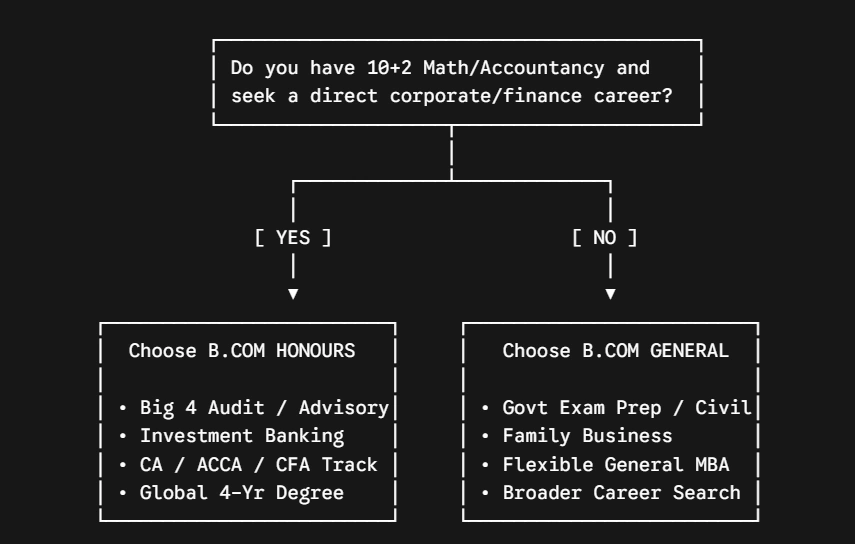
- Select B.Com (Honours) if your priority is landing a high-paying corporate role straight out of college, pursuing finance-heavy credentials (CFA, CA, ACCA), or building an academic profile for top global B-schools.
- Select B.Com (General) if you want a solid baseline in business management while reserving time and mental energy for competitive exam preparation (UPSC/Banking), running a business, or maintaining a flexible schedule.
Frequently Asked Questions
What is the main structural difference between B.Com and B.Com Hons under NEP 2020?
Under NEP 2020, B.Com General is typically a 3-year foundational program focusing on broad commerce principles. B.Com Hons offers a 3-year intensive track or a 4-year “Honours with Research” option (FYUP), integrating mandatory dissertations, data analytics tools, and deeper specialization in corporate finance or auditing.
Is Mathematics mandatory in Class 12 to pursue B.Com Hons?
It depends on the university. Top premier institutions, such as Delhi University, mandate Mathematics or Accountancy in Class 12 (and via CUET domain papers) for B.Com Hons admission. However, many state and private universities offer admission based on aggregate Class 12 scores regardless of stream.
Does B.Com Hons offer higher starting salary packages than B.Com General?
Yes, B.Com Hons graduates generally command higher entry-level packages (₹5.5 LPA – ₹10.5+ LPA at Tier-1 campuses) compared to B.Com General graduates (₹3.0 LPA – ₹5.0 LPA). Corporate recruiters favor Hons graduates for specialized roles like financial analysis, forensic accounting, and risk advisory.
Can I apply directly for a Ph.D. after completing a 4-year B.Com Hons degree?
Yes. Under the NEP 2020 FYUP guidelines, students who complete the 4-year B.Com (Honours with Research) track and maintain a minimum cumulative grade point average (CGPA) of 7.5 are eligible to apply directly for Ph.D. programs without completing a Master’s degree (M.Com).
Which degree provides better exemptions for professional certifications like ACCA or CA?
B.Com Hons offers superior alignment. Due to its advanced curriculum overlap with professional syllabi, B.Com Hons programs often unlock up to 6 to 9 paper exemptions in international certifications like ACCA (UK). B.Com General programs typically qualify for fewer basic-level exemptions.
Which course is better if I am preparing for competitive exams like UPSC or Banking PO?
B.Com General is often the preferred choice for competitive exam aspirants. Its moderate academic schedule and broader curriculum leave sufficient time and mental bandwidth for rigorous entrance test preparation without compromising undergraduate grades, unlike the time-intensive coursework of B.Com Hons.
How does the 4-year FYUP B.Com Hons impact studying abroad for a Master’s?
The 4-year B.Com Hons degree fulfills the 16-year formal education requirement (10+2+4) mandated by most international universities in the US, Canada, and Europe. This eliminates the need for foreign evaluation bridge courses or supplementary postgraduate diplomas prior to applying for overseas Master’s or MBA programs.