In this article
- 01MBA Marketing vs MBA HR: Core Focus and Skill Sets Required 2026
- 02MBA Marketing vs MBA HR: Average Salary and Growth Trajectory 2026
- 03Career Scope: Job Roles and Industries for MBA Marketing Graduates 2026
- 04Career Scope: Job Roles and Industries for MBA HR Graduates 2026
- 05Work-Life Balance: Marketing vs HR MBA Career Paths 2026 Insights
- 06Choosing Between MBA Marketing and HR: Factors to Consider 2026
- 07Frequently Asked Questions
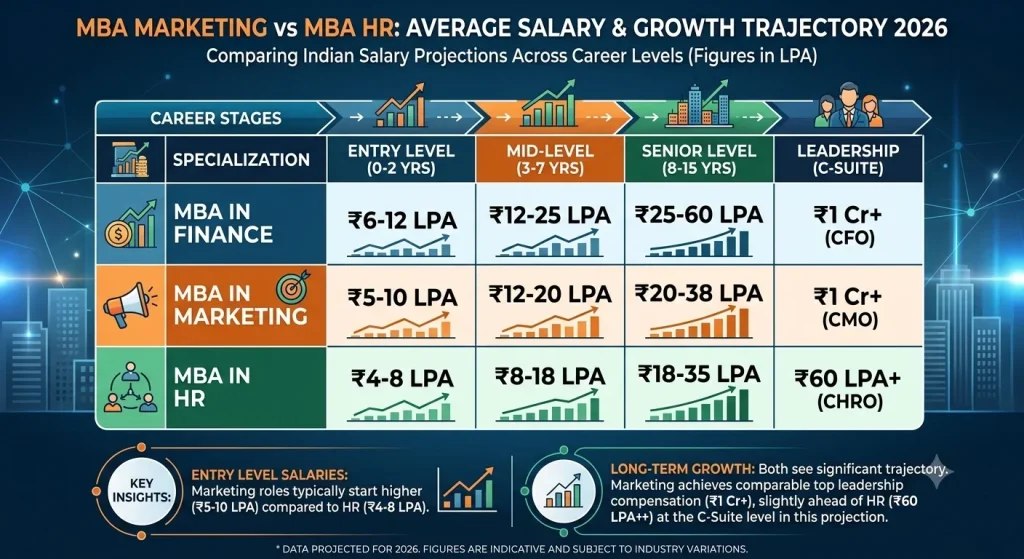
Understanding the Common Management Admission Test (CMAT) is crucial for MBA aspirants, as the National Testing Agency (NTA) oversees this national-level entrance examination. While the NTA governs the CMAT, individual universities and management institutes independently establish their specific admission criteria and specialisation offerings, such as MBA Marketing vs MBA HR. Entry-level salaries (0-2 years) for MBA graduates demonstrate significant variance: an MBA in Finance typically commands ₹6-12 LPA, an MBA in Marketing starts at ₹5-10 LPA, and an MBA in HR begins at ₹4-8 LPA, highlighting diverse financial trajectories from the outset. This article will explore the core focus and required skill sets for MBA Marketing vs MBA HR in 2026, alongside average salary and growth trajectory predictions for the same year.
MBA Marketing vs MBA HR: Core Focus and Skill Sets Required 2026
Choosing between an MBA Marketing and an MBA HR program involves understanding distinct core focuses and required skill sets. An MBA HR primarily centers on managing people and culture, while an MBA Marketing focuses on driving revenue and market growth through customer engagement.
| HR | Marketing | |
| Primary Focus | Employees and workforce | Customers and markets |
| Best For | People-oriented students | Creative and business-oriented students |
| Core Areas | Recruitment, training, compensation, employee relations | Branding, sales, advertising, digital marketing |
| Work Environment | Internal organisational functions | Customer and market-facing functions |
| Popular Roles | HR Manager, Recruiter, HRBP | Marketing Manager, Brand Manager, Sales Manager |
| Important Skill | People management | Customer understanding |
| Use of Analytics | HR and workforce analytics | Marketing and customer analytics |
| Career Goal | Managing people and culture | Driving revenue and market growth |
- MBA HR Core Focus: Employee Management, Talent Development, Organisational Growth and Workforce Strategies.
- MBA HR Suitable For: Students interested in people management, leadership, organisational behaviour, and business strategy.
- MBA HR Major Areas Covered: Recruitment, Training & Development, Performance Management, HR Analytics, Employee Relations.
Also Read: How to Become an HR Manager in India: 2026 Career Path & Skills
| Skill | Description |
| Communication | Useful for interviews, employee interaction, and internal coordination. |
| Empathy | Helps understand employee concerns and workplace situations. |
| Negotiation | Important in recruitment, compensation, and conflict resolution. |
| Organisation | HR involves managing multiple processes, people, and deadlines. |
| HR Analytics | Data skills can support workforce planning and better people decisions. |
These skills are crucial for success in human resources, enabling effective management of people and processes within an organization.
| Skill | Description |
| Communication & Persuasion | Essential for sales, presentations, campaigns, and customer interaction. |
| Creativity | Helps in branding, content, advertising, and campaign ideas. |
| Analytical Thinking | Useful for studying customer behaviour and campaign performance. |
| Digital Skills | Knowledge of digital platforms, analytics, CRM, and online advertising is valuable. |
| Customer Understanding | Strong marketers know what customers want and how buying decisions are made. |
These skills are vital for those pursuing an MBA in Marketing, as they directly contribute to understanding customers and executing successful campaigns.
MBA Marketing vs MBA HR: Average Salary and Growth Trajectory 2026
An MBA in Marketing versus an MBA in HR presents distinct salary trajectories. While both specializations offer significant growth, marketing roles often start with slightly higher entry-level salaries and can lead to comparable leadership compensation, as detailed in the 2026 projections.
Career Scope: Job Roles and Industries for MBA Marketing Graduates 2026
The overall scope for an MBA in Marketing is extremely promising, driven by the rise of AI-driven marketing, digital transformation, and data analytics. Demand for trained marketing professionals is expected to remain steady through 2026, with organizations focusing on data-backed decisions and digital outreach.
| Job Role | Fresher Salary (2026) | Experienced Professional Salary (2026) | Primary Recruiters |
| Brand Manager | ₹6–8 LPA | ₹12–20 LPA | FMCG companies, consumer brands, retail firms |
| Marketing Manager | ₹7–10 LPA (early levels) | ₹15 LPA and above | FMCG companies, service brands, media houses, B2B organizations |
| Digital Marketing Manager | ₹5–7 LPA | ₹12–18 LPA | E-commerce platforms, startups, IT services firms, digital agencies |
| Sales and Business Development Manager | ₹4.5–6.5 LPA | ₹10–18 LPA (often with performance-linked incentives) | FMCG, pharmaceuticals, telecom, real estate, B2B services |
| Market Research Analyst | ₹5–7 LPA | ₹10–15 LPA | Consulting firms, research agencies, corporate strategy teams |
| Product Manager (Marketing-Focused) | N/A | ₹10–20 LPA (depending on company size and experience) | Technology firms, SaaS companies, consumer product organizations |
- Average fresher salary (2026): ₹4.5–7 LPA
- Average salary (3–5 years experience, 2026): ₹10–15 LPA
- Average salary (senior roles, 2026): Can cross ₹20 LPA
- Marketing salaries in metro cities: Higher, especially in Mumbai
- Highest salary marketing jobs: Product Marketing Manager and Senior Brand Manager roles
- Job availability after Online MBA: Strong
| Job Role | Salary Range (2026) |
| Marketing Manager | Up to ₹40 LPA |
| Brand Manager | ₹10–22 LPA |
| Market Research Analyst | ₹8–28 LPA |
| Advertising Manager | Up to ₹38 LPA |
| Sales Manager | Up to ₹42 LPA |
| Product Manager | ₹10–38 LPA |
| Digital Marketing Manager | ₹8–45 LPA |
| Public Relations (PR) Manager | ₹10–30 LPA |
- Skills preferred by recruiters: Communication clarity, data interpretation, presentation skills, understanding of customer behaviour, AI & automation tool expertise, market analytics & data interpretation, digital strategy and performance marketing, AR/VR brand experience planning, consumer psychology & segmentation, brand storytelling & content strategy, CRM and customer journey mapping, leadership & strategic decision-making.
| Job Role | Salary Range (2026) |
| AI Market Strategist | ₹12–50 LPA |
| Performance Marketing Manager | ₹10–40 LPA |
| Customer Experience (CX) Manager | ₹10–35 LPA |
| Marketing Automation Specialist | ₹8–25 LPA |
| Social Commerce Manager | ₹7–20 LPA |
IT companies actively hire marketing professionals, demonstrating the versatility of this degree. Most Online MBA in Marketing programs include digital marketing as an important part of the curriculum, preparing graduates for modern roles.
| Job Role | Average Salary Range (2026) |
| Marketing Executive | ₹3 LPA – ₹6 LPA |
| Digital Marketing Manager | ₹5 LPA – ₹15 LPA |
| Brand Manager | ₹6 LPA – ₹18 LPA |
| Sales Manager | ₹5 LPA – ₹14 LPA |
| Market Research Analyst | ₹4 LPA – ₹10 LPA |
| Product Marketing Manager | ₹8 LPA – ₹20 LPA |
| Social Media Manager | ₹4 LPA – ₹12 LPA |
| Advertising Manager | ₹6 LPA – ₹16 LPA |
Also Read: Top 10 Cheapest Online MBA Programs in India with Fees 2026
Career Scope: Job Roles and Industries for MBA HR Graduates 2026
The HR sector in India shows robust growth, with a 38% year-over-year job growth projected for 2023–2026. This expansion offers diverse opportunities across various industries, making an MBA in HR a promising career path for graduates aiming for roles in talent management, analytics, and strategic HR leadership.
| Indicator | Data |
| HR job growth (2023–25) | +38% year-over-year |
| Average CHRO compensation (top firms) | ₹1.2 Crore+ |
| HR analytics role growth since 2022 | 2.4× increase |
| Global Capability Centres in India | 1,800+ (2026) |
| E-commerce & quick-commerce HR hiring growth | +35% (2023–2026) |
India’s HR market demonstrates significant expansion, driven by strong job growth and a substantial increase in HR analytics roles, alongside a rising number of Global Capability Centres.
| Experience Level | Average Salary Range |
| Freshers (0–2 years) | ₹3–6 LPA |
| Mid-level (2–5 years) | ₹6–12 LPA |
| Senior (5–10 years) | ₹12–25 LPA |
| Senior Leadership / CHRO | ₹30–60+ LPA |
HR professionals in India see a clear salary progression, with earnings increasing significantly as they gain experience and move into senior leadership positions.
| Role | Min (LPA) | Max (LPA) | Midpoint |
| C&B Specialist | 14 | 25 | 19.5 |
| L&D Manager | 12 | 22 | 17 |
| HR Business Partner | 12 | 20 | 16 |
| HR Analytics Lead | 12 | 20 | 16 |
| Employer Branding Mgr | 8 | 18 | 13 |
| Talent Acquisition | 4 | 12 | 8 |
Specialized HR roles like Compensation & Benefits Specialist and Learning & Development Manager command higher average salaries compared to entry-level positions.
| Industry | HR Hiring Share |
| IT / Technology | 32% |
| E-commerce & Quick Commerce | 22% |
| BFSI & Financial Services | 18% |
| Healthcare & Pharma | 13% |
| Consulting | 10% |
| Manufacturing & Industrial | 5% |
The IT/Technology sector leads in HR hiring, with E-commerce and BFSI also representing significant shares of the market for HR professionals.
Work-Life Balance: Marketing vs HR MBA Career Paths 2026 Insights
Both MBA in Marketing and MBA in HR programs share a 2-year, 4-semester duration, yet they diverge significantly in their core focus, career paths, and skill requirements. Understanding these differences helps you align your career aspirations with the right postgraduate specialization.
| Criteria | MBA in Marketing | MBA in HR |
| Full Name | Master of Business Administration in Marketing | Master of Business Administration in Human Resource Management |
| Type | Postgraduate | Postgraduate |
| Duration | 2 Years (4 Semesters) | 2 Years (4 Semesters) |
| Focus Area | 1. Market Analysis 2. Branding 3. Customer Behaviour 4. Revenue Generation | 1. Employee Management 2. Organisational Development 3. People Strategy 4. Training and Development |
| Core Subjects | 1. Integrated Marketing Communications 2. Strategic Management 3. B2B Marketing 4. Retail Marketing and Service Management 5. Digital Marketing and Brand Management | 1. Organisational Behaviour and Human Resource Management 2. Talent Acquisition and Management 3. Learning and Development 4. Industrial Relations and Labour Laws 5. Employee Compensation & Benefits Management |
| Key Skills | 1. Market Research 2. Consumer Insight Analysis 3. Brand Management 4. Strategic Thinking | 1. Talent Management 2. Conflict Resolution 3. Interpersonal Communication 4. Employee Engagement |
Choosing Between MBA Marketing and HR: Factors to Consider 2026
Choosing the right MBA specialisation is a crucial decision that helps you build a future in business management. This section explores the focuses, ideal candidate profiles, and career prospects for MBA Marketing and MBA HR, helping you align your choice with your interests and strengths.
- MBA in Marketing focus: Understanding customers, competitive dynamics, branding, and consumer behaviour.
- MBA in HR focus: Developing skills to manage and expand an organisation’s workforce.
- MBA in Marketing helps learn: Nuances of brand building, customer engagement, and revenue growth.
- MBA in HR equips with skills to: Create people-based strategies that support a healthy workplace culture.
- Primary focus of MBA Marketing: Customers and markets.
- Primary focus of MBA HR: Employees and workforce.
Individuals considering an MBA in Marketing typically enjoy creativity, storytelling, fast-paced environments, and working with targets. Those leaning towards an MBA in HR often enjoy working with people, conflict resolution, and contributing to organizational culture.
| Core Areas of MBA Marketing | Core Areas of MBA HR |
| Branding, sales, advertising, digital marketing | Recruitment, training, compensation, employee relations |
The core areas highlight the operational focuses of each specialisation, with marketing concentrating on external market dynamics and HR on internal workforce management.
- Work environment for MBA Marketing: Customer and market-facing functions.
- Work environment for MBA HR: Internal organisational functions.
- Important skill for MBA Marketing: Customer understanding.
- Important skill for MBA HR: People management.
- Use of analytics in MBA Marketing: Marketing and customer analytics.
- Use of analytics in MBA HR: HR and workforce analytics.
The career goal for an MBA in Marketing is driving revenue and market growth, while for an MBA in HR, it is managing people and culture. Both specialisations offer significant career scope in 2026, with marketing roles evolving in digital marketing and brand management, and HR roles focusing on talent management and employee experience.
| MBA Marketing Subjects | MBA HR Subjects |
| Marketing Management | Human Resource Management |
| Consumer Behaviour | Organisational Behaviour |
| Brand Management | Talent Acquisition |
| Sales Management | Training & Development |
| Digital Marketing | Compensation Management |
| Market Research | Performance Management |
| Advertising & Promotion | Employee Relations |
| Marketing Analytics | HR Analytics |
The subject lists demonstrate the full curriculum for each specialisation, preparing students with targeted knowledge and skills for their chosen career paths.
Frequently Asked Questions
What Is the Core Difference Between MBA Marketing and MBA HR Curricula?
MBA HR focuses on talent acquisition, performance management, labor laws, and training and development. MBA Marketing emphasizes market research and core business subjects.
Which MBA Specialization, Marketing or HR, Offers Better Salary Potential Initially?
Both MBA Marketing and HR offer good initial earning potential. Finance, however, is noted for delivering high earning potential.
How Do Career Paths Diverge for MBA Marketing Versus MBA HR Graduates?
MBA HR leads to HR Executive and Talent Manager roles, while MBA Marketing opens doors to Brand Manager and Digital Marketing Manager positions. Both offer strong management careers, but the work and skills diverge significantly.
Is an MBA in HR or Marketing Better for Someone Without Prior Work Experience?
An MBA without prior work experience is of extremely low value, as you won’t qualify for post-MBA roles. Gaining professional experience first is crucial.
Which MBA Specialization Is More Suitable for a Creative Versus Analytical Personality?
Marketing MBA rewards creativity paired with analytical thinking, focusing on branding and digital campaigns. For analytical, detail-oriented individuals, Finance or Business Analytics are ideal choices for 2025.
Which Course Is Suitable for an MBA: HR or Marketing?
The best MBA course depends on your interests. HR combines management with behavioral sciences, while Marketing focuses on promotion and sales. Many programs offer dual specializations.