In this article
- 01HR Manager Career Path 2026: Step-By-Step Guide for Aspiring Professionals
- 02Essential Qualifications for HR Manager Roles in India: Degrees and Certifications 2026
- 031. Foundational Academic Degrees
- 042. Global Certifications Matrix
- 053. Specialized Short-Term & Executive Certifications
- 06Key Skills Required to Excel as an HR Manager in 2026: Communication, Leadership & More
- 07Entry-Level HR Roles: Gaining Experience Before Becoming an HR Manager in India
- 08HR Manager Salary in India 2026: Expected Earning Potential by Experience and Location
- 09HR Manager vs HR Generalist: Understanding Key Differences in Responsibilities and Growth
- 10Frequently Asked Questions
Projected at ₹15.3 Lakhs per year, the average HR Manager Salary in India for 2026 reflects an overall HR salary range spanning ₹2.5 lakh to ₹18 lakh annually, if you look at leading industry analytics and recruitment firms. An HR Manager is a huge professional handling overseeing an organisation’s human resources functions, including talent acquisition, employee relations, compensation, and compliance. This role typically commands a mid-level salary of ₹6 to 12 LPA for professionals with 2-5 years of experience, escalating to ₹15+ LPA for senior-level positions (5+ years experience), reflecting the critical impact of HR leadership on business success.
HR Manager Career Path 2026: Step-By-Step Guide for Aspiring Professionals
To become an HR manager, you need a clear understanding of the necessary educational background, practical skills, and professional certifications. This guide outlines the essential steps and qualifications to help you advance in your human resources career.
- Understand HR basics: Build foundational knowledge in human resources.
- Enroll in HR certification course: Pursue formal training to validate your skills.
- Learn practical HR skills: Develop hands-on abilities relevant to the field.
- Build professional resume: Create a strong resume highlighting your qualifications.
- Apply for HR jobs: Seek entry-level or specialist positions.
Indeed.com India outlines additional steps to become an HR manager, emphasizing academic qualifications and work experience.
- Complete 10+2: Finish your higher secondary education.
- Obtain a bachelor’s degree: A degree is essential, preferably followed by a master’s.
- Gain relevant work experience: Accumulate practical experience in HR roles.
- Obtain specific HR certifications: Consider additional certifications to enhance your profile.
Also Read: Top 15 Career-Boosting Courses After MBA for 2026: Elevate Your Expertise
The CIPD qualification route offers structured pathways for HR management at various career stages.
| Career stage | CIPD qualification | Purpose |
| Starting out | CIPD Level 3 Certificate in People Practice | Builds essential HR knowledge and confidence for entry-level roles. |
| Progressing to management | CIPD Level 5 Diploma in People Management | Deepens understanding of HR strategy, leadership, and employee experience. |
| Aiming for senior leadership | CIPD Level 7 Diploma in Strategic People Management | Focuses on long-term planning, change management, and business alignment. |
These CIPD qualifications provide a structured path, from building foundational knowledge to developing strategic leadership skills, supporting your progression in HR management.
Essential Qualifications for HR Manager Roles in India: Degrees and Certifications 2026
Navigating a human resources career in India requires balancing foundational business education with regulatory expertise and data-driven capabilities. As Indian organizations shift toward hybrid work models, AI-integrated talent management, and stringent compliance frameworks (including the updated Labor Codes), HR managers must possess both strategic business acumen and specialized credentials.
1. Foundational Academic Degrees
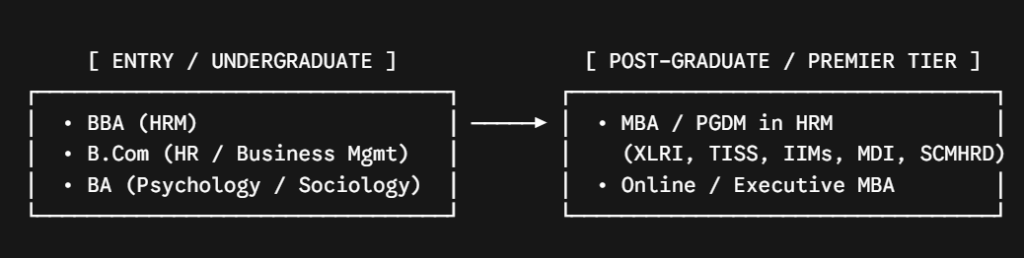
The entry baseline for HR management in India centers on post-graduation, with premier Indian B-schools leading senior leadership recruitment.
Post-Graduate & Leadership Degrees
- MBA / PGDM in Human Resource Management (Full-Time): The benchmark credential for top-tier HR leadership in India. Programs from institutions such as XLRI Jamshedpur, TISS Mumbai, IIM Ranchi, and MDI Gurgaon emphasize industrial relations, corporate governance, and talent strategy.
- Executive & Online MBA in HRM: Designed for working professionals looking to transition from general management or mid-level HR roles into strategic positions without pausing their careers. Covers performance management systems, change management, and labor economics.
- PG Diploma in Human Resource Management (PGDHRM): A targeted post-graduate alternative focused on operational HR skills, payroll architecture, compliance, and employee engagement.
Undergraduate Pathways
- BBA in Human Resource Management: Teaches foundational business administration, organizational behavior, and basic labor dynamics, serving as a primary stepping stone for post-graduate studies.
- B.Com with HR Specialization: Combines core HR management with financial acumen, accounting fundamentals, and business economics—an ideal foundation for HR roles tied to compensation and benefits (C&B) or payroll.
- BA in Psychology or Sociology: Provides deep insight into human behavior, organizational psychology, and group dynamics. Highly valued in talent acquisition, employee wellness, and corporate culture transformation.
2. Global Certifications Matrix
Global credentials validate strategic competencies and open doors within Multinational Corporations (MNCs) operating in India.
| Credential Body | Certification Level | Target Career Stage | Key Focus Areas & Strategic Value |
| CIPD | Level 3 Foundation Certificate | Early Career / Entry | People practice fundamentals, basic talent planning, and workplace culture. |
| CIPD | Level 5 Associate Diploma | Mid-Level / Managerial | Operational HR management, talent development, and employment law principles. |
| CIPD | Level 7 Advanced Diploma | Senior Leadership / CHRO | Strategic people management, organizational design, and enterprise-wide leadership. |
| SHRM | SHRM-CP (Certified Professional) | Mid-Level Operations | Behavioral competencies, operational execution, and policy implementation. |
| SHRM | SHRM-SCP (Senior Certified Professional) | Senior / Strategic | Business strategy alignment, global HR integration, and executive risk management. |
| HRCI | aPHRi (Associate Professional – Int’l) | Entry-Level | Global HR fundamentals, foundational HRIS, and basic workforce planning. |
| HRCI | PHR / PHRi (Professional in HR) | Intermediate | Core operational management, compensation analysis, and talent retention strategy. |
Also Read: Online MBA Fees in India 2026: Top Universities & Payment Options
3. Specialized Short-Term & Executive Certifications
For immediate skill enhancement or functional specialization, targeted certifications provide practical, job-ready capabilities:
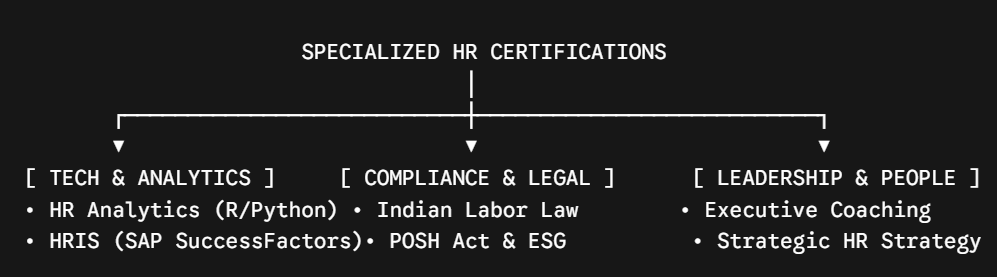
- HR Analytics & HRIS Certifications (3–6 Months): Focus on data-driven decision-making, predictive retention modeling, and platforms like SAP SuccessFactors, Workday, or Tableau.
- Indian Labor Laws & Statutory Compliance (3–6 Months): Essential for managing payroll compliance, EPFO/ESIC regulations, Factories Act requirements, and the unified Labor Codes.
- People Management & Leadership (3–6 Months): Offered by platforms like Coursera (University of Minnesota) or executive education arms of premier institutes, covering performance management, onboarding, and emotional intelligence.
Key Skills Required to Excel as an HR Manager in 2026: Communication, Leadership & More
To excel in this field, you need a strong grasp of both traditional HR functions and emerging technologies. The median annual pay for these professionals was $136,350 as of 2023, reflecting the value organizations place on effective people management.
- Employment Growth (through 2032): 5%
- Time on Employee Relations: Roughly 30% of a week (for 150-300 person company)
- Organizations Needing Systems Skills: Four in five
- Companies Prioritizing People Analytics: 71%
- Top Workplace Need (2026): Effective leadership and management
- HR Leaders with 3+ Year Strategic Planning: Only 12%
Organizations increasingly seek candidates with new skills. Data analysis, AI, and cybersecurity are the most in-demand new skills among organizations posting roles requiring them.
| Most In-Demand New Skills | Percentage of Organizations |
| Data Analysis | 36% |
| AI | 31% |
| Cybersecurity | 21% |
Entry-Level HR Roles: Gaining Experience Before Becoming an HR Manager in India
To gain experience before becoming an HR Manager in India, you typically start in entry-level roles like HR Assistant, HR Coordinator, or Recruiter. These positions are crucial stepping stones in the HR career path, which progresses from HR Intern to CHRO.
- Common Entry Points: HR Assistant, HR Coordinator, or Recruiter
- HR Career Path in India: HR Intern → HR Executive → HR Manager → HRBP → CHRO
- Entry-Level HR Salary (India, 2025): ₹3 to 5 LPA
- Mid-Level HR Salary (India, 2025): ₹6 to 12 LPA
- Senior-Level HR Salary (India, 2025): ₹15+ LPA
- Recommended Qualifications: BBA/MBA in HR, Psychology, or related fields
HR Manager Salary in India 2026: Expected Earning Potential by Experience and Location
The average HR Manager salary in India for 2026 is ₹15.3 Lakhs per year, with the overall HR salary range spanning from ₹2.5 lakh to ₹18 lakh annually. Your earning potential as an HR professional significantly depends on your experience level and the city where you work.
| Experience Level | Typical Role | Salary Range (LPA) | Notes |
| 0–2 years | HR Executive / HR Associate | ₹2.5 – ₹6 | MBA from Tier-1 can start at ₹8–10 LPA at MNCs |
| 3–5 years | HR Manager / HRBP | ₹7 – ₹16 | Specialisation premium begins to apply significantly |
| 6–10 years | Senior HR Manager / HRBP Lead | ₹16 – ₹32 | XLRI/TISS graduates at upper end |
| 10+ years | HR Director / VP HR / CHRO | ₹35 – ₹1.5 Cr | CHRO at listed companies can exceed ₹1 Cr |
HR Manager vs HR Generalist: Understanding Key Differences in Responsibilities and Growth
Understanding the core functions and career progression for an HR Generalist versus an HR Manager is crucial for anyone considering how to become an HR Manager. The HR Generalist primarily executes daily HR tasks, while the HR Manager directs strategy and oversees staff.
- HR Generalist primary function: Doing (executing a wide array of HR tasks, front-lines, tactical, and operational focus)
- HR Manager’s primary function: Directing (overseeing generalists and other HR staff, strategy, planning, people management, program oversight)
- HR Generalist career level: Entry-level to mid-level
- HR Manager career level: Mid-level
- HR Manager experience requirement: 3 to 5 years of previous HR experience, often with previous managerial experience
- HR Generalist education requirement: At least a bachelor’s degree in human resources, communications, or a related field
Both roles typically require at least a bachelor’s degree in human resources, communications, or a related field. The common HR department hierarchy shows a clear path for advancement.
| HR Department Hierarchy (common) |
| 1. HR assistant |
| 2. HR generalist |
| 3. HR manager |
| 4. HR director |
Frequently Asked Questions
What Specific Degree Do I Need to Become an HR Manager?
A bachelor’s degree is typically the minimum requirement to become an HR Manager. Common degrees include Business Administration, Communication, and Economics.
What Are the Typical Steps to Become an HR Manager?
To become an HR Manager, you typically need to complete 10+2, then earn a bachelor’s degree in human resources, business administration, or a related field.
Do I Need Prior HR Experience to Become an HR Manager?
Yes, becoming an HR Manager typically requires a college degree and experience in entry-level HR roles. Limited HR experience can be valuable if you have strong business unit perspective.
What Is the Career Scope for an HR Manager in the Next Five Years?
The HR Manager career path offers growth from specialist roles to strategic leadership, with an average salary of $87,422 per year. This scope will continue to expand over the next five years.
How Does an HR Manager Role Differ from an HR Generalist?
An HR Manager operates at a higher, strategic level, overseeing the department and leading teams, while an HR Generalist focuses on operational tasks.
Are There Specific Certifications That Help Me Become an HR Manager?
Yes, certifications like SHRM-CP/SCP, HR University’s CHRM, and HRCI’s eight certifications can significantly help you become an HR Manager.