In this article
- 01MBA in HR Career Scope in India 2026: Diverse Industry Opportunities
- 02Top Job Roles After MBA in HR 2026: Manager, Consultant, Specialist
- 03Average Salary After MBA in HR 2026: Entry-Level to Senior Positions
- 04MBA HR vs PGDM HR: Career Growth and Opportunities Comparison 2026
- 05Key Skills for Success in HR Roles After MBA 2026
- 06Future Trends in HR Management: Impact on Career Scope by 2026
- 07Frequently Asked Questions
A career in human resources management, pursued through an MBA in HR, demands adherence to specific eligibility criteria set by individual universities, typically a Bachelor’s degree with a minimum aggregate score. By 2026, the career scope for MBA in HR in India is projected to offer significant opportunities, with entry-level graduates (0-2 years post-MBA) earning an average salary of ₹5-8 LPA. Mid-level professionals (3-5 years post-MBA), however, can expect ₹12-20 LPA, with specific roles demonstrating this range: an HR Recruiter (AI LLM Hiring) in Noida, Uttar Pradesh, can command up to ₹6,00,000 annually, while an HR Head COE (Performance & Rewards) in Bengaluru, Karnataka, earns ₹30,00,000 – ₹45,00,000 per year.
MBA in HR Career Scope in India 2026: Diverse Industry Opportunities
Human Resource Management in 2026 has transitioned from an administrative support function into a core strategic business driver. Driven by the adoption of modern HR Tech platforms (e.g., Darwinbox, Workday), enterprise AI screening, workforce analytics, and complex hybrid management models, MBA in HR graduates are increasingly hired to manage talent capital, drive organizational performance, and optimize compensation structures.
| Hiring Sector | Primary HR Priorities in 2026 | Key HR Roles Demanded | Top Recruiters in India |
| IT Services, SaaS & Tech | Managing tech attrition, scaling remote/hybrid teams, global mobility, and skill-gap upskilling. | HRBP, Tech Talent Acquisition Lead, L&D Lead | TCS, Infosys, Wipro, Accenture, Google, Microsoft, Freshworks, Zoho |
| BFSI & FinTech | Rapid field/branch expansion, regulatory workforce compliance, and performance-linked compensation. | HR Business Partner (HRBP), Total Rewards Specialist, Compliance Lead | HDFC Bank, ICICI Bank, Axis Bank, Razorpay, PhonePe, Paytm |
| FMCG & Consumer Goods | Managing large unionized plant labor, supply-chain talent acquisition, and trade sales incentive design. | Factory HR Manager, Area HR Manager, Industrial Relations (IR) Specialist | HUL, P&G, ITC, Nestlé, Britannia, Dabur, Marico |
| E-Commerce & Quick-Commerce | Managing massive gig-economy fleets, warehouse workforce safety, peak-season headcount scaling. | Fulfillment Center HR Lead, Operations HRBP, Gig Talent Partner | Blinkit, Zepto, Swiggy, Zomato, Flipkart, Amazon India |
| Consulting & HRTech | HR transformation advisory, executive search, enterprise HRIS software implementations. | HR Transformation Consultant, Search Partner, HRIS Product Manager | McKinsey, BCG, Deloitte, PwC, EY, KPMG, Darwinbox, Mercer |
Executive Salary & Compensation Matrix (2026 Benchmarks)
| Job Role / Function | Primary Skill Stack & Tools | Mid-Level CTC (2–5 Yrs) | Senior Leadership CTC (5–10+ Yrs) |
| Strategic HR Business Partner (HRBP) | Stakeholder Mgmt, Employee Engagement, Strategic Workforce Planning, Workday | ₹10.0 – ₹18.0 LPA | ₹20.0 – ₹38.0+ LPA |
| Compensation & Benefits (C&B) / Total Rewards Lead | Job Evaluation Models, Financial Modeling, Mercer/Aon Benchmarking, Advanced Excel | ₹12.0 – ₹20.0 LPA | ₹22.0 – ₹42.0+ LPA |
| People Analytics / HR Analytics Manager | Python, SQL, Tableau, Power BI, Predictive Attrition Modeling, Visier | ₹11.0 – ₹19.0 LPA | ₹22.0 – ₹38.0+ LPA |
| Talent Acquisition (TA) Lead | AI Screening Rails, LinkedIn Recruiter, Executive Search, Employer Branding | ₹9.0 – ₹16.0 LPA | ₹18.0 – ₹32.0+ LPA |
| Organization Development (OD) & L&D Lead | Change Management, Leadership Pipelines, LMS Tools (Degreed, Cornerstone) | ₹10.0 – ₹17.0 LPA | ₹18.0 – ₹35.0+ LPA |
Also Read: How to Become an HR Manager in India: 2026 Career Path & Skills
Deep-Dive: Core HR Roles & Key Responsibilities
1. Strategic HR Business Partner (HRBP)
HRBPs align human capital strategies directly with business unit revenues and operational targets.
- Core Responsibilities: Serve as trusted advisors to business unit heads, design retention strategies for critical talent, manage organizational restructuring, and drive performance management cycles (OKRs/KPIs).
- High-Demand Tools: Workday, Darwinbox, SAP SuccessFactors, SuccessFactors, Salesforce.
- Salary Benchmark: ₹10.0 – ₹18.0 LPA for mid-level professionals; ₹20.0 – ₹38.0+ LPA for Senior HRBPs and HR Directors.
2. Compensation & Benefits (C&B) / Total Rewards Manager
C&B leads build market-competitive salary structures, incentive programs, executive pay packages, and employee benefit schemes.
- Core Responsibilities: Analyze market pay benchmark reports, structure short-term/long-term incentives (bonus pools and ESOPs), evaluate health insurance packages, and maintain internal pay equity.
- Why It Pays High: Requires strong quantitative modeling and directly impacts 30–60% of an organization’s operating cost structure (payroll).
- Salary Benchmark: ₹12.0 – ₹20.0 LPA mid-level; ₹22.0 – ₹42.0+ LPA for Heads of Total Rewards.
3. HR Analytics & People Insights Manager
Data-focused specialists who leverage employee data to solve operational challenges like employee turnover, hiring bottlenecks, and workforce productivity.
- Core Responsibilities: Build predictive turnover models, track flight-risk indicators, evaluate channel ROI for talent acquisition, and present workforce data visualizations to executive leadership.
- High-Demand Tools: Python, R, SQL, Power BI, Tableau, Visier, Workday People Analytics.
- Salary Benchmark: ₹11.0 – ₹19.0 LPA for 2–5 years of experience; ₹22.0 – ₹38.0+ LPA for senior leads.
4. Talent Acquisition (TA) & Employer Branding Lead
TA leads design end-to-end recruitment pipelines, manage agency vendors, build candidate networks, and position the company brand to attract specialized talent.
- Core Responsibilities: Manage executive search campaigns, implement AI-assisted resume screening tools, control cost-per-hire and time-to-hire metrics, and run campus hiring drives.
- High-Demand Tools: LinkedIn Recruiter, Greenhouse, Lever, SmartRecruiters, AI-driven assessment rails.
- Salary Benchmark: ₹9.0 – ₹16.0 LPA mid-level; ₹18.0 – ₹32.0+ LPA for Group Heads of Talent Acquisition.
4. Strategic Factors Shaping HR Compensation in 2026
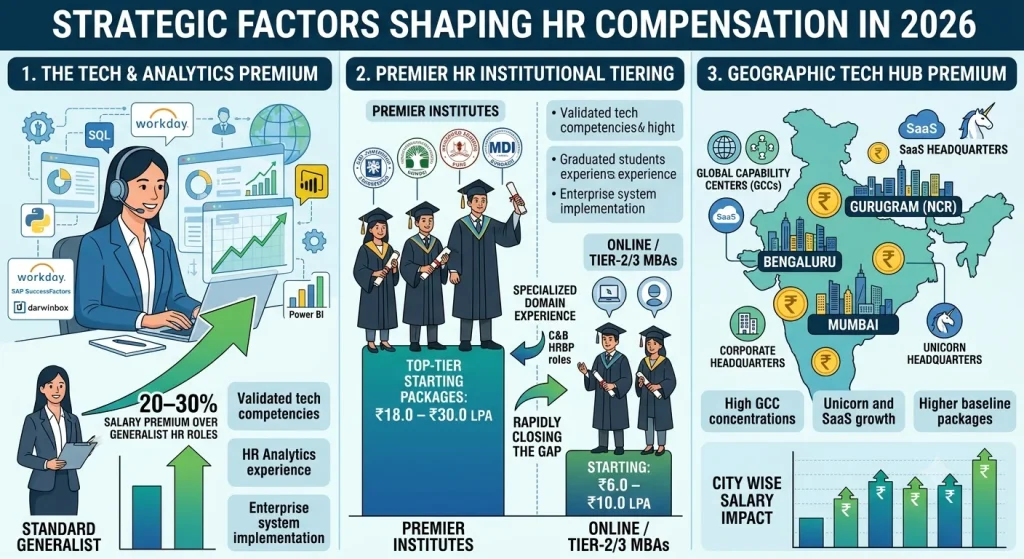
Top Job Roles After MBA in HR 2026: Manager, Consultant, Specialist
The Career Scope for an MBA in HR is broad, with roughly fifteen distinct specializations expected by 2026. You can pursue various roles, from entry-level positions to senior leadership, depending on your experience and career aspirations.
- Entry-level to mid-career roles (0-5 years post-MBA): HR Business Partner (HRBP), People Analytics Analyst, Talent Acquisition Specialist.
- Senior leadership positions (5-15 years post-MBA): Roles 11 through 15.
- HR Business Partner (HRBP) progression: Senior HRBP, then Head of HR for a business unit, then into the Head of Talent or CHRO track.
- People Analytics progression: Senior People Analytics roles, then Head of People Analytics (VP-level).
- Talent Acquisition sub-tracks: Tech recruiting, executive search, and diversity recruiting.
These progression paths highlight the significant growth opportunities within the field, allowing you to specialize and advance your career.
| Role | Location/Experience | Compensation |
| HR Business Partner (HRBP) | India (entry-level) | ₹18 to 28 lakhs per annum |
| HR Business Partner (HRBP) | Globally (US Fortune 500, 3-5 years experience) | $90,000 to $140,000 |
| People Analytics Analyst | India (entry-level) | ₹16 to 26 lakhs per annum |
| People Analytics Analyst | Globally (US-based) | $95,000 to $145,000 |
| Talent Acquisition Specialist | India (entry-level) | ₹14 to 24 lakhs per annum |
| HR Head COE (Performance & Rewards) | Bengaluru, Karnataka | ₹30,00,000 – ₹45,00,000 a year |
| HR Recruiter (AI LLM Hiring) | Noida, Uttar Pradesh | Up to ₹6,00,000 a year |
| Sr. HR Executive | Hyderabad, Telangana | ₹4,00,000 – ₹6,00,000 a year |
| Manager – HR & Admin | Poonamallee, Chennai, Tamil Nadu | ₹30,000 – ₹50,000 a month |
| Human Resources Manager | Kizhakkambalam, Kochi, Kerala | ₹12,527.40 – ₹54,543.78 a month |
| HR Payroll & Compliance Executive | Pune | 25,000 CTC Fixed |
Average Salary After MBA in HR 2026: Entry-Level to Senior Positions
The average salary for an MBA in HR graduate in India varies significantly based on experience and role. Entry-level professionals with 0-2 years post-MBA can expect ₹5-8 LPA, while top 10% graduates command ₹25-40+ LPA. International and niche roles offer even higher compensation, exceeding ₹50 LPA.
| # | Role | Typical experience | Typical annual CTC |
| 1 | HR Intern or Trainee | Student | ₹8,000 to ₹25,000 per month |
| 2 | HR Executive or Officer | 0 to 2 years | ₹2.5 lakh to ₹4.5 lakh |
| 3 | Recruiter or TA Executive | 0 to 3 years | ₹2.5 lakh to ₹5 lakh plus incentives |
| 4 | Senior HR Executive | 2 to 4 years | ₹4 lakh to ₹6.5 lakh |
| 5 | HR Generalist | 3 to 6 years | ₹5 lakh to ₹9 lakh |
| 6 | Payroll and Compliance Specialist | 3 to 7 years | ₹4 lakh to ₹10 lakh |
| 7 | HR Operations Manager | 5 to 9 years | ₹8 lakh to ₹15 lakh |
| 8 | HR Manager | 5 to 8 years | ₹9 lakh to ₹18 lakh |
| 9 | Talent Acquisition Manager | 6 to 10 years | ₹12 lakh to ₹20.5 lakh |
| 10 | HR Business Partner (HRBP) | 8 to 12 years | ₹12 lakh to ₹30 lakh |
| 11 | Compensation and Benefits or HR Analytics Lead | 8 to 14 years | ₹15 lakh to ₹35 lakh |
| 12 | HR Director, VP HR or CHRO | 15 years plus | ₹40 lakh to ₹4 crore |
MBA HR vs PGDM HR: Career Growth and Opportunities Comparison 2026
Choosing between an MBA in HR and a PGDM in HR significantly impacts your career trajectory in human resources. While both offer valuable skills, their curriculum orientation, industry integration, and global recognition differ, influencing your potential for leadership or specialist roles.
| Parameter | Online MBA in Human Resource | Online PGDM in Human Resource |
| Qualification Type | University-granted postgraduate degree | AICTE-approved postgraduate diploma |
| Approving / Regulating Body | UGC-DEB | AICTE |
| Curriculum Orientation | More academic, theory-backed and business-focused | More industry-centric, skills-driven and practice-oriented |
| Learning Outcomes | Strong managerial and strategic HR capabilities | Practical HR application, hands-on problem-solving skills |
| Course Flexibility & Duration | Typically 2 years with structured semesters | Usually 1–2 years with flexible, module-based learning |
| Assessment Style | Exams, assignments and university-driven evaluations | Projects, case studies and industry-focused assessments |
| Industry Integration | Moderate emphasis through projects and internships | Higher emphasis with industry projects, workshops and practical tasks |
| Global Recognition | Widely recognised as a formal master’s degree | Recognised for skill-building but may vary internationally |
| Eligibility & Admission Process | Graduation plus university-specific requirements | Graduation plus institution-level criteria, often more flexible |
| Cost Differences | Generally moderate to high depending on the university | Often more affordable, especially in online formats |
Also Compare: MBA Marketing vs MBA HR: Salary, Scope, and Career Prospects 2026
Key Skills for Success in HR Roles After MBA 2026
HR professionals in 2026 need a diverse skill set beyond traditional recruitment and employee management. Modern organizations expect HR leaders to understand analytics, workplace culture, and AI-driven HR systems to support business decision-making and organizational growth.
- Modern HR roles combine: Business strategy, technology understanding, communication skills, data-driven decision-making, and leadership capabilities.
- Companies expect HR professionals to: Manage AI-enabled HR systems, use workforce analytics, improve employee engagement, build a productive workplace culture, and support leadership.
- HR professionals are responsible for: Recruitment, employee welfare, workforce planning, conflict resolution, performance management, and organizational culture development.
- Strategic HR professionals help organizations: Improve workforce productivity, build employee retention strategies, support leadership planning, and develop long-term talent strategies.
- An MBA in HR equips you with communication, analytics, people management, and business strategy skills.
- Six HR capabilities matter most: Functional HR expertise, business acumen, data literacy, digital and systems fluency, AI fluency, and change and transformation capability.
Modern HR roles demand a blend of soft and hard skills to navigate evolving workplace dynamics and technological advancements. The following table highlights key soft skills employers seek in HR professionals.
| Skill | Why It Matters |
| Leadership | Managing teams and organizational goals |
| Communication | Employee and management interaction |
| Critical Thinking | Solving workplace challenges |
| Creativity | Building innovative HR strategies |
| Teamwork | Supporting collaboration |
| Flexibility | Adapting to changing workplaces |
These soft skills, such as leadership and communication, are crucial for effective interaction and problem-solving within HR roles, complementing the technical expertise required in the field.
Future Trends in HR Management: Impact on Career Scope by 2026
HR trends for 2026 point toward a connected, AI-powered future where automation removes bottlenecks and analytics turn hiring into a measurable growth engine. This shift significantly impacts the Career Scope for MBA in HR, demanding new skills and strategic thinking from professionals.
- Agentic AI shift: 2026 marks a shift to Agentic AI, which understands context and supports smarter decisions.
- HR leaders adopting AI: 76% of HR leaders said their organizations would fall behind without AI adoption.
- Interview coordination time: Can consume up to 35% of recruiter bandwidth.
- Shift to skills-first recruitment: HR trends for 2026 show a shift valuing capability over credentials.
- Employers moving to skills-based model: 55% of employers have already begun this move.
- Most important HR trend: Consolidation, as employers move to single talent acquisition platforms.
The future of HR in 2026, according to Gartner, is shaped by four major trends, including AI triggering questions about the future of HR and being seen as a viable alternative to human talent. Organizations are also walking a growth-efficiency tightrope, and the employment deal shifts to “give more, expect less.”
| CHRO Top Priorities in 2026 (Gartner) |
| 1. Harness AI to Revolutionize HR |
| 2. Shape Work in the Human-Machine Era |
| 3. Mobilize Leaders for Growth in an Uncertain World |
| 4. Address Culture Atrophy to Power Performance |
These priorities highlight the strategic importance of AI and leadership in navigating the evolving HR landscape, directly influencing your career trajectory in this field.
Frequently Asked Questions
What Specific Job Roles Can I Pursue with an MBA in HR?
With an MBA in HR, you can pursue roles like HR Manager, Talent Acquisition Specialist, Training and Development Manager, and HR Business Partner. These diverse opportunities include strategic HR leadership.
How Does an MBA in HR Enhance My Career Progression in the Long Term?
An MBA in HR provides strong career opportunities and long-term professional growth, enhancing employability and access to higher-paying roles. It offers specialized business knowledge for sustained advancement.
What Are the Typical Salary Expectations for MBA HR Graduates in India?
Typical salary expectations for MBA HR graduates in India vary. Early careers at companies like Nestlé offer graduate programs and internships.
Is an MBA in HR Suitable for Someone Without Prior HR Experience?
Yes, admission to an MBA in HR without prior experience is absolutely possible, with most universities only requiring a recognized bachelor’s degree.
What Are the Key Skills Developed During an MBA HR Program for Career Success?
An MBA HR program develops a multidimensional skill set including communication, analytics, people management, and business strategy, essential for leadership and building high-performing teams.
How Can I Maximize My Career Scope After Completing an MBA in HR?
Maximize your career by specializing in HRM programs, focusing on competency-based JDs, and exploring roles like HR Manager, Talent Acquisition Expert, or Learning and Development.