
In this article
- 01Top Career Opportunities After MBA in Finance 2026
- 02High-Paying MBA Finance Jobs: Salary Expectations & Roles 2026
- 03Investment Banking vs Corporate Finance: MBA Career Paths 2026
- 04Specialized Roles: Equity Research, Risk Management & Financial Analytics 2026
- 05Future Scope of MBA in Finance: Industry Trends & Growth 2026
- 06How to Secure Top Placements After MBA in Finance 2026
- 07Frequently Asked Questions
Graduates with an MBA in Finance in India can expect entry-level salaries for online roles ranging from ₹6-12 LPA annually, with mid-career professionals commanding ₹15-35 LPA, and senior management packages potentially exceeding ₹50 LPA to over ₹1 crore, according to placement trends from top-tier online MBA programs. This postgraduate management degree specifically defines a focus on financial management, investment analysis, and corporate finance strategies, reflecting a strong career scope and diverse job market opportunities with competitive compensation, as evidenced by industry reports and leading institutions’ placement data. For instance, a FinTech Specialist can expect ₹6-15 LPA for entry-level roles, while a FinTech Product Manager from an online MBA program can earn up to ₹45 LPA, and a Digital Strategy Analyst can secure ₹20 LPA.
Top Career Opportunities After MBA in Finance 2026
India’s expanding corporate balance sheets, rapid growth in private credit, and booming digital financial infrastructure have driven high demand for finance postgraduates. Career pathways after an MBA in Finance span traditional investment banking and corporate treasury, as well as high-growth tech domains like FinTech risk modeling, quantitative asset management, and private equity.
| Job Role / Domain | Core Recruiting Sectors | Mid-Level CTC (2–5 Yrs) | Senior CTC / Leadership (5+ Yrs) |
| Investment Banking Associate / M&A | Global Investment Banks, Domestic Advisory | ₹20.0 – ₹38.0 LPA | ₹40.0 – ₹75.0+ LPA (Excl. Bonuses) |
| Corporate Finance & FP&A Lead | MNCs, Conglomerates, Consumer Tech | ₹12.0 – ₹20.0 LPA | ₹22.0 – ₹38.0+ LPA |
| Private Equity (PE) / VC Associate | Global PE Funds, Venture Capital Firms | ₹25.0 – ₹45.0 LPA | ₹50.0 LPA – ₹1.2+ Cr (Plus Carry) |
| FinTech Risk & Product Lead | Payment Gateways, Neobanks, WealthTech | ₹14.0 – ₹24.0 LPA | ₹25.0 – ₹48.0+ LPA |
| Equity Research & Portfolio Manager | Asset Management (AMCs), Hedge Funds | ₹11.0 – ₹18.0 LPA | ₹20.0 – ₹35.0+ LPA |
Deep-Dive: High-Demand Finance Roles & Responsibilities
Investment Banking Associate (M&A & Capital Markets)
Investment bankers structure corporate mergers, acquisitions, debt restructuring, and initial public offerings (IPOs).
- Core Responsibilities: Build discounted cash flow (DCF) models, prepare pitch books, execute leverage buyout (LBO) evaluations, and manage regulatory filings with SEBI.
- Top Recruiters: Goldman Sachs, JPMorgan Chase, Morgan Stanley, Avendus Capital, Kotak Investment Banking, Axis Capital.
- High-Value Certifications: CFA (Chartered Financial Analyst) Level 2/3, NISM Series.
- Salary Benchmark: ₹20.0 – ₹38.0 LPA base salary for 2–5 years experience; performance-linked bonuses frequently add 30–80% to base compensation.
Corporate Finance & FP&A Manager
Corporate Finance professionals manage an organization’s internal financial health, long-term capital allocation, and working capital requirements.
- Core Responsibilities: Manage annual budgeting cycles, perform variance analysis, optimize capital structures, oversee cash flows, and advise CFOs on strategic investments.
- Top Recruiters: Tata Group, Reliance Industries, Aditya Birla Group, Hindustan Unilever, Infosys, Amazon India.
- High-Demand Tools: Advanced Excel, SAP S/4HANA, Anaplan, Power BI, Tableau.
- Salary Benchmark: ₹12.0 – ₹20.0 LPA for mid-level roles; scales to ₹22.0 – ₹38.0+ LPA at the General Manager or Director level.
Private Equity (PE) & Venture Capital (VC) Associate
PE and VC associates deploy capital into high-growth startups or mature mid-market companies to drive business turnarounds and achieve profitable exits.
- Core Responsibilities: Conduct commercial and financial due diligence, audit cap tables, structure term sheets, track portfolio valuation multiples, and evaluate exit timelines.
- Top Recruiters: Sequoia Capital India/Peak XV, Blume Ventures, KKR, ChrysCapital, Temasek, SoftBank.
- Salary Benchmark: ₹25.0 – ₹45.0 LPA mid-level; senior principals and partners reach ₹50.0 LPA to ₹1.2+ Cr, augmented by deal “carried interest” (share of profits).
FinTech Risk & Financial Product Manager
Sitting at the intersection of finance, data analytics, and software, these specialists build automated credit risk engines, digital lending pipelines, and algorithmic trading interfaces.
- Core Responsibilities: Design credit scoring models, ensure compliance with RBI digital lending guidelines, manage underwriting algorithms, and monitor default rates (NPAs) on consumer loans.
- Top Recruiters: Razorpay, PhonePe, CRED, Paytm, Slice, Groww, INDmoney, HDFC Bank (Digital).
- High-Demand Tools: SQL, Python, R, SAS, Credit Bureau APIs, FRM (Financial Risk Manager).
- Salary Benchmark: ₹14.0 – ₹24.0 LPA for mid-level; ₹25.0 – ₹48.0+ LPA for Senior Product Managers / Risk Leads.
Equity Research Analyst & Asset / Portfolio Manager
Equity research professionals analyze listed companies to publish “Buy/Sell/Hold” recommendations, while portfolio managers deploy capital into equity and debt mutual funds.
- Core Responsibilities: Conduct quarterly earnings analysis, build three-statement financial models, engage in channel checks, and balance portfolio risk against benchmark indices.
- Top Recruiters: HDFC AMC, ICICI Prudential, SBI Mutual Fund, Motilal Oswal, Jefferies, Nomura.
- Salary Benchmark: ₹11.0 – ₹18.0 LPA mid-level; ₹20.0 – ₹35.0+ LPA for Fund Managers.
Key Factors Influencing Finance Compensation in 2026
- The CFA / FRM Salary Multiplier: Pairing an MBA in Finance with global credentials like CFA (Chartered Financial Analyst) or FRM (Financial Risk Manager) increases starting salary offers by 20–35%, particularly in investment banking, risk management, and portfolio management roles.
- Campus & Tiering Impact: Graduates from Tier-1 institutions (IIM A/B/C, ISB, XLRI, FMS) secure entry-level IB and PE roles starting between ₹22.0 – ₹35.0 LPA. Accredited Online MBA graduates or Tier-2/3 campus graduates typically enter via corporate finance, credit analysis, or commercial banking at ₹6.5 – ₹12.0 LPA, building up toward higher-tier packages through domain experience.
- Geographic Premium: Mumbai remains India’s undisputed financial hub, paying 25–35% higher baseline compensation for core investment banking and asset management roles compared to national averages. Bengaluru and Gurugram (NCR) follow closely for FinTech risk and corporate strategy roles.
High-Paying MBA Finance Jobs: Salary Expectations & Roles 2026
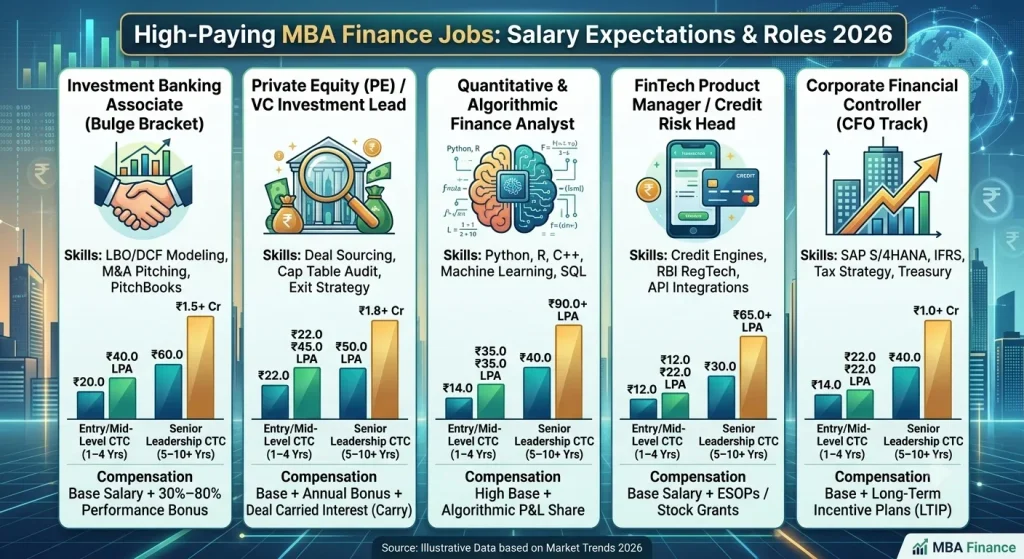
The high-paying tier in post-MBA finance is defined by deal sizes, capital allocation responsibility, and technical specialization. While entry-level corporate finance roles start in the ₹7–14 LPA band, high-stakes domains, such as investment banking, private equity, quantitative finance, and FinTech risk engines, offer double-digit starting packages that scale exponentially through variable performance bonuses.
| High-Paying Role | Primary Skill Stack / Tools | Entry/Mid-Level CTC (Post-MBA / 1–4 Yrs) | Senior Leadership CTC (5–10+ Yrs) | Compensation Structure |
| Investment Banking Associate (Bulge Bracket) | LBO/DCF Modeling, M&A Pitching, PitchBooks | ₹20.0 – ₹40.0 LPA | ₹60.0 – ₹1.5+ Cr | Base Salary + 30%–80% Performance Bonus |
| Private Equity (PE) / VC Investment Lead | Deal Sourcing, Cap Table Audit, Exit Strategy | ₹22.0 – ₹45.0 LPA | ₹50.0 LPA – ₹1.8+ Cr | Base + Annual Bonus + Deal Carried Interest (Carry) |
| Quantitative & Algorithmic Finance Analyst | Python, R, C++, Machine Learning, SQL | ₹14.0 – ₹35.0 LPA | ₹40.0 – ₹90.0+ LPA | High Base + Algorithmic P&L Share |
| FinTech Product Manager / Credit Risk Head | Credit Engines, RBI RegTech, API Integrations | ₹12.0 – ₹22.0 LPA | ₹30.0 – ₹65.0+ LPA | Base Salary + ESOPs / Stock Grants |
| Corporate Financial Controller (CFO Track) | SAP S/4HANA, IFRS, Tax Strategy, Treasury | ₹14.0 – ₹22.0 LPA | ₹40.0 – ₹1.0+ Cr | Base + Long-Term Incentive Plans (LTIP) |
Deep-Dive: Highest-Paying Roles & Revenue Impact
1. Bulge-Bracket Investment Banker (M&A & Debt Capital Markets)
Investment bankers advise corporations on large-scale capital raises, hostile takeovers, cross-border acquisitions, and initial public offerings (IPOs).
- Why It Pays High: Fees are earned as a percentage of overall transaction volume (often 1% to 3% of multi-hundred-crore deals), allowing firms to distribute large performance bonuses.
- Core Responsibilities: Build complex discounted cash flow (DCF) and leveraged buyout (LBO) models, manage regulatory compliance with SEBI, and execute syndicate loan distributions.
- Key Employers: Goldman Sachs, JPMorgan Chase, Morgan Stanley, Jefferies, Avendus Capital, Kotak Investment Banking, Axis Capital.
- Pay Scale: Post-MBA associates at domestic boutiques start at ₹12–25 LPA, while global bulge-bracket banks pay ₹20–40 LPA base. Senior Vice Presidents and Managing Directors earn ₹1.0 to ₹3.5+ Cr.
2. Private Equity (PE) & Venture Capital (VC) Investment Professional
PE and VC leads deploy institutional capital into private companies to accelerate operational growth or execute business turnarounds.
- Why It Pays High: In addition to high base salaries, PE professionals receive carried interest (typically a 20% share of fund profits above a hurdle rate).
- Core Responsibilities: Perform commercial and financial due diligence, structure debt-equity financing instruments, track portfolio EBITDA margins, and lead IPO or trade sale exits.
- Key Employers: Peak XV Partners (formerly Sequoia India), KKR, ChrysCapital, Blackstone, Temasek, Blume Ventures.
- Pay Scale: Mid-level associates command ₹22–45 LPA, while Partners and Managing Directors reach ₹80 LPA to ₹2.0+ Cr plus fund carry.
3. Quantitative Analyst & Algorithmic Trader
Quant leads operate at the intersection of mathematical modeling, financial engineering, and automated execution systems.
- Why It Pays High: Rapid growth in high-frequency trading (HFT), options market-making, and automated risk systems has created supply shortages for candidates possessing both financial acumen and coding capabilities.
- Core Responsibilities: Develop statistical arbitrage algorithms, stress-test derivative portfolios using Monte Carlo simulations, and optimize execution latency.
- Key Employers: Tower Research Capital, WorldQuant, Futures First, AlphaGrep, Edelweiss Quantitative Services, HSBC Global Services.
- Pay Scale: Entry-level quants start at ₹14–35 LPA (among the highest entry figures in non-consulting finance), scaling to ₹50–90+ LPA for quantitative portfolio managers.
4. FinTech Risk Lead & Financial Product Manager
FinTech Product Managers design scalable digital lending workflows, instant underwriting algorithms, and payment routing protocols.
- Why It Pays High: Managing risk and conversion across high-volume transaction rails directly affects net interest margins (NIM) and non-performing asset (NPA) ratios for digital lenders.
- Core Responsibilities: Build automated credit scoring engines using alternative data, ensure compliance with RBI digital lending directives, and reduce transaction drop-offs.
- Key Employers: Razorpay, CRED, PhonePe, Groww, INDmoney, Slice, HDFC Bank (Digital Wing).
- Pay Scale: Mid-level product leads earn ₹12–22 LPA, with senior product directors reaching ₹35–65 LPA in cash along with valuable equity grants (ESOPs).
Investment Banking vs Corporate Finance: MBA Career Paths 2026
For MBA in Finance graduates, deciding between Investment Banking (IB) and Corporate Finance (Corp Fin) determines the rhythm of your daily work, your compensation curve, and your long-term career trajectory. While both domains require mastery over accounting, valuation, and financial modeling, they operate on fundamental trade-offs: External Advisory vs. Internal Operations and High-Risk/High-Reward Dealmaking vs. Sustainable/Predictable Value Creation.
| Feature / Metric | Investment Banking (IB) | Corporate Finance (Corp Fin) |
| Core Mandate | Sell-side/buy-side transaction advisory, capital raising (IPOs/Debt), and M&A execution. | Managing internal balance sheets, capital allocation, FP&A, budgeting, and treasury operations. |
| Client Interaction | External: Executive suites, private equity sponsors, board members, and institutional investors. | Internal: Business unit heads, operations leads, internal strategy teams, and the CFO/CEO. |
| Average Work Hours | 70–90+ Hours/Week (Unpredictable, deal-flow dependent). | 40–50 Hours/Week (Predictable, spikes around quarterly financial closes). |
| Mid-Level Compensation (2–5 Yrs) | ₹20.0 – ₹40.0 LPA Base (+ 30%–80% Performance Bonus). | ₹12.0 – ₹20.0 LPA (+ 15%–25% Annual Variable). |
| Senior Leadership CTC (5–10+ Yrs) | ₹60.0 LPA – ₹1.5+ Cr (MDs reach ₹3.0–5.0+ Cr). | ₹25.0 – ₹45.0 LPA (CFOs reach ₹1.0–2.5+ Cr). |
| Primary Skill Stack | LBO/DCF modeling, pitch deck creation, debt/equity structuring, transaction legalities. | SAP/ERP systems, FP&A variance analysis, working capital optimization, cash-flow forecasting. |
| Top Recruiters in India | Goldman Sachs, JP Morgan, Morgan Stanley, Avendus, Kotak IB, Axis Capital. | Tata Group, Reliance, HUL, Infosys, Amazon, Mahindra, ITC, PhonePe. |
| Common Exit Options | Private Equity (PE), Venture Capital (VC), Hedge Funds, Corporate M&A. | Divisional Finance Director, Corporate CFO, Business Controller, Strategy Lead. |
-
The IB Pay Premium: Investment bankers receive a higher total compensation package in exchange for extended work hours and revenue volatility. Performance bonuses during strong M&A years can add 50% to 100% of the base salary.
-
The Corporate Finance Stability Discount: Corporate finance packages offer lower initial cash figures, but feature higher job security, regular hours, and predictable equity grants/stock options (RSUs/ESOPs) at mid-to-senior tiers.
Decision Framework: Which Path Matches Your Profile?
Choose Investment Banking if:
- You thrive in high-intensity, deal-driven environments and are willing to dedicate 70–80+ hours per week in your early career.
- Your primary career objective is maximizing front-office cash compensation and positioning yourself for buy-side exits in Private Equity, Venture Capital, or Hedge Funds.
- You excel at financial modeling, transaction structuring, and executive-level deal presentations under tight deadlines.
Choose Corporate Finance if:
- You prefer building a long-term career inside an operating company (FMCG, Tech, Conglomerates, Automotive) with sustainable work-life balance (45–50 hours/week).
- You are interested in operational strategy, understanding how inventory management, pricing models, and marketing spend impact the overall balance sheet.
- Your long-term ambition is to become a Chief Financial Officer (CFO), Chief Strategy Officer, or Managing Director of an operating enterprise.
Specialized Roles: Equity Research, Risk Management & Financial Analytics 2026
An MBA in Finance opens doors to diverse roles in financial management, offering strong earning potential. Graduates can pursue careers as finance officers, research analysts, or even reach senior corporate positions with significant long-term salary ceilings.
- MBA in Financial Management job opportunities: Finance Officer, Finance Manager, Insurance Officer, Assistant Branch Manager, Accounts Manager, Research Analyst, Equity Research Analyst.
- Financial Analyst / Financial Manager Average Salary (India): ₹10–22 LPA.
- Financial Analyst / Financial Manager Average Salary (US): 85K–130K.
- Long-term ceiling for MBA finance graduates (senior corporate roles): ₹50–80 LPA.
- MBA in Business Analytics job opportunities: Data Scientists, Quantitative Analysts, Market Research Analysts, Project Managers.
Future Scope of MBA in Finance: Industry Trends & Growth 2026
The future of finance careers in India is strong, driven by skill-based hiring and technological advancements. An MBA in Finance is a high-value qualification, equipping you with deep knowledge and practical skills for emerging roles in a dynamic industry.
- Future of finance careers: Strong, skill-driven, and technology-focused.
- Opportunities exist: Banking, fintech, consulting, startups, corporate finance.
- Impact of AI: Automates tasks; does not replace professionals entirely.
- Demand for graduates: High across BFSI, fintech, and startups.
- Emerging finance roles: Fintech analyst, AI risk analyst, ESG analyst.
- Future-proof: Yes, with continuous upskilling.
Professionals who combine finance knowledge with technology skills like Excel, data analytics, and AI tools will have better career prospects. Continuous learning is essential to stay relevant, especially with rapid fintech growth and increasing entrepreneurship in India.
| Specialization | Focus Areas | Typical Roles | India Salary Range |
| Finance | Corporate finance, investment banking, risk management, fintech integration | Financial analyst, investment banker, CFO | ₹10-40 LPA (top IIMs: ₹20-35+ LPA) |
| Marketing (including Digital Marketing) | Brand strategy, consumer behavior, digital channels | Marketing manager, digital strategist, brand lead | ₹8-20 LPA |
| Human Resource Management (HR / Organizational Leadership) | Talent management, diversity and inclusion, people analytics | HR director, talent acquisition lead | ₹7-15 LPA |
| Operations / Supply Chain Management | Logistics, procurement, operational efficiency | Supply chain manager, operations director | ₹8-18 LPA |
| International Business | Global strategy, cross-border management | Export manager, international business strategist | ₹9-22 LPA |
Traditional MBA specializations like Finance continue to offer high demand and stable returns, with top institutions commanding premium salaries.
| Specialization | Focus Areas | Typical Roles | India Salary Range |
| Business Analytics / Big Data | Data modeling, predictive insights, tools such as Python, SQL, and Tableau | Analytics manager, data consultant | ₹10-35 LPA (often the highest in tech/consulting) |
| Artificial Intelligence & Machine Learning | AI ethics, implementation, business applications | AI consultant, strategy lead | ₹12-35+ LPA (premium in IT/fintech) |
| Sustainability / ESG | Impact investing, green strategy, climate finance | Sustainability officer, ESG analyst | ₹8-20 LPA (rising rapidly) |
| FinTech / Digital Business | Blockchain, digital payments, technology-enabled finance | FinTech product manager, digital banking specialist | ₹10-25 LPA |
| Healthcare Management | Health policy, hospital operations, and pharmaceutical business | Healthcare administrator | ₹8-18 LPA |
Emerging specializations, particularly in Business Analytics, AI, and FinTech, are experiencing the fastest growth and offer competitive salaries, reflecting macro trends in tech-enabled finance and digital platforms.
How to Secure Top Placements After MBA in Finance 2026
Securing top placements after your MBA in Finance for 2026 requires a strategic approach, focusing on long-term career growth rather than immediate gains. Your career after an MBA is a series of small, well-informed bets, so start with a structured assessment to guide your path.
- Mentoring Framework: Discover your psychometric profile and complete a structured interview.
- Decision Phase: Narrow your career options to three credible paths.
- Action Plan: Design a 12-month action plan to achieve your goals.
- Delivery: Engage in monthly check-ins to monitor progress and adjust.
- Student Advice: Design experiments like internships and projects to test your shortlisted paths.
- Parent Advice: Be a ‘funder of options’ for your student, supporting 2-3 credible paths.
Professionals should focus on adjacent moves that compound their existing 5–10 years of experience, rather than considering a complete career overhaul. Avoid common mistakes that can hinder your progress.
- Wrong Horizon: Plan for year 10, not month 1; your first salary matters less than your third.
- Single-Source Advice: Avoid relying on one uncle, coaching class, or Instagram reel for guidance.
- Prestige vs. Fit: A prestigious path you cannot stay engaged with will underperform a less fashionable path you can compound on.
- Ignoring AI: Every role in 2026 will be reshaped by 2030; pick paths where AI is a tool, not a replacement.
- Skipping Conversation: A structured family conversation with a trained mentor offers the highest leverage.
Frequently Asked Questions
What Specific Finance Roles Are Available After an MBA?
An MBA in Finance opens doors to roles like Investment Banking, Investment Management, Corporate Finance, and Global Taxation. Specific positions include Equity Research & Advisory and Commercial Credit & Risk.
How Does an MBA in Finance Enhance Career Progression?
An MBA in Finance enhances career progression by developing financial expertise, analytical skills, and decision-making ability, leading to strong growth in investment banking, corporate finance, fintech, and wealth management.
What Skills Are Essential for a Successful MBA Finance Career?
Essential skills include critical thinking, problem-solving, advanced Excel and financial modeling, communication, and adaptability. Interpersonal skills and financial reporting are also key.
Which Industries Offer the Best Career Scope for MBA Finance Graduates?
Investment banking, financial analysis, and corporate finance offer excellent career scope for MBA Finance graduates, with roles in mergers, acquisitions, and capital raising. Management consulting and financial analyst positions are also projected to be strong careers in 2025.
Is an MBA in Finance Suitable for a Career in Fintech?
Yes, an MBA in Finance is suitable for fintech, especially with modern programs blending finance, technology, and business strategy. The fintech scope is enormous and promising due to rapid integration of technology and finance.
What Are the Typical Long-Term Career Outcomes for MBA Finance Holders?
MBA Finance holders typically advance to leadership roles like CFO, Portfolio Manager, or Investment Banker, often reaching executive positions within 10-15 years.