
In this article
- 01Bank Manager Eligibility Criteria 2026: Education, Age & Experience
- 02Top Banking Courses for Aspiring Bank Managers 2026
- 03Best Banking Courses After Graduation for Bank Manager Roles 2026
- 04Key Bank Manager Entrance Exams
- 05Step-By-Step Guide: How to Become a Bank Manager in India by 2026
- 06Bank Manager Career Path & Promotion Structure in India 2026
- 07Bank Manager Salary & Top Recruiting Banks in India 2026
- 08Approximate Annual Salaries for Bank Managers Across Various Leading Banks in India
- 09Highest-Paying Bank Jobs in India
- 10Frequently Asked Questions
Navigating the path to becoming a Bank Manager in India requires a strategic mix of academic preparation, competitive exam mastery, and rapid career progression. Far beyond handling daily cash operations, today’s bank managers act as strategic financial leaders overseeing credit risk, digital banking platforms, multi-million rupee portfolios, and regulatory compliance under Reserve Bank of India (RBI) guidelines.
Whether your goal is leading a public sector bank branch through top-tier recruitment exams like IBPS PO and SBI PO, securing direct-entry leadership roles via RBI Grade B, or leveraging specialized postgraduate banking degrees for private sector management, this guide breaks down everything you need to know. Discover the essential eligibility criteria, exam roadmaps, and key certifications required to step into a bank manager’s office.
Bank Manager Eligibility Criteria 2026: Education, Age & Experience
To become a bank manager, you generally need a Bachelor’s degree with at least 60% aggregate marks, though some banks allow 55% for SC/ST candidates. Your age and work experience requirements vary significantly depending on whether you enter through an entry-level exam like IBPS PO or a direct lateral entry.
| Criteria | Important Details |
| Minimum Educational Requirement | Bachelor’s degree from a recognised university |
| Minimum Percentage | 60% aggregate; some banks may allow 55% for SC/ST candidates |
| Age for entry-level (via IBPS PO) | 20–30 years, with applicable age relaxations |
| Age for direct lateral entry | Up to 35–40 years, depending on the bank |
| Work Experience for direct entry | 3–5 years in banking or financial services |
| Nationality | Indian citizen |
Top Banking Courses for Aspiring Bank Managers 2026
To step into managerial roles in the banking and financial services sector, professionals rely on specialized certification programs and postgraduate courses. These programs build expertise in risk management, credit appraisal, regulatory compliance, digital banking technologies, and financial analysis.
| Program Name | Certifying Institute | Ideal For | Core Curriculum Covered | Career Impact |
| JAIIB (Junior Associate of IIBF) | Indian Institute of Banking and Finance (IIBF) | Serving Banking Professionals | Banking Principles, Accounting, Finance, Legal & Regulatory Aspects | Mandatory baseline for fast-track internal promotions in Indian banks. |
| CAIIB (Certified Associate of IIBF) | IIBF | JAIIB-cleared Officers & Managers | Advanced Bank Management, Bank Financial Management, Risk Management | Direct eligibility for managerial scale upgrades and incremental salary hikes. |
| Post Graduate Diploma in Banking & Finance (PGDBF) | Manipal Academy / NIBM / Select Banks | Fresh Graduates & Entry-Level Applicants | Core Banking Solutions (Finacle), Credit Appraisal, Retail Banking, Wealth Management | Direct hiring pipeline into Scale-I Officer / Assistant Manager roles at top private/public banks. |
| Certificate in Risk in Financial Services | IIBF / GARP (Financial Risk Manager – FRM) | Credit & Risk Managers | Market Risk, Credit Risk, Operational Risk, Basel III/IV Frameworks | Qualifies professionals for specialized Risk Manager (Scale-II/III) positions. |
| NISM Certifications (Series V-A, VIII, XV) | National Institute of Securities Markets | Wealth Managers & Treasury Officers | Mutual Funds, Equity Derivatives, Research Analysis, Portfolio Management | Statutory requirement for managing wealth management and treasury operations in banks. |
Also Read: Investment Banker Salary in India 2026: Levels, Bonuses, and Growth
Postgraduate Degree Programs for Executive Leadership
A. Executive MBA / Post Graduate Diploma in Management (PGDM) in Banking & Finance
- Institutes: National Institute of Bank Management (NIBM Pune), SPJIMR, Symbiosis (SSBF), Xavier Institute of Management (XIMB).
- Focus: Enterprise financial management, digital transformation in banking, Treasury and Forex operations, and strategic leadership.
- Outcome: Prepares candidates for mid-to-senior managerial roles such as Branch Head, Treasury Lead, or Senior Credit Officer.
B. Specialised Certifications in FinTech & Digital Banking
- Providers: IITs, IIMs (Executive Education), and IIBF.
- Focus: Open Banking APIs, Blockchain in Trade Finance, Artificial Intelligence in Fraud Detection, and Digital Payments Architecture.
- Outcome: High demand for modern Bank Managers overseeing digital branches, neo-banking units, and technology-driven operations.
3. Strategic Recommendations for Career Progression
- For In-Service Banking Officers: Prioritize clearing JAIIB and CAIIB as early as possible. These certifications directly impact increment structures and qualify you for internal promotion interviews to Scale-II (Manager) and Scale-III (Senior Manager) ranks.
- For Career Switchers & Fresh Graduates: Enrolling in a PGDBF program (such as those offered by NIBM Pune or university-bank tie-up programs) provides direct campus placements into probationary managerial tracks.
- For Specialized Roles (Risk/Credit/Treasury): Pair your banking background with global credentials like the FRM (Financial Risk Manager) or IIBF’s Certificate Course in Credit Management.
Best Banking Courses After Graduation for Bank Manager Roles 2026
Choosing the right banking course after graduation is crucial for aspiring bank managers. This section details various programs, from postgraduate diplomas to certification courses, highlighting their duration, potential starting salaries, and the career paths they open in the dynamic banking sector.
| Course | Duration | Starting Salary | Best Suited For |
| PGDM in Banking (BIFS) | 2 years | ₹10–18 LPA | Management track – credit, IB, corporate banking |
| CFA (Chartered Financial Analyst) | 3 levels (variable) | ₹8–15 LPA (candidates), ₹18–35 LPA (charterholders) | Investment management, equity research, asset management |
| FRM (Financial Risk Management) | Variable (2 parts) | ₹8–12 LPA (entry-level), ₹15–22 LPA (mid-level) | Credit risk, market risk, operational risk management |
| NISM Certifications | Short (weeks/months) | Entry-level (variable) | Wealth management, mutual fund distribution, capital markets operations |
| CFP (Certified Financial Planner) | Variable | ₹7–12 LPA (starting), scales sharply | Wealth management, financial planning, client advisory |
| Bank PO Exams (IBPS, SBI, RBI) | Variable (exam prep) | ₹5–8 LPA | Government banking (job security, structured increments) |
| HDFC Bank Future Bankers 2.0 Program | 12 months | ₹5,59,000 PA (including loan benefits) | Personal Banker (Deputy Manager (L2))→ Relationship Manager → Assistant Branch Manager → Branch Manager → Relationship Banking Head |
| Axis Bank Young Bankers Program | 1 year | ₹4,42,000 PA (including incentives) | Branch Relationship Officers (Assistant Manager (L2) Grade) at Axis Bank |
| Kotak Mahindra Bank Operations Program | 45 days | ₹3,50,000 PA + performance bonus up to ₹75,000 | Assistant Manager – Banking Operations |
| Axis Bank Operations Program (Exclusive for Women) | 3 months | ₹4,46,000 PA (including benefits) | Banking operations for women graduates |
| Kotak Mahindra Bank Ignite Program – LAP | 4 months | ₹4,80,000 PA + incentives | Relationship Manager – LAP |
| Equitas Small Finance Bank BDO Program | 2 weeks | ₹3,50,000 PA + incentives | Business Development Officer (BDO) roles |
Also Read: Top 10 High-Salary Courses After 12th Commerce in India 2026
Key Bank Manager Entrance Exams
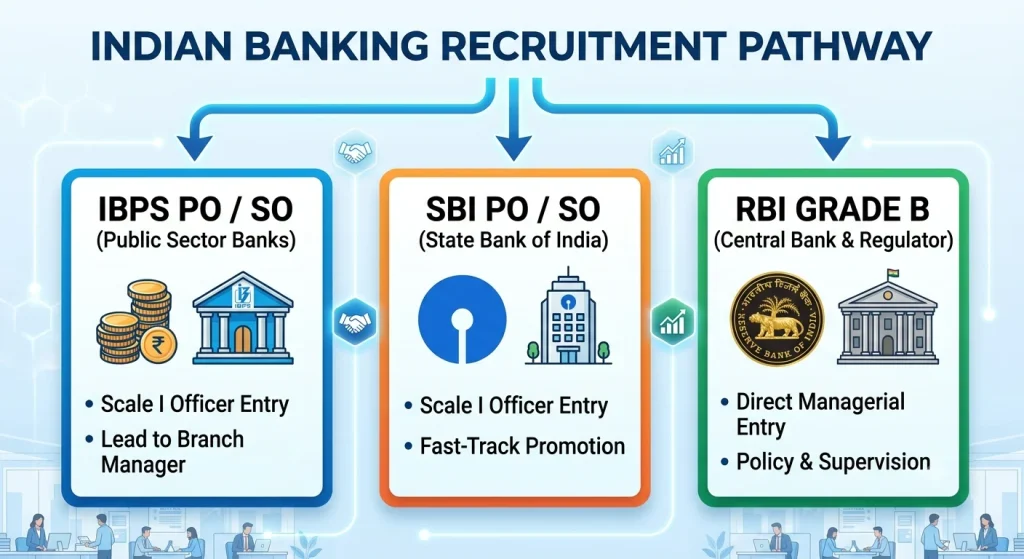
Entering a managerial or officer-level position in the Indian banking sector requires clearing national competitive examinations conducted by official recruitment bodies like the IBPS, SBI, and RBI. These exams test quantitative aptitude, reasoning ability, English language proficiency, general/financial awareness, and managerial decision-making.
| Exam Name | Conducting Body | Target Role / Scale | Exam Pattern / Stages | Average Selection CTC (2026) |
| IBPS PO (Probationary Officer) | Institute of Banking Personnel Selection | Scale-I Officer across 11 Public Sector Banks | Prelims $\rightarrow$ Mains + Descriptive $\rightarrow$ Interview | ₹8.5 LPA – ₹10.5 LPA |
| SBI PO (Probationary Officer) | State Bank of India | Scale-I Officer at SBI | Prelims $\rightarrow$ Mains + Psychometric Test $\rightarrow$ GD & Interview | ₹12.0 LPA – ₹14.5 LPA |
| RBI Grade B Officer | Reserve Bank of India | Direct Grade B Manager (General / DEPR / DSIM) | Phase I (Objective) $\rightarrow$ Phase II (Descriptive + Objective) $\rightarrow$ Interview | ₹28.0 LPA – ₹32.0 LPA |
| IBPS SO (Specialist Officer) | IBPS | Scale-I Specialist Manager (IT, HR, Marketing, Law) | Prelims $\rightarrow$ Mains (Professional Knowledge) $\rightarrow$ Interview | ₹8.5 LPA – ₹11.0 LPA |
| SBI Specialist Officer (SO) | State Bank of India | Scale-II / Scale-III Specialist Manager | Shortlisting / Written Exam $\rightarrow$ Technical Personal Interview | ₹14.0 LPA – ₹22.0 LPA |
| IBPS RRB Officer Scale II & III | IBPS | Manager (Scale-II) & Senior Manager (Scale-III) in Regional Rural Banks | Single Integrated Exam $\rightarrow$ Personal Interview | ₹10.0 LPA – ₹15.0 LPA |
SBI Probationary Officer (SBI PO)
- Role Trajectory: Appointed as Scale-I Probationary Officers, candidates undergo a 2-year probation period. Upon clearing internal confirmation tests, they are promoted to Deputy Manager (Scale-II) and rapidly transition into Branch Manager positions.
- Selection Process:
- Phase I (Prelims): Quantitative Aptitude, Reasoning, and English (100 Marks).
- Phase II (Mains): Objective Test (200 Marks) covering Data Analysis, General/Banking Awareness, Reasoning, and English, plus a Descriptive Test (50 Marks).
- Phase III: Psychometric Evaluation followed by Group Exercises (20 Marks) and Interview (30 Marks).
IBPS PO (Participating Public Sector Banks)
- Role Trajectory: Recruits join participating banks (e.g., Punjab National Bank, Bank of Baroda, Canara Bank) as Scale-I Officers and progress to Branch Manager roles within 3 to 5 years.
- Selection Process: Similar to SBI PO, featuring a Preliminary Exam, a Mains Exam (including a data interpretation and financial awareness focus), and a panel interview conducted by participating banks.
RBI Grade B Officer (Direct Managerial Cadre)
- Role Trajectory: This is the most prestigious direct-entry managerial exam in India’s financial sector. Successful candidates join directly as Manager (Grade B) at RBI regional offices and headquarters.
- Selection Process:
- Phase I: General Awareness, Quantitative Aptitude, English, and Reasoning.
- Phase II: Three papers—Economic & Social Issues (ESI), English Writing Skills, and Finance & Management (FM) (combining objective and detailed descriptive answers).
- Phase III: Personal Interview.
Lateral Entry & Scale-II Manager Exams (IBPS RRB Scale II & SBI SO)
- Target Audience: Designed for candidates with prior experience (e.g., 1–3 years in banking, finance, or corporate domains).
- Exam Focus: Skips the basic preliminary screening rounds and directly evaluates Professional Domain Knowledge, financial management, and industry experience.
Eligibility Framework & Preparation Timeline
Educational Qualification: Bachelor’s degree in any discipline from a recognized university with a minimum of 60% aggregate for RBI Grade B and SBI (passing mark for general IBPS PO).
Age Limits:
- IBPS / SBI PO: 21 to 30 years (relaxations apply for reserved categories).
- RBI Grade B: 21 to 30 years (up to 32 years for candidates holding M.Phil/Ph.D.).
- Scale II / III Lateral Entry: 21 to 38 years depending on the scale and specific role.
Step-By-Step Guide: How to Become a Bank Manager in India by 2026
To become a bank manager in India by 2026, you generally need at least five to six years after completing your 10+2 education. This includes earning a bachelor’s degree, clearing competitive banking exams, and gaining relevant experience for promotion.
- Step 1: Basic Education: Obtain a bachelor’s degree (e.g., B.Com, B.B.A.) with a minimum of 50% marks after 12th standard.
- Step 2 (Route 1): Banking Experience: After your bachelor’s, take an entry-level banking job, often by clearing exams like IBPS PO.
- Promotion (Route 1): You can be promoted to a bank manager after at least three years of relevant experience.
- Step 2 (Route 2): Master’s Degree: Complete a master’s degree in finance or business administration from a reputed college.
- Direct Selection (Route 2): Some banks, mostly private, conduct campus interviews to directly select candidates for bank manager positions.
- Overall Journey: Complete Graduation → Prepare for Banking Opportunities → Enter the Banking Sector → Gain Experience → Build Leadership Skills → Take Greater Responsibility → Progress Into Management.
The path to becoming a bank manager varies, but both routes emphasize a strong educational foundation and practical experience within the banking sector.
| Route | Key Steps | Timeframe |
| Graduation + Exams + Promotion | Bachelor’s degree, clear banking exams, gain 3 years experience | At least five or six years after 10+2 (3-4 years for degree, 1-2 years for exams, 3 years for promotion) |
| Post-graduation Route | Master’s degree after graduation, direct application for manager post | Two years for a master’s degree after graduation |
| Public Sector Bank (Route A) | Graduate in any stream, clear IBPS PO/SBI PO/IBPS RRB Officer Scale-I, join as PO/Assistant Manager, progress to Manager | ~5–10 years based on performance to reach Manager |
| Private Sector Bank (Route B) | Pursue BBA/B.Com/BA Economics/BMS, private banks recruit through own processes/campus interviews (especially after master’s) | Varies based on bank’s hiring process |
Bank Manager Career Path & Promotion Structure in India 2026
Aspiring bank managers in India follow a structured career path, beginning as Probationary Officers and advancing through various management grades. This progression typically takes several years, culminating in top executive leadership roles. Understanding this hierarchy helps you plan your career effectively.
| Grade | Position |
| Junior Management Grade Scale-I (JMGS-I) | Probationary Officer/Assistant Manager |
| Middle Management Grade Scale-II (MMGS-II) | Manager |
| Middle Management Grade Scale-III (MMGS-III) | Senior Manager |
| Senior Management Grade Scale-IV (SMGS-IV) | Chief Manager |
| Senior Management Grade Scale-V (SMGS-V) | Assistant General Manager |
| Top Executive Grade Scale-VI (TEGS-VI) | Deputy General Manager |
| Top Executive Grade Scale-VII (TEGS-VII) | General Manager |
| Top Management (TM) | Chief General Manager (CGM) |
| Top Management (TM) | Executive Director / Managing Director / CMD |
Bank Manager Salary & Top Recruiting Banks in India 2026
A bank manager’s salary in India averages between ₹7.59L and ₹8.32L in 2026, with significant variations based on experience, bank type, and location. Private banks generally offer 20–40% more than public sector banks, often including substantial variable pay.
| Country | Average Salary | Entry / Base Range | Senior / Top Range | Key Insights |
| India | ₹7.59L – ₹8.32L | ₹3.6L – ₹12L Entry to mid-level | ₹12L – ₹20L+ Top: ₹39.25L | Branch Avg: ₹17.59L | Private banks (HDFC, ICICI, Axis) pay 20–40% more than public sector banks. Performance bonuses matter. |
| United States | $117K – $136K | $57K – $102K Broad national range | $148K – $186K Top: $243K+ | Large banks pay significantly more. Branch managers average ~$118K, smaller banks lower (~$70K). |
| United Kingdom | £40,800 | £32K – £50K England average range | £50K – £68K Top: £71K+ | London offers stronger pay. Major employers include Barclays, HSBC, Lloyds and NatWest. |
Salary progression for bank managers
| Salary Component | Assistant Bank Manager | Bank Manager |
| Average annual salary | ₹4–7 LPA | ₹7–12 LPA |
| Average monthly salary | ₹33,000–₹58,000 | ₹58,000–₹1,00,000 |
| Entry-level salary | ₹3–5 LPA | ₹4–6 LPA |
| Mid-level salary | ₹5–7 LPA | ₹8–12 LPA |
| Senior-level salary | ₹8–12 LPA | ₹15–25+ LPA |
| Experience | Average Annual Salary | Approximate Monthly Salary |
| 0–3 years | ₹4–6 LPA | ₹33,000–₹50,000 |
| 4–7 years | ₹7–10 LPA | ₹58,000–₹83,000 |
| 8–12 years | ₹10–15 LPA | ₹83,000–₹1.25 lakh |
| 12+ years | ₹15–25+ LPA | ₹1.25 lakh–₹2 lakh+ |
Approximate Annual Salaries for Bank Managers Across Various Leading Banks in India
| Bank | Approximate Annual Salary |
| State Bank of India | ₹10–16 LPA |
| Punjab National Bank | ₹9–11 LPA |
| Bank of Baroda | ₹10–12 LPA |
| Canara Bank | ₹7–10 LPA |
| ICICI Bank | ₹8–10 LPA |
| HDFC Bank | ₹8–11 LPA |
| Axis Bank | ₹8–11 LPA |
| Yes Bank | ₹8–9 LPA |
| Federal Bank | ₹7–9 LPA |
| UBS Bank | ₹13–18 LPA |
Highest-Paying Bank Jobs in India
| Highest-Paying Bank Jobs | Average Salary Range |
| Investment Banker | ₹23.1 LPA to ₹28.3 LPA |
| State Bank of India – Probationary Officer | ₹14.9 LPA – ₹16.9 LPA |
| Branch Manager | ₹10 LPA to ₹11.3 LPA |
| Reserve Bank of India – Grade B Officer | ₹9.4 LPA to ₹18.6 LPA |
| Credit Analyst | ₹8.7 LPA to ₹9.6 LPA |
| NABARD Grade A & B Officers | ₹8.5 LPA to ₹11 LPA |
| Finance Advisor | ₹5.6 LPA to ₹10.4 LPA |
| Institute of Banking Personnel Selection (IBPS) – Probationary Officers | ₹5.8 LPA to ₹8.9 LPA |
| Institute of Banking Personnel Selection (IBPS)- RRB (PO) | ₹5.8 LPA to ₹8.9 LPA |
| Reserve Bank of India – Assistant | ₹6.1 LPA to ₹8.8 LPA |
| Personal Banker | ₹5 LPA to ₹7.5 LPA |
| Auditor | ₹4.8 LPA to ₹7.2 LPA |
| Relationship Manager | ₹4.5 LPA to ₹7.1 LPA |
| Loan Officer | ₹4.3 LPA to ₹7 LPA |
| NABARD Development Assistant | ₹4 LPA to ₹7 LPA |
Frequently Asked Questions
What Exams Are Required to Become a Bank Manager in India?
To become a bank manager in India, you must pass competitive exams like IBPS PO for public banks or SBI PO for State Bank of India. Private banks have their own entrance tests.
How Long Does It Typically Take to Become a Bank Manager?
Becoming a bank manager typically takes 5-10 years, combining education and progressive experience in banking roles. This includes time for a bachelor’s degree and gaining relevant work experience.
What Are the Top Companies Hiring Bank Managers in 2026?
Top companies hiring bank managers in 2026 include Union Bank of India, JP Morgan Services India Pvt Ltd, CSB Bank, KCB, Equity, Absa, Co-operative Bank, NCBA, Stanbic, and DTB.
What Is the Career Scope After Becoming a Bank Manager?
A bank manager oversees branch operations and staff. Career scope includes roles like investment banker, credit analyst, or financial advisor, with average starter salaries around £32,000.
How Do Private and Public Sector Bank Manager Roles Differ?
Public sector bank managers prioritize public interest and financial inclusion, often experiencing frequent transfers. Private sector bank managers focus on profitability and customer experience, tending to stay in the same role and location longer.
What Is the Required Education for a Bank Manager in 2026?
By 2026, a bachelor’s degree in Accounting, Economics, or Business from a recognized university will be the required education for a bank manager. Certifications like JAIIB or CAIIB further enhance qualifications.