In this article
- 01BCA Syllabus 2026 Overview: Core Subjects & Learning Objectives
- 02BCA Subjects 2026: Programming, Database, Networking & Web Technologies
- 03BCA Syllabus in the Top Colleges in India 2026
- 04Top Trending BCA Specializations in 2026
- 05BCA NEP Syllabus 2026: Key Changes and Implementation Details
- 06Frequently Asked Questions
The Bachelor of Computer Applications (BCA) Syllabus 2026 reflects a massive shift toward industry-first technical skills, aligned with the AICTE guidelines and the National Education Policy (NEP 2020) framework. Designed as a 3-year (6-semester) or 4-year (8-semester) undergraduate degree, the modern BCA curriculum bridges the gap between theoretical computer science and real-world software engineering.
From foundational programming in C, Python, and Java to advanced modules in Cloud Computing, Artificial Intelligence, Cybersecurity, and Web Technologies, the updated syllabus equips students for the fast-evolving IT landscape. Whether you are planning your academic path or choosing the right university, this comprehensive guide breaks down semester-wise subjects, core learning objectives, top college variations, and trending specialization tracks for 2026.
BCA Syllabus 2026 Overview: Core Subjects & Learning Objectives
The BCA program is a three-year undergraduate program, structured across six semesters. The first year focuses on computer science fundamentals and programming basics, while the second year dives into core computer science subjects that directly map to industry skills.
| Course Code | Course-Title | Course Type | Credits |
| BCA101 | Professional English | AECC | 02 |
| BCA102 | Foundational Mathematics | Core | 04 |
| BCA103 | Digital Electronics | Core | 04 |
| BCA104 | Introduction to Programming Using C | Core | 04 |
| BCA105 | Computer Architecture | Core | 04 |
| BCA106 | Digital Electronics Lab | DSCP | 02 |
| BCA107 | C Programming Lab | DSCP | 02 |
| BCA201 | Organizational Behaviour | AECC | 02 |
| BCA202 | Advance Mathematics | Core | 04 |
| BCA203 | Computer Applications | Core | 04 |
| BCA204 | Operating Systems | Core | 04 |
| BCA205 | Data Structures | Core | 04 |
| BCA206 | Operating System Lab | DSCP | 02 |
| BCA207 | Data Structures Lab | DSCP | 02 |
| BCA301 | Financial Accounting & Management | AECC | 02 |
| BCA302 | Statistics | Core | 04 |
| BCA303 | Object Oriented Programming using C++ | Core | 04 |
| BCA304 | Database Management System | Core | 04 |
| BCA305 | C++ Programming Lab | DSCP | 02 |
| BCA306 | DBMS Lab | DSCP | 02 |
| BCA307 | Accounting Tools Lab | SEC | 01 |
| BCA401 | Software Engineering | Core | 04 |
| BCA402 | Cyber Security | Core | 04 |
| BCA403 | Java Programming | Core | 04 |
| BCA404 | Web Technology | Core | 04 |
| BCA405 | Java Programming LAB | DSCP | 02 |
| BCA406 | Web Technology LAB | DSCP | 02 |
| BCA501 | Python Programming | CORE | 4 |
| BCA502 | Computer Networks | CORE | 4 |
| BCA503A | Big Data | DSEC | 4 |
| BCA503B | Computer Graphics & Multimedia Application | None | None |
| BCA503C | Business Intelligence | None | None |
| BCA504A | Digital Image Processing | DSEC | 4 |
| BCA504B | None | None | None |
| BCA504C | Cloud Computing | None | None |
| BCA 505 | Python Programming Lab | DSCP | 2 |
| BCA506 | Project – I | None | 2 |
| BCA601 | Artificial Intelligence | CORE | 5 |
| BCA602A | Internet of Things | None | None |
| BCA602B | Android App Developer | DSEC | 5 |
| BCA603 | Major Project | DSEP | 8 |
Also Read: Online BCA Course Fees in India 2026: University-wise Breakdown & Comparison
BCA Subjects 2026: Programming, Database, Networking & Web Technologies
The BCA program is a three-year undergraduate programme structured across six semesters. It focuses on building a strong foundation in computer science fundamentals and programming basics in the first year, then moves to core industry-relevant subjects, and finally to specialisations and electives.
| Subject Category | Key Topics | Importance |
| Programming Languages | C, C++, Java, Python | Helps develop logical thinking and problem-solving, which is essential for software development |
| Database Management Systems (DBMS) | Concepts, SQL | Teaches how to manage and organise data efficiently for IT systems |
| Data Structures & Algorithms | Arrays, Linked Lists, Trees, Searching & Sorting | Important for solving programming problems and writing optimised code |
| Operating Systems | Fundamentals, Types of OS | Explains how software interacts with hardware and runs smoothly |
| Computer Networks | Basics, Protocols | Introduces networking concepts needed for data transfer and communication |
| Web Technologies | HTML, CSS, JavaScript, Introduction to server-side | Lets you create dynamic websites and understand web applications |
| Mathematics & Statistics for IT | Discrete Mathematics, Probability | Supports logical reasoning, algorithms, and data analysis |
| Software Engineering | Software development life cycle, methodologies | Shows structured ways to build quality software projects |
| Computer Fundamentals & Organisation | Hardware, Software basics | Gives a clear understanding of how computer systems work |
This table outlines the core subjects in the BCA syllabus, detailing key topics and their importance for developing essential IT skills.
| Subject | Focus Area |
| Introduction to Programming (C/C++) | Introduces programming concepts, logical thinking, and problem-solving |
| Basic Mathematics for Computers | Covers foundational maths and reasoning skills essential for computing |
| Digital Electronics | Focuses on the basics of digital circuits and understanding computer hardware |
| Computer Fundamentals | Provides knowledge of hardware, software, and system components |
| Communication Skills | Enhances written and verbal communication for IT professionals |
| Data Structures | Teaches organisation and efficient management of data |
| Database Management Systems (DBMS) | Introduces database design and SQL for managing data |
| Operating Systems | Covers basics of OS and how software interacts with hardware |
The first year of the BCA program focuses on foundational subjects, ensuring you build a strong base in programming, mathematics, and computer hardware.
| Subject | Focus Area |
| Object-Oriented Programming (Java) | Explains advanced programming concepts, classes, and objects |
| Computer Networks | Introduces networking concepts, protocols, and communication systems |
| Software Engineering | Covers the software development life cycle and methodologies |
| Web Technology (HTML, CSS, JS) | Teaches building interactive websites and basic server-side concepts |
| Statistical Methods | Applies probability and statistics to computing problems |
| Financial Management | Provides basic financial knowledge relevant to IT projects |
| Elective 1 (Python Programming) | Optional subject for additional programming skills |
In the second year, the curriculum shifts to core computer science subjects that directly map to industry skills, including advanced programming and web technologies.
| Subject | Focus Area |
| Advanced Java/Python/PHP | Covers advanced coding and application development |
| E-commerce | Explains online business models and digital transactions |
| Cyber Security | Introduces concepts for protecting systems and networks |
| Mobile Application Development | Teaches app development for Android and iOS platforms |
| Cloud Computing | Covers cloud platforms, services, and deployment concepts |
| Project Work/Internship | Provides practical experience and real-world application |
| Elective 2 (Data Science Basics / Machine Learning Intro) | Optional advanced skill-based subject for modern IT applications |
The third year of the BCA program focuses on specialisations and electives, allowing you to gain practical experience through projects and internships.
Also read: Online BCA Admission 2026: Eligibility, Fees, Top Universities, and Application Process
BCA Syllabus in the Top Colleges in India 2026
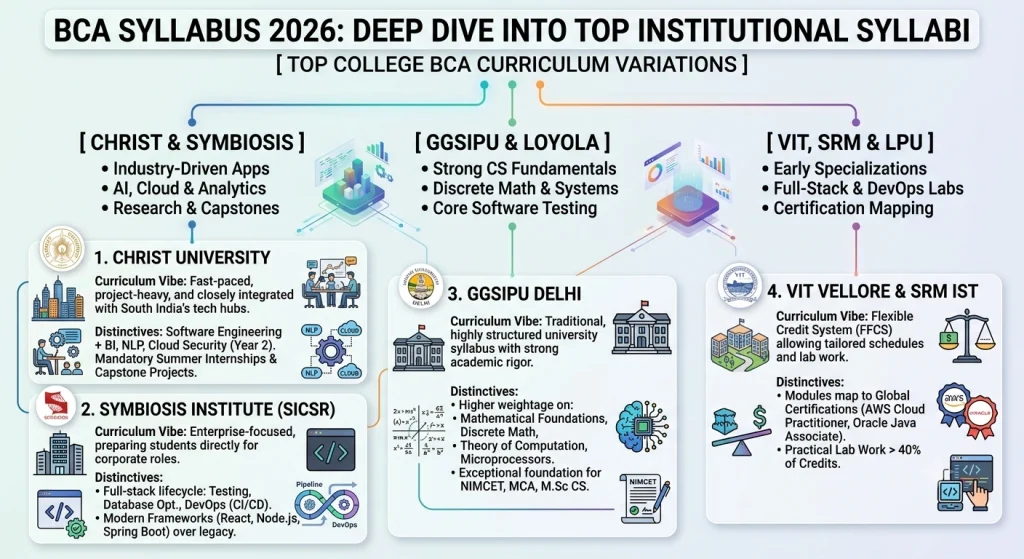
While the AICTE model curriculum and NEP 2020 framework set nationwide guidelines, premier IT institutions in India customize their BCA syllabus to match industry shifts, corporate partnerships, and research capabilities.
When evaluating top-tier BCA programs in 2026, understanding how these universities structure their curricula, from core coding to specialized tracks, helps you choose a program aligned with your career goals.
Comparison of Curriculum Focus across Premier BCA Institutes
| College / University | Curriculum Focus & Pedagogy | Key Syllabus Highlights (2026 Updates) | Unique Elective Tracks Offered |
| Christ University (Bangalore) | Industry-Aligned & Applied Computing: High practical weightage, mandatory research credits, and continuous evaluation. | Cloud Architecture, Advanced Python, Artificial Intelligence, Business Intelligence, Capstone Research. | • AI & Machine Learning
• Cloud Computing • Data Analytics |
| SICSR (Symbiosis Pune) | Software Engineering & Enterprise IT: Blends technical programming with software project management and UI/UX design. | Agile Methodologies, DevOps Tools, Advanced DBMS & SQL, Enterprise Java, Mobile Frameworks. | • Software Development
• Systems & Enterprise Databases |
| GGSIPU (IP University, Delhi) | Core Computer Science & Fundamentals: Heavy focus on discrete math, algorithmic complexity, and hardware-software integration. | Object-Oriented Software Engineering, Operating Systems Mechanics, Microprocessors, Cyber Laws. | • Network Administration
• Web Security & Analytics |
| Loyola College (Chennai) | Theoretical Grounding & Applied Logic: Budget-friendly model focusing on robust coding logic and classical CS theory. | C/C++ Data Structures, Discrete Mathematics, Operating System Internals, Software Testing. | • Open Source Technologies
• Database Administration |
| VIT Vellore / SRMIST | Specialization-First & Lab-Centric: Early access to specialization tracks, industry certifications, and hands-on hackathons. | Full Stack Web Development (MERN), Mobile App Dev (Flutter/iOS), AWS/Azure Fundamentals, IoT. | • Cyber Security & Forensics
• Full Stack Development • Data Science |
Top Trending BCA Specializations in 2026
With the tech landscape shifting rapidly toward automated systems, cloud infrastructure, and data-driven decision-making, taking a generalized BCA is often supplemented by choosing a targeted specialization. Below are the top specialized BCA tracks driving the industry in 2026:
| Specialization Track | Core Advanced Modules Covered | Ideal For Students Who Enjoy | Target Career Roles |
| Artificial Intelligence & Machine Learning (AI/ML) | Deep Learning, Neural Networks, Natural Language Processing (NLP), Computer Vision, Python/R | Logic, complex algorithms, predictive models, and automation | AI Engineer, ML Developer, Prompt Engineer, NLP Specialist |
| Data Science & Business Analytics | Big Data Tools (Hadoop/Spark), SQL/NoSQL, Data Visualization (Tableau/Power BI), Predictive Statistics | Patterns, working with numbers, data storytelling, and business logic | Data Analyst, Data Engineer, BI Developer, Business Analyst |
| Cybersecurity & Ethical Hacking | Network Defence, Cryptography, Penetration Testing, OWASP Top 10, Digital Forensics | Security, risk analysis, ethical hacking, and system protection | Security Analyst, SOC Analyst, Penetration Tester, Incident Responder |
| Cloud Computing & DevOps | AWS/Azure/GCP Infrastructure, Docker, Kubernetes, CI/CD Pipelines, Microservices | Server architecture, virtualization, systems administration | Cloud Engineer, DevOps Associate, System Administrator, Site Reliability Engineer (SRE) |
| Full Stack Web & Mobile Development | MERN/MEAN Stack (MongoDB, Express, React, Node), Flutter/React Native, REST APIs | Building complete web/mobile products from scratch (UI/UX + Backend) | Full Stack Developer, Mobile App Developer (Android/iOS), Web Engineer |
BCA NEP Syllabus 2026: Key Changes and Implementation Details
The BCA program, set for implementation in 2026, aligns with the New Education Policy (NEP-2020) framework. This three-year undergraduate program offers multiple exit options, allowing students flexibility in their academic journey.
| Semester | Major Subject (Core Subject) (6 Credits) | Additional/ Interdisciplinary/ Multidisciplinary (4 Credits) | Skill Course/ Vocational subject/ Course Field Visit/ Entrepreneurship skills (2 Credits) | Vocational Discipline specific/ Open Elective/Project (4 Credits) | Extracurricular Courses/CC (2 Credits) | Extracurricular Compulsory course (2 Credits) | Total Credits |
| I | Computer Fundamental (4) + Computer Fundamental Lab (2) Programming in ‘C’ (4) + Programming in ‘C’ Lab (2) | Internet Technologies (3) + HTML Lab (1) | Office Automation/ PC hardware (2) | Mathematical Foundation | Not Applicable | Life Skills and Personality development | 20 |
| II | Programming in C++ (4) + Programming in C++ Lab (2) Computer Architecture and Digital Electronics (4) + Computer Architecture and Digital Electronics LAB (2) | Computer Based Numerical Techniques (3) + Computer Based Numerical Techniques Lab (1) | Linux Environment / Cyber Security / Business Intelligence (2) | Digital | Not Applicable | Understanding and connecting with Environment | 20 |
| III | Data Structure & File Organization (4) + Data Structure & File Organization lab (2) Operating System (4) + Operating System Lab (2) | Python Programming (3) + Python Programming lab (1) | Modelling & Simulation/ Graph Theory/ Informatics Cyber laws (2) | Not Applicable | Not Applicable | Indian Knowledge System-I (2) | 20 |
| IV | Computer Networks (4) + Computer Networks lab (2) Database Management System (4) + Database Management System Lab (2) | R Programming (3) + R Programming lab (1) | System Administrator/ Software Testing/ Software Engineering (2) | Not Applicable | Not Applicable | Indian Knowledge System-II (2) | 20 |
| V | Compiler Design (4) + Compiler Design lab (2) Computer Graphics (4) + Computer Graphics Lab (2) | Multimedia Application (2) | ASP.Net/ Pattern Recognition/ SQL/PL-SQL (4) | Not Applicable | Not Applicable | DSE 1 Lab (2) | 20 |
| VI | Cryptography & Network Security (4) + Cryptography & Network Security Lab (2) Design and Analysis of Algorithm (4) + Design and Analysis of Algorithm Lab (2) | E-Commerce (2) | Image Processing/ Parallel Programming/ Data Compression (4) | Not Applicable | Not Applicable | Project (2) | 20 |
| VII | Artificial Intelligence (4) + Artificial Intelligence lab (2) Cloud Computing (4) + Cloud Computing Lab (2) | Fundamentals of Data Science (2) | Internet of Things/ Machine Learning/ Data Analytics (4) | Not Applicable | Not Applicable | DSE 2 Lab (2) | 20 |
| VIII | Deep Learning (4) + Deep Learning Lab (2) Wireless and Mobile Computing (4) + Wireless and Mobile Computing Lab (2) | Blockchain Technology (2) | Not Applicable | Not Applicable | Not Applicable | Thesis/Dissertation (06) | 20 |
Frequently Asked Questions
When Do Applications Typically Open for BCA Programs?
Applications for BCA programs generally open in November–December for the main intake, with a July intake typically starting applications in May–June.
Who Is Eligible for BCA?
Indian citizens with 45- 60% in 10+2 (any stream) are eligible for BCA. Math is preferred but not always mandatory.
What Are the Important Dates for BCA?
Registration for BCA 2026 commences on July 7th and closes on July 23rd, with entrance tests on July 10th, 22nd, and 31st. The admission process for Academic Year 2025-2026 is closed.
How to Apply for BCA?
To apply for BCA, candidates must have passed 12th grade with 45-60% marks in any stream. Admissions are open for July ’26.
What Documents Are Required for BCA?
For BCA admission, you’ll need Class 10 and 12 mark sheets, a valid ID, passport-size photograph, and transfer/migration certificates. An entrance exam scorecard and hall ticket may also be required.
What Is the Expected Cutoff for BCA?
BCA cutoffs vary by institution and exam. For example, BBAU Lucknow’s expected CUET 2026 BCA cutoff for the General category is 530-570 out of 750 marks.