In this article
- 01BCA Core Subjects List 2026: Programming, Databases, Web Development
- 02BCA Syllabus: Year-wise Subjects Comprehensive List
- 03BCA Core vs Elective Subjects: Specialization Options 2026
- 04Emerging Technologies in BCA Syllabus: Cloud, AI, Cybersecurity 2026
- 05BCA Subjects: Skills Gained for an IT Career
- 06Frequently Asked Questions
Academic institutions across India, such as Manav Rachna, meticulously define the BCA subjects list, structuring its standard 3-year Bachelor of Computer Applications program into 6 semesters. This detailed BCA syllabus outlines foundational courses and key topics for 2026, encompassing BCA Core Subjects like Programming, Databases, and Web Development. For instance, Semester I mandates BCA105 Computer Architecture (4 Credits) and practical skills through BCA107 C Programming Lab (2 Credits), ensuring early IT career readiness.
BCA Core Subjects List 2026: Programming, Databases, Web Development
The BCA program typically spans three years, divided into six semesters. Its curriculum covers many core and elective subjects, emphasizing practical applications for real-world challenges. These core BCA subjects provide a strong foundation in Computer Science Programming and Information Technology, focusing on computer applications and software.
| Subjects | Description | Topics |
| Programming Fundamentals | This subject is an introduction to the basics of programming, semantics, and logic, and covers syntax using languages such as C or Python. | Variables, data types, functions, basic input-output operations, and control structures. |
| Data Structure | This subject is a study of how data should be organized, managed, and stored for efficient access and modifications. This is critical for developing efficient algorithms based on the understanding of different data operations and their performance. | Stacks, queues, trees, graphs, hash tables, arrays, and linked lists. |
| Database Management Systems (DBMS) | This subject emphasizes the design, management, and implementation of databases with hands-on experiences with tools like MySQL, Oracle, or PostgreSQL. | Relational databases, SQL, normalization, database design, transactions, and indexing. |
| Software Engineering | This subject introduces the principles and methodologies for developing software, covering various methodologies like Agile, Waterfall, and DevOps. | Project management, requirement analysis, design, coding, testing, and maintenance. |
| Object Oriented Programming | The subject OOP introduces the principles of programming and object-oriented design using commonly taught languages like Java or C++. | Inheritance, objects, classes, polymorphism, abstraction, and encapsulation. |
| Operating Systems | This chapter is a study of fundamental concepts of operating systems. | Process management, file systems, input/output systems, security, and memory management. |
| Design and Analysis of Algorithms | This subject deals with techniques for designing efficient algorithms and their performance analysis. | Dynamic programming, greedy algorithms, complexity analysis, and dynamic programming. |
| Web Technology | This subject deals with web development and internet technologies with frameworks like Angular, React, or WUE.js. | HTML, CSS, JavaScript, web servers, and client-server architectures. |
| Computer Networks | This subject emphasizes the basics of computer networking, the implementation of network systems, and the design of network systems with tools and simulators that are relevant. | Network topologies, protocols, OSI and TCP/IP models, network security, routing, and switching. |
| Human-Computer Interaction | This subject is a study of interaction between users and computers. | Usability tests, user experience, and user interface design. |
| Information Security | This subject teaches the basics of security information and protecting data from threats within and outside the system. | Network security, application security, security policy, ethical hacking, and cryptography. |
| Mathematics for Computers | The subject focuses on mathematics | None |
Also Read: Online BCA Admission 2026: Eligibility, Fees, Top Universities, and Application Process
BCA Syllabus: Year-wise Subjects Comprehensive List
The Bachelor of Computer Applications (BCA) is a standard 3-year undergraduate program divided into 6 semesters. Top academic institutions across India structure the BCA curriculum to balance theoretical computing fundamentals with practical software development.
Under updated National Education Policy (NEP) guidelines, the 2026 BCA syllabus emphasizes industry-aligned skills like full-stack development, cloud computing, artificial intelligence, and cybersecurity from early semesters.
BCA Core Subjects: Foundation to Advanced
The core curriculum provides a strong technical foundation required by modern IT companies, software houses, and Global Capability Centres (GCCs).
| Subject Name | Core Description | Key Topics Covered |
| Programming Fundamentals | Introduces basic logic, syntax, and problem-solving using languages like C or Python. | Variables, data types, control structures, loops, functions, and array handling. |
| Data Structures & Algorithms (DSA) | Focuses on organizing and storing data efficiently for optimal algorithm execution. | Arrays, linked lists, stacks, queues, trees, graphs, sorting, and searching. |
| Database Management Systems (DBMS) | Covers the design, implementation, and administration of relational and non-relational databases. | SQL queries, ER modeling, normalization (up to BCNF), indexing, and transactions. |
| Object-Oriented Programming (OOP) | Explores modular software design using modern languages such as Java or C++. | Classes, objects, inheritance, polymorphism, abstraction, and encapsulation. |
| Operating Systems (OS) | Explores fundamental OS architecture and hardware-software resource management. | Process scheduling, memory management, deadlocks, file systems, and concurrency. |
| Computer Networks | Covers data communication protocols, network architecture, and security basics. | OSI & TCP/IP models, routing algorithms, IP addressing, switching, and network protocols. |
| Web Technologies | Teaches front-end and back-end tools for building responsive web applications. | HTML5, CSS3, JavaScript, REST APIs, and modern frameworks (React / Node.js). |
| Software Engineering | Teaches structured methodologies for planning, building, and maintaining software systems. | SDLC models, Agile/Scrum, requirements analysis, testing, QA, and DevOps basics. |
| Discrete Mathematics | Builds mathematical reasoning and logic required for algorithm design. | Set theory, graph theory, Boolean algebra, relations, and propositional logic. |
Semester-Wise BCA Syllabus Breakdown (2026 Curriculum)
Below is the standard semester-wise progression of core theory and practical lab subjects across the 3-year program:
Year 1: Foundations of Computing (Semesters I & II)
| Semester | Course Title | Course Type | Credits | Core Focus / Key Topics |
| Semester I | Programming in C | Core Theory | 4 | Logic building, pointers, structures, file handling |
| Semester I | C Programming Lab | Practical | 2 | Hands-on code execution & debugging |
| Semester I | Computer Fundamentals & Architecture | Core Theory | 4 | Digital logic, ALU, CPU memory architecture |
| Semester I | Mathematical Foundation for CS | Discipline Core | 4 | Matrices, calculus, discrete structures |
| Semester I | Professional Communication | Skill Enhancement | 2 | Verbal & written corporate communication |
| Semester II | Data Structures & Algorithms | Core Theory | 4 | Stacks, queues, trees, sorting & searching |
| Semester II | Data Structures Lab | Practical | 2 | Implementation of DSA algorithms |
| Semester II | Object-Oriented Programming (C++) | Core Theory | 4 | Classes, inheritance, operator overloading |
| Semester II | Digital Electronics | Discipline Core | 3 | Logic gates, combinational & sequential circuits |
| Semester II | Environmental Studies | Ability Enhancement | 2 | Ecological awareness & sustainable computing |
Also Read: Online BCA Course Fees in India 2026: University-wise Breakdown & Comparison
Year 2: Core Development & Database Systems (Semesters III & IV)
| Semester | Course Title | Course Type | Credits | Core Focus / Key Topics |
| Semester III | Database Management Systems (DBMS) | Core Theory | 4 | Relational model, ER diagrams, SQL, normalization |
| Semester III | DBMS & SQL Lab | Practical | 2 | Writing queries in MySQL / PostgreSQL |
| Semester III | Java Programming | Core Theory | 4 | OOP concepts, exception handling, multithreading |
| Semester III | Java Programming Lab | Practical | 2 | GUI building, Applets/Swing, file I/O |
| Semester III | Operating Systems | Core Theory | 4 | CPU scheduling, memory management, virtual memory |
| Semester IV | Web Technologies | Core Theory | 4 | HTML5, CSS3, JavaScript, JSON, responsive design |
| Semester IV | Web Design Lab | Practical | 2 | Dynamic client-side website creation |
| Semester IV | Computer Networks | Core Theory | 4 | OSI layers, TCP/IP, IP addressing, socket coding |
| Semester IV | Software Engineering | Core Theory | 3 | SDLC, Agile methodology, testing, UML diagrams |
| Semester IV | Python for Data Science (Elective I) | Discipline Specific | 3 | NumPy, Pandas, Matplotlib, basic data manipulation |
Year 3: Advanced Topics, Electives & Projects (Semesters V & VI)
| Semester | Course Title | Course Type | Credits | Core Focus / Key Topics |
| Semester V | Cloud Computing | Core / Elective | 4 | Virtualization, AWS/Azure, IaaS, PaaS, SaaS models |
| Semester V | Cybersecurity & Ethical Hacking | Core / Elective | 4 | Network security, cryptography, malware analysis |
| Semester V | Python / Mobile App Development | Core Theory | 4 | Android application development or Advanced Python |
| Semester V | Minor Project / Industrial Internship | Practical | 4 | Building a full-stack functional application |
| Semester VI | Artificial Intelligence & Machine Learning | Core / Elective | 4 | Supervised learning, neural networks, NLP basics |
| Semester VI | Big Data Analytics / IoT | Elective | 3 | Hadoop ecosystem, IoT architecture, sensors |
| Semester VI | Major Capstone Project & Viva | Dissertation | 6 | Full software development lifecycle deployment |
Emerging Technologies in the 2026 BCA Curriculum
Leading universities (e.g., Manav Rachna, Bennett University, Graphic Era) now offer BCA Specializations that integrate high-demand technologies directly into the core degree:
- Artificial Intelligence & Machine Learning (AI/ML): Covers automation, predictive modeling, and integration with frameworks like TensorFlow and PyTorch.
- Cloud Computing & DevOps: Focuses on cloud architectures (AWS, Google Cloud, Azure), containerization (Docker, Kubernetes), and CI/CD deployment pipelines.
- Cybersecurity & Digital Forensics: Hands-on training in vulnerability assessment, penetration testing, network defense, and threat analysis.
- Data Science & Business Analytics: Integrates Python, R programming, SQL, and business intelligence software (Tableau, Power BI) to solve data-driven business problems.
BCA Core vs Elective Subjects: Specialization Options 2026
The BCA program is a three-year undergraduate degree spread over six semesters. This section explores the core curriculum and specialization options available in BCA subjects, helping you understand the foundational knowledge and advanced skills you can acquire.
| Subject Category | Key Topics | Importance |
| Programming Languages | C, C++, Java, Python | Helps develop logical thinking and problem-solving, which is essential for software development |
| Database Management Systems (DBMS) | Concepts, SQL | Teaches how to manage and organise data efficiently for IT systems |
| Data Structures & Algorithms | Arrays, Linked Lists, Trees, Searching & Sorting | Important for solving programming problems and writing optimised code |
| Operating Systems | Fundamentals, Types of OS | Explains how software interacts with hardware and runs smoothly |
| Computer Networks | Basics, Protocols | Introduces networking concepts needed for data transfer and communication |
| Web Technologies | HTML, CSS, JavaScript, Introduction to server-side | Lets you create dynamic websites and understand web applications |
| Mathematics & Statistics for IT | Discrete Mathematics, Probability | Supports logical reasoning, algorithms, and data analysis |
| Software Engineering | Software development life cycle, methodologies | Shows structured ways to build quality software projects |
| Computer Fundamentals & Organisation | Hardware, Software basics | Gives a clear understanding of how computer systems work |
The BCA curriculum balances theory with real-world practice, gradually building from basic to advanced topics. You typically identify your domain of specialization in the second year of the program.
- Object-Oriented Programming (Java): Explains advanced concepts like classes and objects.
- Computer Networks: Introduces networking concepts, protocols, and communication.
- Software Engineering: Covers the software development life cycle and methodologies.
- Web Technology (HTML, CSS, JS): Teaches building interactive websites.
- Statistical Methods: Applies probability and statistics to computing.
- Elective 1 (Python Programming): An optional subject for additional programming skills.
Specialization electives become available in the final year, though their availability varies considerably between institutions. These advanced subjects allow you to deepen your expertise in specific IT domains.
- Advanced Java/Python/PHP: Covers advanced coding and application development.
- E-commerce: Explains online business models and digital transactions.
- Cyber Security: Introduces concepts for protecting systems and networks.
- Mobile Application Development: Teaches app development for Android and iOS.
- Cloud Computing: Covers cloud platforms, services, and deployment concepts.
- Elective 2 (Data Science Basics / Machine Learning Intro): An optional advanced skill-based subject.
Emerging Technologies in BCA Syllabus: Cloud, AI, Cybersecurity 2026
Leading BCA programs across India are transforming their curriculum, integrating AI, Cloud Computing, and Cybersecurity to align with 2026 industry demands. These new BCA subjects move beyond basic programming, focusing on practical skills and real-world applications you need for future careers.
- Employer Focus: Employers in 2026 prioritize skills, adaptability, and real-world exposure.
- Cloud Computing: Programs include cloud architecture, security, and platforms like AWS, Google Cloud, and Azure.
- AI & Machine Learning: Curricula embed AI/ML for building applications, data-driven decisions, and automation tools.
- Cybersecurity: Many programs offer dedicated subjects on network security, ethical hacking, and cyber defense mechanisms.
- Data Analytics: Students learn data collection, analysis, Python, R, SQL, and business intelligence techniques.
- New Specialisations: Top universities introduce Blockchain, IoT, Cloud Security, and AR/VR Development.
These integrated curricula also emphasize full-stack web and mobile app development, using languages like JavaScript and Python. This prepares you for in-demand roles such as Cloud Support Engineer, Cybersecurity Analyst, or Digital Forensic Expert. Institutions like Manav Rachna and Bennett University offer specialized programs, including BCA with Cyber Security or Artificial Intelligence, aligning their offerings with industry requirements.
| Marks / CGPA in Qualifying Examination | Tuition Fee Waiver |
| 98% and above | 100% |
| 95% to 97.99% | 50% |
| 90% to 94.99% | 25% |
| 85% to 89.99% | 10% |
Manav Rachna offered a scholarship program for its BCA Cyber Security specialization, providing tuition fee waivers based on qualifying examination marks. The application deadline for this program was 02 July 2026.
BCA Subjects: Skills Gained for an IT Career
A Bachelor of Computer Applications (BCA) is more than just a theoretical computer science degree—it is an applied, skill-centric program built specifically to transition students into industry-ready software professionals.
While learning syntax and understanding database architecture form the academic backbone, the real value of the BCA curriculum lies in the technical, analytical, and professional competencies developed along the way. Every core module translates directly into a practical capability that tech companies actively look for during campus hiring and technical interviews.
Here is a detailed breakdown of how specific BCA subject areas translate into high-demand IT industry skills.
Core Skill Mapping: From Classroom Subjects to Industry Capabilities
Deep Dive into Core IT Competency Clusters
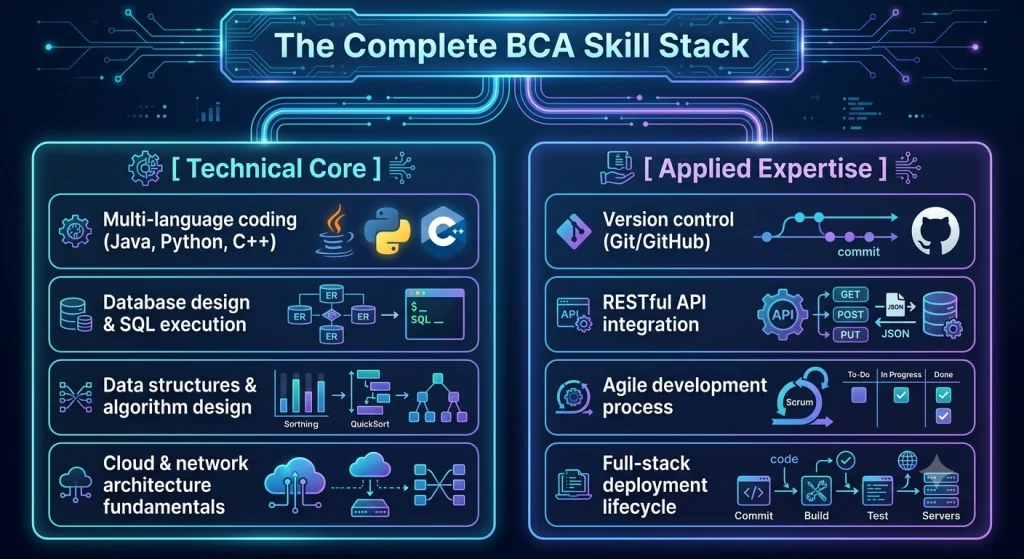
1. Advanced Problem-Solving & Algorithmic Efficiency
Through subjects like Data Structures & Algorithms and Design & Analysis of Algorithms, students move beyond basic coding into optimizing software performance.
-
What you learn: How to evaluate Time and Space Complexity using Big-O notation, select optimal data structures (like Hash Tables, Trees, or Graphs) for real-world scenarios, and write memory-efficient logic.
-
Why employers care: Companies like TCS, Infosys, Wipro, and product startups conduct technical screening rounds almost exclusively on DSA to assess candidate logic and problem-solving speed.
2. Enterprise Data Architecture & Backend Management
Data powers every modern web app and enterprise tool. Subjects like DBMS and Advanced Database Systems provide hands-on experience with both relational databases (MySQL, PostgreSQL) and modern non-relational tools (MongoDB).
-
What you learn: Constructing complex SQL queries, normalizing databases up to BCNF, handling ACID transactions, and ensuring zero data redundancy.
-
Why employers care: Backend developers and database managers must build systems capable of supporting thousands of concurrent users without data loss or latency.
3. Full-Stack Web & Application Engineering
The combination of Web Technology, Java/Python Programming, and Mobile App Development turns students into full-stack creators.
-
What you learn: Building dynamic user interfaces using modern JavaScript frameworks, connecting front-ends to databases via RESTful APIs, and deploying applications on servers.
-
Why employers care: Full-stack developers who can build both client-side interfaces and server-side logic are among the most recruited freshers in the tech ecosystem.
4. Modern Agile Practices & Version Control
Subject tracks in Software Engineering introduce corporate software workflows before students ever step into an office.
-
What you learn: Collaborating on code bases using Git & GitHub, managing software sprints using Agile frameworks, writing system documentation, and understanding software testing strategies (Unit, Integration, Regression).
-
Why employers care: Freshers who already know Git workflows and Agile practices integrate into production development teams weeks faster than candidates with pure theoretical backgrounds.
Soft Skills & Corporate Readiness
A computer application degree goes beyond hard technical skills. Modern BCA programs embed soft skill modules across semesters to build well-rounded corporate professionals:
-
Technical Communication: Writing detailed Software Requirement Specifications (SRS), creating API documentation, and presenting capstone project demos.
-
Analytical Reasoning & Mathematics: Discrete Math and Statistics modules hone quantitative aptitude, crucial for data analytics and software logic.
-
Collaborative Project Management: Semester capstone projects train students to work in cross-functional team setups, manage deadlines, and present software solutions to non-technical stakeholders.
The Final Skill Stack: Graduate Employability Matrix
Frequently Asked Questions
What Core Subjects Are Typically Included in a BCA Program Curriculum?
BCA programs typically cover core subjects like Programming (C, Java), Data Structures, Database Management Systems, Operating Systems, and Computer Networks, providing a strong foundation in computer applications.
How Do BCA Subjects Differ from Those in a B.SC. Computer Science Degree?
BCA subjects are geared toward practical application and skill-focused learning, while B.Sc. Computer Science focuses more on theoretical knowledge and academic detail.
What Career Opportunities Open UP After Completing a BCA Degree with These Subjects?
A BCA degree opens doors to roles like technical analyst, software engineer, data scientist, cloud architect, and cybersecurity professional. Other opportunities include IT support superintendent and web inventor.
How Can I Choose the Best BCA Subjects for My Specific Career Goals?
Align your BCA subjects with your specific career goals. Popular choices like Artificial Intelligence and Cyber Security are excellent for specific industry paths.
What Are the Core Subjects Taught in a BCA Program?
A BCA program primarily teaches core subjects like Programming (C, Java, Python), Data Structures, Database Management Systems (DBMS), Software Engineering, and Web Technologies. Other key areas include Computer Networks and Operating Systems.
What Career Opportunities Open UP After Completing BCA Subjects?
After completing BCA, career opportunities include Software Developer, Web Developer, Data Scientist, Cybersecurity Expert, Data Analyst, Technical Analyst, and Cloud Engineer.