In this article
- 01MBA Fees in India 2026: Fees Breakup in Tier-Wise Colleges
- 02IIM MBA Fees 2026: Comparing Flagship PGP Program Costs
- 03MBA Fees in India: Top Tier 2 & 3 Colleges in 2026
- 04One-Year MBA Fees in India 2026: ISB, IIMs, XLRI & MDI Programs
- 05Top Government MBA/PGDM Institutions Under ₹5 Lakhs Total Fees
- 06Top Tier-2 private B-schools (NMIMS, SIBM, IMT) vs New/Baby IIMs (IIM Trichy, Udaipur, Jammu)
- 07Online MBA Fees in India 2026 vs Traditional Full-Time Programs
- 08Frequently Asked Questions
Choosing an MBA program in India in 2026 requires navigating an enormous financial spectrum, with total course costs ranging from ₹50,000 in top government institutions to over ₹28 Lakhs at premier private B-schools and IIMs. Beyond basic tuition, evaluating the true cost of an MBA means factoring in hostel charges, global immersion expenses, hidden administrative fees, and opportunity costs like foregone salary. This comprehensive guide breaks down the 2026 MBA fee structure across Tier-1, Tier-2, and Tier-3 institutions, compares high-ROI government colleges like FMS and TISS, and analyzes 1-year versus 2-year and online formats, equipping you with the data needed to maximize your career return on investment.
MBA Fees in India 2026: Fees Breakup in Tier-Wise Colleges
Pursuing an MBA in India involves a vast financial spectrum, with two-year tuition and total course costs ranging from ₹25,000 in top government universities to over ₹45 Lakhs in elite private institutions. Understanding the tier-wise fee structure, additional cost components, and return-on-investment (ROI) dynamics is essential for planning your management education budget.
Tier-Wise Fee Distribution & ROI Comparison (2026–2028 Batch)
B-schools in India are broadly categorized into three distinct tiers based on accreditation, brand equity, infrastructure, and average campus placements.
| Tier / Category | Representative Institutions | Average Total Course Fee Range | Average / Median Salary | Expected ROI Profile |
| Tier-1: Premier IIMs & Top Private | IIM Ahmedabad, IIM Bangalore, IIM Calcutta, XLRI Jamshedpur, SPJIMR Mumbai, MDI Gurgaon | ₹22.0 L – ₹30.5 L | ₹28.0 LPA – ₹35.0 LPA | High Absolute Yield · High upfront cost compensated by top-tier consulting and global roles. |
| Tier-1: High-ROI Government | FMS Delhi, JBIMS Mumbai, TISS Mumbai, IIT Bombay (SJMSOM), IIT Delhi (DMS) | ₹2.0 L – ₹15.0 L | ₹25.0 LPA – ₹34.0 LPA | Maximum Financial ROI · Minimal debt burden with top-tier corporate recruitment access. |
| Tier-2: New IIMs & Established Private | IIM Trichy, IIM Udaipur, NMIMS Mumbai, SIBM Pune, IMT Ghaziabad, IMI New Delhi | ₹15.0 L – ₹25.0 L | ₹14.0 LPA – ₹22.0 LPA | Balanced Growth · Steady corporate placement pipelines across mid-to-senior roles. |
| Tier-3: Regional Private & State Universities | Amity University, Jaipuria Institute, ITM Business School, State Open/Affiliated Colleges | ₹4.0 L – ₹12.0 L | ₹5.0 LPA – ₹8.5 LPA | Local Industry Focus · Best suited for regional job mobility or functional upskilling. |
Also Read: Top 15 Career-Boosting Courses After MBA for 2026: Elevate Your Expertise
IIM MBA Fees 2026: Comparing Flagship PGP Program Costs
Prospective students considering a management degree across India’s Indian Institutes of Management (IIMs) will find significant variations in investment requirements. Flagship two-year Post Graduate Programmes (PGP/MBA) reflect a wide cost spectrum: top-tier campuses like IIM Ahmedabad and IIM Calcutta command fees around ₹27.00 Lakhs to ₹27.50 Lakhs, while newer institutions like IIM Visakhapatnam offer accredited programs at a more accessible ₹17.83 Lakhs.
For perspective, non-IIM public universities like FMS Delhi remain exceptional outliers, delivering equivalent tier-1 placements at a nominal fee of ₹2.00 – ₹3.00 Lakhs.
| Institution | Flagship Program Name | Total Course Fee (Approx.) | Key Inclusions & Deposit Terms |
| IIM Ahmedabad | MBA / PGP | ₹27.50 Lakhs | Includes tuition, accommodation, and access to campus facilities. |
| IIM Calcutta | MBA | ₹27.00 Lakhs | Covers tuition, hostel stay, and immersion expenses. |
| IIM Bangalore | PGP / MBA | ₹24.50 Lakhs | Excludes ₹30,000 refundable caution deposit and mess charges. |
| IIM Mumbai | MBA | ₹21.00 Lakhs | Includes a ₹50,000 refundable caution deposit. |
| IIM Indore | MBA / PGP | ₹24.00 Lakhs | Course fee + additional security deposits and mess advances. |
| IIM Kozhikode | MBA / PGP | ₹23.50 Lakhs | Tuition, academic support, and hostel accommodation. |
| IIM Lucknow | MBA | ₹20.75 Lakhs | Academic tuition fees, learning materials, and utility charges. |
| IIM Raipur | MBA / PGP | ₹20.08 Lakhs | Academic fee; mess, health insurance, and caution fees billed separately. |
| IIM Trichy | MBA / PGPM | ₹19.80 Lakhs | ₹18.50 L tuition + ₹1.0 L acceptance + ₹30,000 deposit + mess. |
| IIM Rohtak | MBA / PGP | ₹17.90 Lakhs | Base academic fee; utility and living expenses extra. |
| IIM Visakhapatnam | MBA / PGP | ₹17.83 Lakhs | Tuition and hostel charges for the full two-year duration. |
| FMS Delhi (Non-IIM Government) | MBA | ₹2.43 Lakhs | Heavily subsidized university tuition fee. |
Also Read: Top MBA Specialisations in India for 2026: High Demand & Career Scope
MBA Fees in India: Top Tier 2 & 3 Colleges in 2026
While Tier-1 B-schools command national headlines, Tier-2 and Tier-3 institutions represent over 80% of management graduates in India. Tier-2 B-schools offer robust corporate placement networks and modern infrastructure at moderate-to-high fee points. In contrast, Tier-3 regional institutions focus on local employability, specialized functional skills, and affordable tuition.
Tier-2 B-Schools: High Infrastructure & Mid-Corporate Placements
Tier-2 institutions usually charge between ₹12 Lakhs and ₹25 Lakhs for two-year full-time PGDM/MBA programs. These schools maintain strong corporate partnerships, national accreditations (NBA, NAAC, or global AACSB/AMBA recognition), and structured placement cells that deliver average salaries between ₹8 LPA and ₹18 LPA.
| Institution / B-School | Entrance Exams Accepted | Total Course Fee (Approx. 2-Year) | Average CTC / Package | Top Target Recruiters |
| NMIMS Mumbai (SBM) | NMAT by GMAC | ₹23.0 L – ₹27.0 Lakhs | ₹18.6 L – ₹25.1 LPA | Deloitte, EY, Barclays, Marico, Amazon |
| SIBM Pune (Symbiosis) | SNAP | ₹26.2 L – ₹27.7 Lakhs | ₹23.0 L – ₹26.5 LPA | Accenture Strategy, ITC, Bajaj Auto, Godrej |
| IMT Ghaziabad | CAT / XAT / GMAT | ₹21.5 L – ₹23.0 Lakhs | ₹15.5 L – ₹17.3 LPA | Google, Microsoft, Morgan Stanley, HSBC |
| IMI New Delhi | CAT / GMAT | ₹20.8 L – ₹22.5 Lakhs | ₹16.5 L – ₹17.0 LPA | PwC, KPMG, Shell, J.P. Morgan, Infosys |
| GIM Goa (Goa Institute of MGMT) | CAT / XAT / GMAT / CMAT | ₹18.5 L – ₹20.0 Lakhs | ₹14.8 L – ₹15.0 LPA | Bain Capability Network, Cognizant, Reliance |
| TAPMI Manipal | CAT / XAT / GMAT / NMAT | ₹16.5 L – ₹17.5 Lakhs | ₹12.5 L – ₹13.8 LPA | Capgemini, HDFC Bank, Infosys Consulting |
| FORE School of Management, Delhi | CAT / XAT / GMAT | ₹16.0 L – ₹17.0 Lakhs | ₹14.0 L – ₹14.5 LPA | Tata Motors, ICICI Bank, Gartner, Wipro |
| Great Lakes, Chennai (2-Yr PGDM) | CAT / XAT / CMAT / GMAT | ₹11.0 L – ₹13.5 Lakhs | ₹11.5 L – ₹12.5 LPA | McKinsey Digital, HSBC, TVS Credit, Virtusa |
Tier-3 B-Schools: Regional Access & Budget Mobility
Tier-3 colleges generally fall within the ₹3 Lakhs to ₹11 Lakhs total fee range. They primarily cater to local business ecosystems, family-owned enterprise management, or entry-level corporate roles (analysts, relationship managers, sales executives).
| Institution Category | Total Fee Range | Average CTC | Key Characteristics & Student Profiles |
| Established Regional Private Chain
(e.g., Jaipuria Institute, ITM Business School, BIMTECH Noida) |
₹8.0 L – ₹16.0 Lakhs | ₹6.5 L – ₹9.0 LPA | Hybrid teaching, industry-aligned electives, national student intake, and regional placement drives. |
| University-Affiliated Private Colleges
(e.g., Amity, Chandigarh Univ, LPU, Alliance) |
₹4.5 L – ₹9.5 Lakhs | ₹4.5 L – ₹7.0 LPA | Large batch sizes, modern campus amenities, active placement cells for mass campus drives. |
| State Government & Regional Open Units
(e.g., AKTU / PUS / Affiliated State Units) |
₹1.5 L – ₹4.0 Lakhs | ₹3.5 L – ₹5.5 LPA | Highly subsidized fees, regional state quota seats, ideal for local career moves or government exams. |
Key Decision Matrix: Is a Tier-2 or Tier-3 MBA Worth It?
- Choose Tier-2 if: You score between the 80th and 95th percentile in CAT/XAT/NMAT, want structured placement support into MNCs, and can afford an education loan of ₹15–20 Lakhs with an expected starting salary of ₹12–18 LPA.
- Choose Tier-3 if: You need an accredited degree for immediate employment, plan to join a family business, want local geographical mobility, or need to keep total educational debt below ₹5 Lakhs.
One-Year MBA Fees in India 2026: ISB, IIMs, XLRI & MDI Programs
A major structural reality of the Indian management education system is that 1-year full-time, regular residential MBA/PGP programs are universally designed for professionals with prior work experience.
Unlike 2-year traditional MBAs (which welcome freshers) or part-time/weekend Executive MBAs (which allow you to work while studying), a 1-year regular MBA is a fast-paced, high-intensity residential program. Because the curriculum condenses two years of coursework into 12 months, universities skip basic introductory business concepts and mandate a baseline of full-time professional experience.
Mandatory Eligibility Benchmarks & Academic Criteria
To qualify for a full-time 1-year regular MBA at any recognized Indian B-school, candidates must meet four non-negotiable criteria:
- Mandatory Work Experience: Minimum 2 to 5 years of full-time, post-graduation corporate/professional work experience (calculated as of the program start date). Freshers are legally and academically ineligible for these flagship 1-year residential tracks.
- Undergraduate Degree: Bachelor’s degree in any discipline with a minimum of 50% aggregate marks (45% for SC/ST/PwD).
- Competitive Entrance Scores: Valid score in GMAT (Focus Edition) or GRE. Select private institutes also accept CAT or XAT.
- Leadership Profile & Written Assessment: Evaluation of essays, Statement of Purpose (SOP), career progression, and a rigorous Personal Interview (PI) round.
Fee Structure & Placement Outcomes: Top 1-Year MBA Colleges
Because these programs pack full faculty exposure, global immersion trips, and high-intensity placement drives into a single year, total program fees are comparable to standard 2-year MBAs.
| Institute & Program Name | Mandatory Min. Work Experience | Entrance Exam Accepted | Total Program Fee (Approx.) | Median / Avg. Salary Package |
| ISB Hyderabad / Mohali (PGP) | 2 Years (Avg. 4.5 yrs) | GMAT / GRE | ₹34.0 L – ₹41.8 Lakhs | ₹34.00 – ₹37.29 LPA |
| IIM Ahmedabad (PGPX) | 4 Years | GMAT / GRE | ₹31.5 L – ₹35.0 Lakhs | ₹31.28 – ₹35.50 LPA |
| IIM Bangalore (EPGP) | 5 Years | GMAT / GRE | ₹31.46 – ₹33.71 Lakhs | ₹30.00 – ₹34.33 LPA |
| IIM Calcutta (MBA-Ex) | 5 Years | GMAT | ₹31.00 Lakhs | ₹30.90 – ₹32.50 LPA |
| XLRI Jamshedpur (PGDM-GM) | 5 Years | GMAT / GRE / XAT | ₹21.78 – ₹23.15 Lakhs | ₹29.50 – ₹31.40 LPA |
| SPJIMR Mumbai (PGPM) | 3 Years | GMAT / CAT | ₹23.50 Lakhs | ₹24.00 – ₹26.00 LPA |
| IIM Kozhikode (PGP-BL) | 3 Years | GMAT / GRE / CAT | ₹22.50 Lakhs | ₹25.00 – ₹29.00 LPA |
| Great Lakes Chennai / Gurgaon (PGPM) | 2 Years | GMAT / CAT / XAT | ₹20.75 – ₹22.50 Lakhs | ₹15.10 – ₹18.10 LPA |
| MDI Gurgaon (PGDM-BM) | 3 Years | GMAT / CAT / XAT | ₹11.80 Lakhs | ₹20.50 – ₹24.00 LPA |
What Makes 1-Year Regular MBA Fees So High?
Even though students spend only 12 months on campus instead of 24 months, fees range from ₹11 Lakhs to over ₹41 Lakhs due to specific structural cost factors:
- Global Immersion Modules: Mandatory 2-to-4 week study trips to international partner B-schools (e.g., Kellogg, INSEAD, NUS) with travel, tuition, and lodging bundled into the fees.
- Equal Credit Hours: The total instructional classroom hours and academic credits match those of a traditional 2-year MBA, requiring compressed, high-density term schedules and specialized elective blocks.
- Experienced Peer Group & Lateral Placement Cells: Career services target mid-to-senior level corporate transitions (e.g., Senior Consultant, Product Manager, Vice President), requiring specialized executive placement networks.
The Fresher Alternative: What If You Have 0–1 Years Experience?
If an applicant has no work experience and insists on a fast-track or lower-cost qualification, a 1-year residential regular MBA is off the table. Their alternatives are:
- Standard 2-Year Regular MBA / PGDM: The only format where freshers are eligible for top-tier campus placements and foundational management training.
- Master in Management (MiM) Abroad: Overseas programs tailored specifically for fresh graduates with 0–1 years of experience.
- Work First, Apply Later: Accumulate 24 to 36 months of full-time corporate experience to unlock eligibility for high-yield 1-year programs at ISB, Great Lakes, or the IIMs.
Top Government MBA/PGDM Institutions Under ₹5 Lakhs Total Fees
While private business schools and premier IIMs charge upwards of ₹20 Lakhs to ₹30 Lakhs, select elite government institutions deliver top-tier management education at a fraction of the cost. Combining heavily subsidized tuition fees with placement packages that rival top IIMs, these institutes represent the gold standard of Return on Investment (ROI) in management education.
| Institution | Degree Offered | Selection Process | Total Academic Fees (2 Years) | Median / Average CTC | Expected ROI Yield |
| FMS Delhi (Faculty of Management Studies) | MBA | CAT + PI / GD | ~₹2.43 Lakhs | ₹34.10 LPA | ~14x – 17x |
| SIMSREE Mumbai (Sydenham Institute) | MMS / MFM | MAH MBA CET / CAT + CAP | ~₹1.34 L – ₹1.53 L | ₹13.30 LPA | ~9x – 10x |
| TISS Mumbai (Tata Institute of Social Sciences) | MA in HRM & LR (MBA Equivalent) | CAT + TISS-NET/TISS-MAT & Online Interview | ~₹1.85 Lakhs | ₹27.22 LPA | ~14x |
| Department of Financial Studies (DFS), DU | MBA (Finance) | CAT + GD/PI | ~₹50,000 | ₹17.10 LPA | ~34x |
| DSE Delhi (Delhi School of Economics) | MBA (IB / HRD) | CAT + PI | ~₹48,000 | ₹14.50 LPA | ~30x |
(Note: JBIMS Mumbai previously operated in this sub-₹5 Lakh budget; however, its updated Master in Management Studies (MMS) fees currently range between ₹7.0 Lakhs and ₹8.33 Lakhs, moving it into the mid-tier fee segment)
In-Depth Profile Breakdown
1. Faculty of Management Studies (FMS), University of Delhi
- Academic Reputation: Widely acknowledged as the “Red Building of Dreams,” FMS is one of Asia’s most prestigious B-schools. Operating under the University of Delhi, it benefits from central public funding.
- Total Academic Fee: ₹2,43,272 for the 2-year full-time MBA program (paid semester-wise at ~₹60,818/semester).
- Placement Highlights: The average package stands at ₹34.10 LPA with the highest international/domestic offers crossing ₹1 Crore. Top recruiters include McKinsey, BCG, Bain, Morgan Stanley, and Unilever.
- Admission Path: Extreme competition via CAT (typically requires 99.7+ percentile for General Category) followed by Extempore and Personal Interview.
2. Sydenham Institute of Management Studies (SIMSREE), Mumbai
- Academic Reputation: Managed directly by the Government of Maharashtra and affiliated with the University of Mumbai, SIMSREE offers a top-tier corporate exposure profile in Churchgate, Mumbai.
- Total Academic Fee: ~₹1.34 Lakhs to ₹1.53 Lakhs for the full 2-year Master in Management Studies (MMS) course.
- Placement Highlights: Average CTC stands at ₹13.30 LPA with a peak CTC reaching ₹21.5 LPA. Strong presence across BFSI, FMCG, and IT Consulting.
- Admission Path: Primary route via MAH MBA CET through the DTE Centralized Admission Process (CAP) cutoffs, requiring a 99.8+ percentile for Maharashtra State and Outside Maharashtra (OMS) seats.
3. Tata Institute of Social Sciences (TISS), Mumbai
- Academic Reputation: TISS Mumbai’s flagship Master of Arts in Human Resources Management & Labour Relations (HRM & LR) is widely considered the academic and professional equivalent to an IIM/XLRI specialized HR MBA.
- Total Academic Fee: ~₹1.85 Lakhs (excluding residential hostel fees) spread across four semesters.
- Placement Highlights: Median package touches ₹25.75 LPA, with average CTC hovering at ₹27.22 LPA. Top recruiters include Accenture Strategy, ITC, Reliance, Shell, and Amazon.
- Admission Path: Shortlisting based on CAT scores, followed by Stage 2 assessments (TISS Online Assessment / Personal Interview).
4. Delhi University Specialized Units: DFS & DSE
- Department of Financial Studies (DFS): Tailored specifically for careers in Investment Banking, Equity Research, and Corporate Finance. Total tuition fees are ~₹50,000 for 2 years, delivering an average placement package of ₹17.10 LPA.
- Delhi School of Economics (DSE): Offers MBA in International Business (IB) and Human Resource Development (HRD). With a 2-year total fee of ~₹48,000, students secure average placements of ₹14.50 LPA.
Top Tier-2 private B-schools (NMIMS, SIBM, IMT) vs New/Baby IIMs (IIM Trichy, Udaipur, Jammu)
Evaluating top Tier-2 private B-schools against New/Baby IIMs requires balancing Immediate Returns (fixed salary, brand reach) against Long-term Capital (the IIM tag, network value).
| Metric / Parameter | Top Tier-2 Private B-Schools(NMIMS Mumbai, SIBM Pune, IMT Ghaziabad) | New & Baby IIMs(IIM Trichy, IIM Udaipur, IIM Jammu) |
| Total Fees (Tuition + Hostel) | ₹22 Lakhs – ₹28+ Lakhs
(NMIMS/SIBM sit at the higher end; living costs in Mumbai/Pune add a premium) |
₹17 Lakhs – ₹21 Lakhs
(IIM Trichy & Udaipur around ₹19–21L; Baby IIMs like Jammu around ₹17–18L) |
| Average CTC | ₹17.5 LPA – ₹26.5 LPA
(SIBM ~₹26.5L, NMIMS ~₹25L, IMT ~₹17.5L) |
₹15.0 LPA – ₹20.5 LPA
(Udaipur ~₹18.8L, Trichy ~₹18–20L, Jammu ~₹15–16L) |
| Batch Size & Competition | Large (NMIMS ~600+ in core, IMT ~700+ across programs; SIBM is smaller at ~180) | Small to Moderate (~240 to 360 students per batch) |
| Brand Perception | Strong corporate trust in FMCG, BFSI, and Marketing; high regional/industry recognition | National prestige due to the “IIM” tag, strong government backing, fast-growing alumni networks |
| Alumni Network Strength | Extensive & Mature (20–40+ years of corporate legacy across leadership roles) | Nascent to Mid-level (New IIMs: 12-14 yrs; Baby IIMs: 7-9 yrs) |
Key Differentiators & Analysis
- Brand Value: Immediate Relevance vs. Lifetime Tag
- Private Schools: Tier-2 leaders like SIBM Pune and NMIMS Mumbai hold established corporate relationships built over decades. Their locations (Mumbai/Pune) offer direct proximity to corporate HQs, leading to strong industry interactions and leadership roles in Marketing, HR, and BFSI.
- New/Baby IIMs: The “IIM” brand acts as a permanent resume stamp that opens doors globally and across government/consulting sectors where brand pedigree is strictly screened. New IIMs (Trichy, Udaipur) have largely bridged the corporate gap, whereas Baby IIMs (Jammu) are still scaling their corporate footprint.
- Return on Investment (ROI) and Class Dynamics
- Batch Size Risk: NMIMS and IMT feature large batch sizes, which means internal competition during placements can be intense. Landing top-tier roles requires standing out in a pool of 600+ peers.
- Cost Efficiency: New/Baby IIMs offer lower total expenditure with subsidized infrastructure, leading to a better initial ROI ratio for average performers compared to high-fee private institutes.
- Career Trajectory & Roles
- Top Tier-2 Private: Stronger for FMCG Sales & Marketing, BFSI, and niche HR profiles (especially SIBM).
- New/Baby IIMs: Better suited for analytics, operations, IT consulting, and general management roles. Consulting firms often prefer IIM candidates due to institutional screening standards.
Summary Verdict
- Choose Tier-2 Private (SIBM/NMIMS) if you value immediate location advantages, a mature alumni network, or specific strengths in Marketing/HR, and are comfortable managing a higher fee structure.
- Choose New IIMs (Trichy/Udaipur) if you prioritize strong academic rigor, lower batch competition, and a versatile, lifelong brand tag with lower fee overhead.
- Choose Baby IIMs (Jammu) primarily if long-term brand equity and lower capital risk matter more to you than immediate high-paying placement opportunities.
Online MBA Fees in India 2026 vs Traditional Full-Time Programs
Evaluating an Online MBA against a Traditional Full-Time MBA in 2026 requires looking beyond tuition stickers to consider total capital outlay, opportunity costs, and ROI velocity. While full-time programs deliver deep residential immersion, Online MBAs offer continuous earning power at a lower-cost entry point.
| Cost Head | Online MBA (2-Year Total) | Traditional Full-Time MBA (2-Year Total) |
| Academic Tuition Fee | ₹60,000 – ₹3,000,000 | ₹4,000,000 – ₹28,000,000 |
| Living & Hostel Costs | ₹0 (Stay at home / current city) | ₹2,50,000 – ₹5,000,000 |
| Books, Study Material & LMS | Included in tuition / E-books | ₹40,000 – ₹1,20,000 |
| Opportunity Cost (Foregone Salary) | ₹0 (Retain full-time employment) | ₹8,000,000 – ₹30,000,000+ (2 yrs lost pay) |
| Total Net Investment | ₹60,000 – ₹3,000,000 | ₹14.50 Lakhs – ₹63.00+ Lakhs |
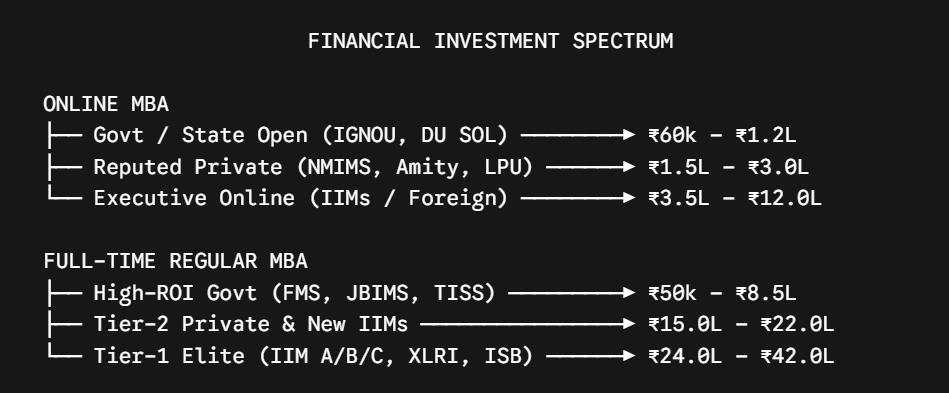
MBA Fee Tiers: Online vs. Full-Time (2026 Batch)
1. Government & State Universities
- Online MBA Fees (e.g., IGNOU, DU SOL, Jamia): ₹60,000 – ₹1,20,000 total. Offers the lowest cost path to a UGC-DEB recognized degree, making it ideal for government job eligibility, promotional cadres, or foundational business knowledge.
- Full-Time Government (e.g., FMS, DSE, SIMSREE): ₹50,000 – ₹3,00,000 total. Highly competitive entrance route delivering top-tier campus placement packages (~₹13 LPA to ₹34 LPA) for a minimal fee outlay.
2. Established Private Universities & B-Schools
- Online MBA (e.g., NMIMS CDOE, Symbiosis SSODL, LPU, Amity): ₹1,50,000 – ₹3,00,000 total. Provides structured learning management systems (LMS), live/recorded lectures, virtual job portals, and flexible online proctored exams.
- Full-Time Private (e.g., SIBM Pune, NMIMS Mumbai, IMT Ghaziabad): ₹18,00,000 – ₹27,00,000 total. High capital investment requiring upfront tuition plus city living expenses, balanced by direct access to tier-1 campus placement drives.
3. Premium / Executive Level
- Online/Hybrid Executive Tracks (e.g., IIM Kozhikode EPGP, IIM Lucknow Direct-to-Device): ₹3,50,000 – ₹12,00,000. Targets working professionals with 3+ years of experience who want an elite brand tag without leaving their jobs.
- Full-Time Tier-1 Flagship (e.g., IIM A/B/C, XLRI, ISB): ₹24,00,000 – ₹42,00,000. The most expensive management track in India, built for high-stakes career switches into global management consulting, investment banking, and executive leadership roles.
Hidden Costs & Financing Mechanics
- Loan Accessibility:
- Full-Time MBA: Nationalized banks offer collateral-free education loans up to ₹40 Lakhs for Premier List institutes (covering tuition, hostel, and laptop costs).
- Online MBA: Traditional education loans are rarely granted for online tracks. Instead, universities partner with NBFCs to offer no-cost monthly EMI options (e.g., ₹8,000 to ₹15,000/month) spread across 12 to 24 months.
- Technology Overhead: Online MBA students must budget for a reliable laptop, high-speed broadband, and webcams for remote proctored examinations (adding ~₹30,000 to ₹50,000 if not already owned).
Verdict: Which Format Maximizes Your Return?
- Choose an Online MBA if: You are currently employed earning a stable salary, want to accelerate promotions or switch internal functions, need a UGC-DEB valid degree for higher education/PSU criteria, or cannot afford to take on a ₹15+ Lakh loan debt.
- Choose a Full-Time MBA if: You are a fresher or early-career professional (0–2 years) seeking a major industry pivot, need campus recruitment support, and want an immersive peer network and campus experience.
Frequently Asked Questions
What is the average cost of pursuing an MBA in India in 2026?
The average total cost varies significantly across tiers. Top-tier private B-schools and IIMs range between ₹18 Lakhs and ₹28 Lakhs. Tier-2 private institutions typically charge ₹12 Lakhs to ₹18 Lakhs, whereas government universities (like FMS Delhi or DSE) offer MBAs under ₹2.5 Lakhs.
Which top MBA colleges in India offer the highest Return on Investment (ROI)?
Government management institutions deliver the highest financial ROI due to low tuition and high placement figures. FMS Delhi stands out with a 2-year fee of ~₹2.43 Lakhs and average packages exceeding ₹34 LPA. Other exceptional high-ROI options include SIMSREE, TISS Mumbai, DFS, and DSE.
Are hostel and food charges included in the published MBA fee structure?
It depends on the institution. Residential programs like the IIMs usually include hostel accommodation within the overall program fee, though mess charges and personal expenses are billed separately. Tier-2 and Tier-3 private B-schools often quote academic tuition separately, adding ₹1.5 L to ₹2.5 L annually for room and dining.
How can I get a collateral-free education loan for an MBA?
Leading nationalized and private banks (such as SBI, HDFC Credila, and ICICI) offer collateral-free loans from ₹20 L to ₹50 lakh for candidates admitted to Tier-1 and top Tier-2 institutes (“Premier List”). Approval relies primarily on the institute’s ranking, admission letter, and future earning potential rather than family collateral.
What is the fee difference between a 1-year and a 2-year regular MBA?
Top 1-year regular MBAs (like ISB or IIM PGPX) cost ₹22 Lakhs to ₹41+ Lakhs, similar to or higher than 2-year MBAs, because they condense equal academic credits, global immersion modules, and senior-level placement drives into 12 intensive months. They also require 2 to 5 years of mandatory work experience.
Why is an Online MBA significantly cheaper than a Regular MBA?
Online MBAs (ranging from ₹60,000 to ₹3 Lakhs) eliminate physical campus overheads, residential housing, land upkeep, and daily on-campus operational costs. Furthermore, because online students retain their full-time jobs, they face zero opportunity cost (no lost salary over two years).
Are there hidden expenses in MBA college fees that I should budget for?
Yes. Beyond the base tuition fee, students should budget for one-time caution deposits (₹20k–₹50k), exam fees, laptop and analytical software tools, global immersion flight charges, placement cell registration fees, and routine living/travel expenses, which typically add ₹1 Lakh to ₹2.5 Lakhs overall.
Do top B-schools offer scholarships or fee concessions?
Yes. Premier institutes like the IIMs, XLRI, and SPJIMR offer Need-Based Financial Assistance (NBFA) and Merit-cum-Means scholarships that cover 20% to 100% of tuition fees. Additionally, central and state government scholarships cater specifically to reserved categories (SC/ST/OBC-NCL/EWS) and PwD students.