In this article
- 01Integrated MBA vs Regular MBA: Core Differences in Structure and Duration 2026
- 02Integrated MBA vs Regular MBA: Top Colleges, Fees, Placement Comparison
- 03Eligibility Criteria: Integrated MBA After 12th vs Regular MBA After Graduation 2026
- 04Integrated MBA Advantages: Early Start, Seamless Learning, and Cost Benefits 2026
- 05Regular MBA Benefits: Work Experience, Specialization Flexibility, and Networking 2026
- 06Career Opportunities & Salary Prospects: Integrated vs Regular MBA Graduates 2026
- 07Online BBA + MBA vs Regular MBA: Which Path Is Faster and More Flexible 2026?
- 08MBA vs Regular MBA: Which has better ROI?
- 09Frequently Asked Questions
Deciding between a 5-year Integrated MBA right after Class 12 and a traditional 2-year Regular MBA post-graduation is a crucial career crossroads. An Integrated MBA (like the IPM at premier IIMs) locks in a master’s degree early, saving candidates from the high-stakes CAT competition later. Conversely, a Regular MBA allows students to build baseline domain expertise in engineering, commerce, or humanities, often backed by valuable work experience, before entering business school. Both routes open doors to elite corporate roles, but key differences in fee structures, entrance exams, and Return on Investment (ROI) determine which path fits your goals for 2026.
Integrated MBA vs Regular MBA: Core Differences in Structure and Duration 2026
Choosing between an Integrated MBA and a Regular MBA comes down to when you decide to commit to management education. An Integrated MBA (such as the IPM program) spans 5 years, seamlessly combining undergraduate foundational studies with advanced postgraduate business coursework immediately after Class 12. In contrast, a Regular MBA is a 2-year dedicated master’s program undertaken after completing a separate 3- or 4-year bachelor’s degree.
| Feature | Integrated MBA (5-Year IPM / Dual Degree) | Regular MBA (2-Year Postgraduate) |
| Duration | 5 Years (10 Semesters continuous) | 2 Years (4 Semesters post-graduation) |
| Entry Point | Directly after Class 12 / Higher Secondary (10+2) | After completing a Bachelor’s Degree (10+2+3 or 10+2+4) |
| Work Experience | Not Required (Designed for high school graduates) | Optional to Preferred (Freshers or candidates with 1–5 years experience) |
| Curriculum Progression | Progressive: Years 1–3 focus on undergraduate humanities, analytics, and basic management; Years 4–5 merge directly into advanced PGP core and electives. | Intensive: Covers core management disciplines (Finance, Marketing, Ops) from Term 1, followed by specialized electives in Year 2. |
| Academic Target Audience | School-leavers (ages 17–18) seeking an early, guaranteed management trajectory. | University graduates & working professionals looking to pivot careers or accelerate managerial growth. |
| Degree Awarded | Dual Degree (BBA + MBA / BA in Management + MBA) or single consolidated Master’s | Master of Business Administration (MBA) or Post Graduate Diploma in Management (PGDM) |
Also Read: Online vs Regular MBA India 2026: Value, Career Outcomes, Fees & Flexibility
Integrated MBA vs Regular MBA: Top Colleges, Fees, Placement Comparison
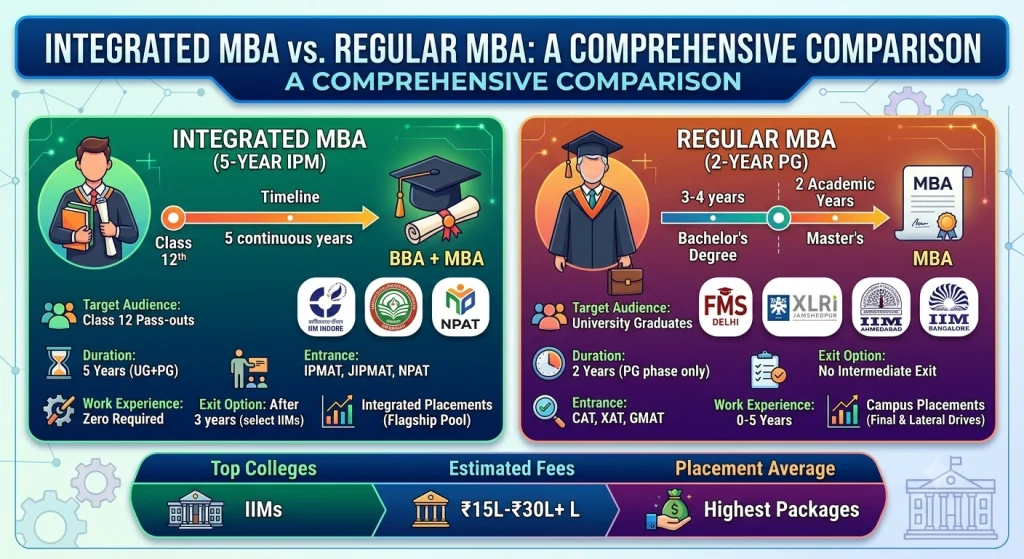
Choosing between an Integrated MBA (5-year BBA+MBA/IPM) and a Regular MBA (2-year PG following a bachelor’s degree) comes down to career clarity, total financial commitment, and entrance exam timing.
An Integrated MBA secures a master’s degree directly after Class 12, whereas a Regular MBA requires completing a 3- to 4-year undergraduate degree before sitting for graduate entrance exams.
Top Colleges, Entrance Exams & Fee Structure Comparison
At IIMs offering IPM (Indore, Rohtak, Ranchi, Jammu, Bodh Gaya), the first 3 years cover undergraduate foundational courses, while Years 4 and 5 match the fee and curriculum of the flagship 2-year Post Graduate Programme (PGP).
| College / Institution | Program Type | Entrance Exam Accepted | Total Program Fee (Approx) |
| IIM Indore | Integrated MBA (IPM) | IPMAT (Indore) | ₹35.00 Lakhs – ₹40.00 Lakhs |
| IIM Rohtak | Integrated MBA (IPM) | IPMAT (Rohtak) | ₹34.00 Lakhs – ₹38.95 Lakhs |
| IIM Ranchi | Integrated MBA (IPM) | IPMAT (Indore) | ₹33.00 Lakhs – ₹35.00 Lakhs |
| IIM Jammu / Bodh Gaya | Integrated MBA (IPM) | JIPMAT | ₹30.00 Lakhs – ₹34.00 Lakhs |
| IIFT Kakinada | Integrated MBA (IPM) | IPMAT (Indore) | ₹29.00 Lakhs – ₹32.00 Lakhs |
| NMIMS Mumbai / Nirma | Integrated BBA + MBA | NPAT / IPMAT | ₹18.00 Lakhs – ₹25.00 Lakhs |
| IIM Ahmedabad / Bangalore / Calcutta | Regular MBA (PGP) | CAT | ₹24.00 Lakhs – ₹27.00 Lakhs |
| XLRI Jamshedpur | Regular MBA (PGDM) | XAT | ₹28.00 Lakhs – ₹30.00 Lakhs |
| FMS Delhi | Regular MBA | CAT | ₹2.00 Lakhs (High ROI) |
| SPJIMR Mumbai | Regular PGDM | CAT / GMAT | ₹22.00 Lakhs – ₹24.00 Lakhs |
Also Read: MBA After Engineering: Benefits, Specializations, and Career Outlook 2026
Placement Performance & Career Outcomes
In institutions like IIM Indore and IIM Rohtak, 5th-year Integrated MBA students compete in the exact same placement process alongside the 2-year Regular MBA (PGP) cohort. Recruiters evaluate both groups for identical corporate roles in Consulting, Finance, Product Management, and Marketing.
| Placement Metric | Integrated MBA (IIM IPM Final Year) | Regular MBA (Top Tier-1 IIMs / XLRI) | Regular MBA (Baby/New IIMs & Tier-2) |
| Average CTC (IIM Indore) | ₹29.57 LPA | ₹33.00 LPA – ₹35.00 LPA (IIM A/B/C) | ₹16.00 LPA – ₹20.00 LPA |
| Median CTC (IIM Indore) | ₹27.00 LPA | ₹31.00 LPA – ₹33.00 LPA | ₹15.00 LPA – ₹18.00 LPA |
| Average CTC (IIM Rohtak) | ₹20.30 LPA | — | — |
| Highest Domestic CTC | ₹48.25 LPA – ₹70.00 LPA | ₹1.00 Crore+ (International / Product) | ₹30.00 LPA – ₹45.00 LPA |
| Top Recruiter Profile | BCG, Goldman Sachs, McKinsey, Amazon, Deloitte | MBB Consulting, Investment Banking, FMCG Leadership | Big 4, IT Services, Banking, Telecom |
Eligibility Criteria: Integrated MBA After 12th vs Regular MBA After Graduation 2026
Understanding the eligibility criteria for an integrated MBA after 12th grade versus a regular MBA after graduation helps you plan your academic path effectively. The primary distinction lies in the academic stage at which you apply, with different requirements for each.
- Integrated MBA after 12th: Class 12 completion, minimum 50% marks, entrance tests.
- Regular MBA eligibility: Undergraduate degree (BBA, B.Com, or BA (Economics)).
- Integrated MBA eligible streams: Commerce, Science and Arts.
- Integrated MBA minimum 12th percentage: 50% to 60%.
- Integrated MBA mandatory 12th subject: English.
- Integrated MBA admission route: Entrance exam, merit, interview or university process.
You must complete Class 12 with at least 50% marks and pass an entrance test for an integrated MBA. In contrast, you need an undergraduate degree before applying for a regular MBA after graduation.
| Integrated MBA Popular Entrance Exams |
| IPMAT |
| JIPMAT |
| CUET |
| NPAT |
| University-level tests |
Several popular entrance exams, including IPMAT and CUET, support admission to the integrated MBA program. These tests are crucial for securing a spot in your desired program.
Integrated MBA Advantages: Early Start, Seamless Learning, and Cost Benefits 2026
The integrated MBA offers a streamlined path to a management degree, saving you valuable time compared to traditional programs. This five-year structure combines undergraduate and postgraduate studies, providing a smooth educational journey.
- Integrated MBA duration: five years
- Time saved: an entire year
- Structure: five-year undergraduate and postgraduate degree
- Admission eligibility: Class 12 or equivalent education
- Admission exams: Integrated Programme in Management Aptitude Test (IPMAT)
- Admission consideration: Class 12 marks
You can save up to a year with this efficient program. The Integrated BBA MBA Course, which was published on May 6, 2026, is a five-year, full-time program divided into ten semesters. For eligibility, you need 50% to 60% in your 12th-grade board examinations.
Regular MBA Benefits: Work Experience, Specialization Flexibility, and Networking 2026
A regular MBA offers strong entry-level placement advantages, particularly for fresh graduates aiming for roles in consulting, FMCG, banking, or corporate leadership. This structured learning experience provides face-to-face interaction with faculty, live case studies, and solid peer networking.
- Learning Experience: Face-to-face interaction with faculty, live case studies, and simulations.
- Networking & Industry Exposure: Attend corporate seminars, participate in internships, build alumni networks.
- Placement Support: Dedicated placement cells, campus recruitment drives, industry tie-ups.
- Target Roles: Consulting, FMCG, banking, or corporate leadership.
- Average Salary (Tier 1 & 2, 2026): ₹6–12 LPA.
- Top Colleges Salary (2026): ₹15–25 LPA.
The employability rate for MBA graduates in India was 71 percent in 2024, with an average base salary of ₹9,93,000. Employers highly value interpersonal, communication, leadership, and strategic thinking skills in these graduates.
| Factor | MBA Advantage |
| Career Shift | High |
| Salary Boost | Strong |
| Leadership Roles | Fast-track |
| Networking | Excellent |
An MBA offers significant advantages for career shifts, salary boosts, and faster entry into leadership roles, alongside excellent networking opportunities.
Career Opportunities & Salary Prospects: Integrated vs Regular MBA Graduates 2026
Integrated MBA graduates often see 25–30% higher starting salaries compared to those with separate BBA and MBA degrees. This section explores the salary prospects and career trajectories for graduates of integrated, regular, and online MBA programs, with projections for 2026.
| Program Type | Average salary | Top colleges |
| Regular MBA (Tier 1 & Tier 2 Colleges) | ₹6–12 LPA | ₹15–25 LPA |
| Online MBA (Freshers) | ₹3–6 LPA | None |
| Online MBA (Working Professionals) | 20–40% salary hike possible depending on role | None |
| Salary & Career Impact (2026): Online MBA | ₹4-10 LPA (mid-career upgrade) | Fastest growth for working professionals (300% over 7 years) |
| Salary & Career Impact (2026): Regular MBA | ₹6-18 LPA (top institutions higher) | Steeper initial growth due to structured placements (275% over 7 years) |
- Integrated MBA starting salary (India): ₹6–10 LPA
- Integrated MBA starting salary with internships/global certifications: ₹12–15 LPA
- Integrated MBA mid-career salary (5–8 years): ₹20 LPA +
- Online MBA (Working Professionals) growth trajectory: 300% over 7 years
- Regular MBA growth trajectory: 275% over 7 years
Online BBA + MBA vs Regular MBA: Which Path Is Faster and More Flexible 2026?
Choosing between an online BBA + online MBA and a regular MBA involves weighing factors like duration, flexibility, and career prospects. The integrated MBA vs regular MBA path offers significant time savings and a fully online learning experience, making it an attractive option for many.
| Factor | Regular MBA | BBA + MBA (Online) |
| Time Required for Completion | A bachelor’s degree takes three years. A separate MBA takes two more years. The total duration is five years. After completing the bachelor’s degree, students must undergo a separate admission process for an MBA. | The program is 4.5 years long, saving six months compared to a regular MBA. Students do not need to apply separately for the MBA. The transition from undergraduate to postgraduate level is smooth. |
| Study Flexibility and Learning Mode | Requires attending physical classes. Students follow a fixed schedule. Course materials are mostly textbooks and classroom lectures. There is no option for self-paced learning. | 100% online learning. Students can study at their own pace. Learning materials include ebooks, audiobooks, videos, and library resources. Suitable for new graduates and working professionals. |
| Career Growth and Job Readiness | Focuses on theoretical knowledge. Most students need to search for internships separately. Placement opportunities depend on the campus recruitment process. | Includes a corporate internship as part of the course. Provides placement assistance through 500+ hiring partners. Students graduate with both theoretical and practical knowledge. |
| Cost and Financial Investment | Students pay separately for both degrees. The total cost is usually high. There are no combined EMI options for tuition fees. | Lower tuition cost than pursuing two separate degrees. The zero-cost EMI option is available at ₹14,409 per month. Scholarships are available for eligible students. |
| Global Recognition and Accreditation | While regular MBA programs are usually well-recognised and accredited, online courses lack this recognition. | Amity University Online is ranked among the Top 10 in the Asia Pacific by QS, 2024. The program is: UGC-approved, AICTE-recognised, WES-accredited (Canada), Ranked in the top 3% globally. A degree from Amity University Online is globally recognised, helping students build international careers. |
| Admission Process | Students must first complete a bachelor’s degree. They must prepare for and pass entrance exams. They must apply separately for MBA admission. Some universities require work experience for MBA admissions. | One-time admission for the entire program. There is no need to apply separately for an MBA. Open to fresh graduates, working professionals, and entrepreneurs. Simple eligibility criteria: Graduation with 40% marks (test required if marks are below 40%). English language proficiency is required. |
| Career Specialisations and Growth Opportunities | Students choose specialisations after completing a bachelor’s degree. Specialisation choices depend on the university’s offerings. | The program includes both foundational and advanced business knowledge. Specialisation options are available in Finance, Marketing, Sales, Operations, Logistics, and more. |
MBA vs Regular MBA: Which has better ROI?
Determining whether an Integrated MBA or a Regular MBA yields a superior Return on Investment (ROI) depends on total tuition outlay, opportunity costs, and the institute’s placement trajectory. Calculating direct academic ROI relies on the standard metric.
| Metric / Parameter | Integrated MBA (IIM IPM Route) | Regular MBA (Top IIMs: A/B/C) | Regular MBA (Public: FMS / JBIMS) |
| Total Program Fee | ₹30.00 Lakhs – ₹40.00 Lakhs | ₹24.00 Lakhs – ₹27.00 Lakhs | ₹2.00 Lakhs – ₹6.00 Lakhs |
| Undergraduate Fee | Included in 5-year fee | ₹2.00 Lakhs – ₹10.00 Lakhs | ₹1.00 Lakhs – ₹5.00 Lakhs |
| Average Annual Starting CTC | ₹20.00 LPA – ₹29.50 LPA | ₹32.00 LPA – ₹35.00 LPA | ₹28.00 LPA – ₹34.10 LPA |
| Direct Tuition ROI | ~65% – 75% | ~120% – 140% | ~500% – 1700% |
| Estimated Payback Period | 1.3 to 1.6 Years | 0.8 to 1.0 Years | 0.1 to 0.3 Years |
| Pre-MBA Salary Foregone | ₹0 (Enters directly after 12th) | ₹10.00 L – ₹25.00 L (2 yrs work exp) | ₹10.00 L – ₹25.00 L (2 yrs work exp) |
Detailed ROI Drivers & Analysis
- Financial Outlay vs. Starting Pay
- Regular MBA (Edge in Tier-1 & Public B-Schools): Regular MBA programs at top institutes yield higher immediate ROI due to lower baseline fees relative to starting packages. Central institutions like FMS Delhi and JBIMS offer unmatched ROI ratios ($\ge 500\%$) because tuition is heavily subsidized while final campus placements match premier IIM levels.
- Integrated MBA (Longer Amortization): The Integrated IPM route requires paying 5 full years of fees upfront. While the final placement salary matches regular PGP candidates at IIM Indore or Rohtak, the combined 5-year tuition outlay inflates total investment, resulting in a lower direct tuition ROI (~65%–75%).
- The Opportunity Cost & Early Career Advantage
- Integrated MBA Edge: Eliminates post-graduation unemployment risk and saves 1–2 years typically spent preparing for CAT/XAT or attempting re-takes. Candidates enter the workforce earning tier-1 managerial salaries by age 22–23.
- Regular MBA Edge: Candidates who work for 2–3 years before a Regular MBA accumulate prior earnings ($\approx \text{₹12L–₹20L}$ cumulative) to offset educational loan burdens, though they forgo two years of active salary during their PG study window.
- Long-Term Career Trajectory
- Lateral Hiring Advantage: Regular MBA graduates with prior industry experience often secure higher mid-level corporate positions (Senior Consultant, Lead Product Manager) right after placement.
- Compounded Early Earnings: Integrated MBA graduates gain a 2- to 3-year head start in tier-1 corporate roles, enabling faster mid-career promotions that offset the lower initial tuition ROI by age 30.
Frequently Asked Questions
What Is the Core Difference Between an Integrated MBA and a Regular MBA?
An Integrated MBA is a 4-year program pursued directly after school, while a Regular MBA is a 2-year postgraduate program requiring a prior Bachelor’s degree.
What Are the Career Outcomes and Job Prospects After an Integrated MBA?
Integrated MBA graduates pursue roles like marketing managers, brand managers, or advertising executives in sectors including banking, consulting, FMCG, and IT.
Can I Switch from a Regular MBA to an Integrated MBA Program?
Switching from a Regular MBA to an Integrated MBA is generally not possible. Integrated MBAs are typically four-year programs, while Regular MBAs are two-year postgraduate degrees.
What Is the Typical Application Timeline for Integrated MBA Programs?
Integrated MBA applications typically open in April and close in May, unlike regular MBA programs with rounds in September, January, and March.
Is an Integrated MBA More Beneficial for Fresh Graduates?
Yes, an Integrated MBA can be more beneficial for fresh graduates, offering faster career prospects and saving one year compared to two separate degrees.
Is AICTE Approval Necessary for MBA?
No, AICTE approval is not necessary for university-approved MBA programs, including online MBAs, as ruled by the Supreme Court. It is required for non-university institutes.