In this article
- 01What Does UGC Approval Mean for an Online Degree in India?
- 02How to Verify a University’s UGC-DEB Approval Yourself (2-Minute Check)?
- 03How to Spot a Fake or Unrecognized “Online Degree”?
- 04UGC-Entitled Online Programmes for July 2026: What the Official List Shows
- 05Best Online Universities for a Bachelor’s Degree in India
- 06Best Online Universities & Colleges for a Master’s Degree in India
- 07UGC Approved Online Degrees in India: Equivalence & Guidelines 2026
- 08Benefits of Online Degrees for Working Professionals
- 09Online vs. Distance vs. Regular Degree- What’s the Real Difference?
- 10Frequently Asked Questions
An online degree in India is valid only when the university is entitled by the University Grants Commission (UGC) to run that specific programme online, for the session you join. For the July 2026 session, the UGC Distance Education Bureau (UGC-DEB) lists 986 online programmes at 145 universities. This guide explains what UGC approval covers, how to check a programme yourself on the UGC-DEB portal, which universities and programmes are on the current list, and how online, distance and regular degrees compare.
What Does UGC Approval Mean for an Online Degree in India?
UGC does not accredit universities; NAAC does. What UGC gives is entitlement or recognition to offer a named programme in online mode for a given academic session. That approval is what makes an online degree legally equivalent to a campus degree.
The UGC-DEB Framework Explained
- The Regulatory Bodies: While the University Grants Commission (UGC) sets overall standards for higher education, its specialized vertical, the Distance Education Bureau (DEB), specifically monitors, approves, and regulates all Online Learning (OL) and Open Distance Learning (ODL) programs across Indian universities.
- Legal Equivalence Mandate: Under official UGC regulations, degrees awarded through online mode from UGC-DEB-recognized universities carry 100% legal parity with conventional campus degrees. This explicitly makes online degree holders eligible for central and state government jobs, public sector unit (PSU) recruitment, UPSC/State PSC exams, and higher education both in India and abroad.
Institutional vs. Programmatic Approval (The Critical Distinction)
Many prospective students fall into the trap of assuming that if a university is UGC-recognized, all of its online programs are automatically valid. This is untrue:
- Institutional Recognition: Means the overall university is recognized by the UGC to operate as an institution.
- Programmatic Entitlement: Means the university has received explicit session-by-session approval from the DEB to deliver a specific degree online (e.g., Online MBA or Online BCA). An institution might be permitted to offer an Online B.Com but completely unapproved to offer an Online MCA.
NAAC and NIRF Conditions for Offering Online Programmes
Under UGC guidelines, universities must meet strict quality thresholds to offer online programs. They usually qualify via two routes:
- Entitled category: Under the UGC (Open and Distance Learning Programmes and Online Programmes) Regulations, 2020, a university with a NAAC score of 3.26 or above, or a top-100 rank in the NIRF university category at least twice in the three preceding cycles, may start online programmes without prior UGC approval. It can run up to three UG and ten PG programmes this way, and must stop admitting if it no longer meets the condition.
- Prior approval route: Universities with a NAAC score between 3.01 and 3.25 can offer online programmes only after UGC approves each programme.
Also Read: Online MBA Validity in India 2026: Recognition, Approvals & Career Value
How to Verify a University’s UGC-DEB Approval Yourself (2-Minute Check)?
Never rely solely on a university counselor’s claims or a website banner. Follow this 4-step self-verification process on the official government portal before paying any admission or registration fees.
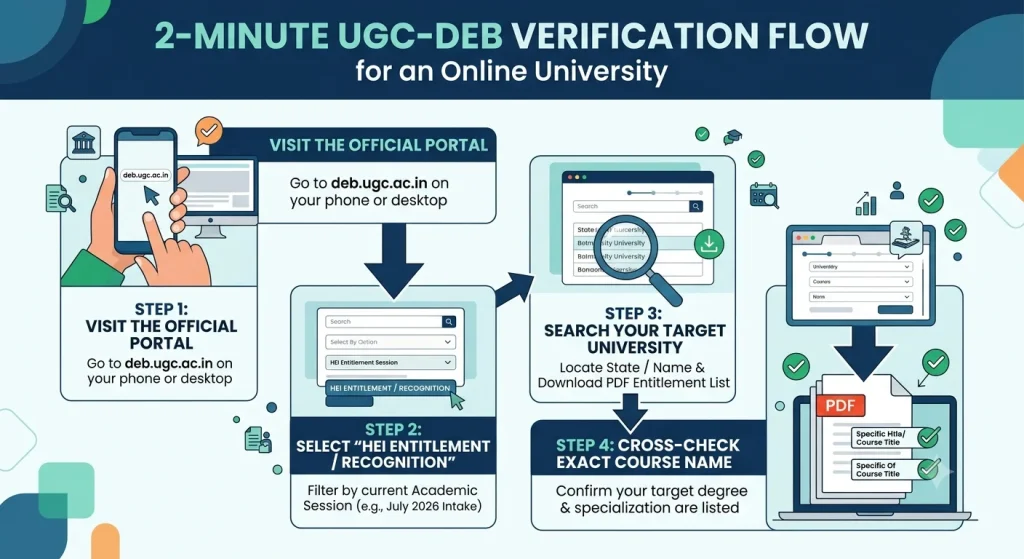
Step 1: Access the Official UGC-DEB Portal
Open your browser and navigate directly to deb.ugc.ac.in. Avoid third-party education portals or aggregator sites when performing this check.
Step 2: Navigate to Student Corner / Recognized HEIs
Click on the “HEI Entitlement/Recognition Status” tab on the homepage. Select the current academic year and session (e.g., July 2026 Intake or 2025–2026 Session).
Step 3: Locate the University and Download the Entitlement List
Search by state or university type (Central, State, Deemed, or Private). Click on your target university to open its official UGC entitlement notification PDF.
Step 4: Verify the Exact Program Name & Territorial Jurisdiction
- Check if your specific degree (e.g., Master of Business Administration or Bachelor of Computer Applications) is explicitly listed in the table of approved courses.
- Check the Territorial Jurisdiction notes, online programs are delivered nationally/internationally, but the university’s operating headquarters must match its recognized address.
Red flag: If a university says its approval is “under process” or “applied for”, or cannot show the programme on the UGC-DEB list for your session, do not enrol. A degree from a session the programme was not approved for is not recognised.
How to Spot a Fake or Unrecognized “Online Degree”?
With the rapid expansion of digital higher education in India, fraudulent institutions, misleading aggregators, and unapproved academies actively target unsuspecting students. Enrolling in an unrecognized online program wastes money and leaves you with an invalid qualification that employers, government bodies, and foreign universities will reject.
1. Major Red Flags of Unrecognized Online Degrees
| Warning Sign | What It Means | Correct UGC / Govt Benchmark |
| Bypassing ABC ID & DEB ID | The university does not require you to create a 12-digit ABC ID on DigiLocker or a DEB ID on deb.ugc.ac.in. | Mandatory for all online degree enrollments in India. No DEB ID = legally invalid admission. |
| Offering Banned Online Degrees | The platform advertises online programs in B.Tech/M.Tech, LL.B, Pharmacy, Nursing, MBBS, Agriculture, or Ph.D. | UGC strictly prohibits professional, clinical, and lab-intensive programs in online mode. |
| “Fast-Track” or Accelerated Duration | Claims you can complete a 2-year MBA in 6 months or a 3-year BBA in 1 year (“10-Day MBA” or “Fast-Track Degrees”). | UGC mandates standard academic timelines: 3–4 years for UG and 2 years for PG degrees. |
| Absence of a Formal LMS | Study materials are distributed via shared Google Drive links, WhatsApp, or basic emails rather than a proctored portal. | Legitimate universities deliver courses through a 4-Quadrant LMS with live/recorded classes, e-content, and proctored exams. |
| “Foreign University Affiliation” Loophole | The institution claims to award an online degree from an unaccredited overseas “institute” without AIU / UGC equivalence. | Online foreign degrees must hold recognized accreditation in their home country and AIU equivalence in India. |
| No Official UGC-DEB Listing | Searching the university or course on deb.ugc.ac.in yields no results for the current academic session. | Every online university must be listed on the official UGC-DEB portal with session-specific entitlement. |
2. Common Deceptive Tactics Used by Scammers
A. Misleading Nomenclature & Fake Abbreviations
Fraudulent entities often create course titles that closely mimic recognized higher education degrees—such as “PGP in Management (Online MBA Equivalent)”, “Executive Doctorate”, or “10-Day MBA”. Unless the final degree certificate explicitly awards an MBA, M.Sc, MCA, BBA, or BCA conferred by a UGC-recognized university, it is merely an unaccredited private diploma.
B. Misrepresenting “UGC Approval”
A common scam involves showing an old, expired UGC approval letter or claiming overall institutional recognition while hiding the fact that their online learning (OL) wing lacks DEB entitlement. Always verify that the university is entitled specifically for online delivery in the current session.
C. Third-Party Agent Fee Collections
Genuine universities process tuition payments strictly through official website domains (.ac.in or .edu.in) and integrated bank payment gateways. Never transfer money into personal UPI IDs, bank accounts of third-party admission agents, or unverified educational consulting portals.
3. UGC Action & Official Whistleblower Channels
The University Grants Commission regularly updates its official List of Fake Universities and issues public alerts against unauthorized online entities.
- Check the UGC Fake University List: Before applying, cross-check the official list published on the UGC portal (ugc.gov.in) to ensure your target institution is not flagged.
- Report Suspicious Platforms: If you encounter an entity selling fast-track online degrees, report them directly to the UGC e-Samadhan Portal (samadhan.ugc.ac.in), the National Consumer Helpline (1915), or the National Cyber Crime Reporting Portal (cybercrime.gov.in).
UGC-Entitled Online Programmes for July 2026: What the Official List Shows
The UGC-DEB portal publishes every programme a university may run in online or distance mode, by session. For the July 2026 session it lists 986 online programmes (658 postgraduate and 323 undergraduate) at 145 universities. Figures below are from the UGC-DEB programme list, checked on 14 October 2026.
Universities Entitled to Offer Online Programmes, by Type
| University type | Universities with online programmes (July 2026) |
|---|---|
| Private University | 54 |
| Deemed University | 44 |
| State University | 33 |
| Central University | 8 |
| State Open University | 5 |
| Central Open University | 1 |
Most Offered Online Degrees
| Degree | Online programmes listed (July 2026) |
|---|---|
| Master of Arts | 244 |
| Master of Business Administration | 169 |
| Bachelor of Business Administration | 99 |
| Master of Computer Applications | 87 |
| Bachelor of Commerce | 80 |
| Bachelor of Computer Applications | 72 |
| Master of Commerce | 65 |
| Master of Science | 59 |
| Bachelor of Arts | 51 |
Each specialisation is counted as a separate programme, so an MA in English and an MA in Economics at the same university count as two.
Best Online Universities for a Bachelor’s Degree in India
Pursuing an online undergraduate degree (BBA, BCA, B.Com, B.A., or B.Sc) provides fresh school graduates and working diploma holders with flexibility, lower education costs, and early corporate exposure. Selecting the right institution ensures your 3-to-4-year degree aligns with NEP 2020 guidelines, offers robust technical foundation building, and carries official recognition for government job eligibility and postgraduate entry.
Top Universities for Online Undergraduate (UG) Programs
| University | Listed for (July 2026) | Total online programmes listed |
|---|---|---|
| Amity University | BBA, BCA, B.Com, BA | 27 |
| Manipal University Jaipur | BBA, BCA, B.Com | 9 |
| Lovely Professional University | BBA, BCA, BA | 13 |
| Chandigarh University | BBA, BCA, BA | 10 |
| JAIN (Deemed-to-be University) | BBA, BCA, B.Com | 11 |
| IGNOU | BCA, B.Com | 16 |
Source: UGC-DEB programme list for the July 2026 session, checked 14 October 2026. Fees change every intake, so confirm them on each university’s official website.
Key UG Selection Criteria
- 4-Year UG Honors Provision: Confirm that the university supports the 4-year undergraduate honors track with research options under NEP 2020.
- Practical Learning Tools: For IT and business streams (BCA/BBA), ensure the LMS incorporates lab environments, software tools (Excel, SQL, Python), and real-world case studies.
- Credit Mobility via ABC ID: Ensure earned credits are deposited directly to your Academic Bank of Credits (ABC) portal for future credit transfers or postgraduate admissions.
Best Online Universities & Colleges for a Master’s Degree in India
An online Master’s degree (MBA, MCA, M.Com, M.A., or M.Sc) is designed primarily for working professionals seeking promotions, lateral career transitions, or higher specialized skills without pausing full-time employment. Evaluating PG institutions requires looking beyond baseline approvals to scrutinize corporate partner networks, specialization depth, and long-term ROI.
Top Universities for Online Postgraduate (PG) Programs
| University | Listed for (July 2026) | Total online programmes listed |
|---|---|---|
| SVKM’s NMIMS | MBA | 4 |
| Manipal Academy of Higher Education | MBA, MCA, M.Sc | 10 |
| Amity University | MBA, MCA, M.Com, MA, M.Sc | 27 |
| Dr. D.Y. Patil Vidyapeeth | MBA, MCA | 5 |
| UPES | MBA, MCA | 9 |
| Lovely Professional University | MBA, MCA, M.Com, MA, M.Sc | 13 |
| IGNOU | MBA, MCA, M.Com, MA | 16 |
| BML Munjal University | MBA | 1 |
Source: UGC-DEB programme list for the July 2026 session, checked 14 October 2026. Fees change every intake, so confirm them on each university’s official website.
BML Munjal University, a Hero Group institution, is on the July 2026 list for one online programme, the MBA. Details are on the BMU Online MBA page.
Key PG Selection Criteria
- Specialization Alignment: Ensure the university offers industry-relevant specializations (e.g., FinTech, Business Analytics, Cybersecurity, AI Management) rather than just general theory tracks.
- Examination Mechanics: Check if semester assessments are 100% remote AI-proctored with slot booking options to avoid conflict with work hours.
- Lateral Salary & Career Outcomes: Evaluate whether the institution provides active career support, such as resume building, mock interviews, and access to private recruiter network portals, to facilitate post-degree salary hikes.
UGC Approved Online Degrees in India: Equivalence & Guidelines 2026
The regulatory framework surrounding online higher education in India guarantees complete legal legitimacy for students pursuing degrees online. Governed by the University Grants Commission (UGC) and its Distance Education Bureau (DEB), these mandates ensure that online qualifications are treated with the same academic and professional respect as traditional on-campus degrees.
1. The Legal Equivalence Mandate (Regulation 22)
The cornerstone of online degree validity in India rests on Regulation 22 of the UGC (Open and Distance Learning Programmes and Online Programmes) Regulations.
- Equal Academic Standing: Undergraduate and postgraduate degrees—as well as PG diplomas, awarded by recognized Higher Educational Institutions (HEIs) through online mode are legally equivalent to corresponding degrees earned through conventional campus programs.
- Universal Recognition: An online degree from a UGC-DEB-entitled university fulfills basic educational eligibility for:
- Central & State Government Jobs: Civil Services (UPSC), Staff Selection Commission (SSC), Banking (IBPS/SBI), Railways, and Defense exams.
- Higher Education Admissions: Master’s degrees, Ph.D. entrance tests, NET/SET lectureship exams, and GATE.
- Private Corporate Employment: Corporate roles across Indian and multinational corporations (MNCs).
2. Essential UGC Compliance Guidelines for 2026 Learners
To ensure your degree remains valid and eligible for credit transfers under the National Education Policy (NEP 2020), every student must adhere to the current compliance framework:
A. Mandatory DEB ID & ABC ID Integration
- Enrollment in any recognized online program requires creating an Academic Bank of Credits (ABC ID) via DigiLocker and registering on deb.ugc.ac.in to obtain a unique DEB ID.
- Admissions processed without capturing a verified DEB ID are treated as unapproved by the central government.
B. Dual Degree Provision
- Students can legally pursue two academic degrees simultaneously. You can combine:
- One regular on-campus degree + One online degree, OR
- Two online/distance degrees at the same time.
- Condition: Class timings and examination schedules for both programs must not overlap.
C. Multiple Entry & Exit Options (MEES)
- Under NEP 2020 guidelines, online undergraduate students can exit a 3-or-4-year program after Year 1 with an Undergraduate Certificate or after Year 2 with an Undergraduate Diploma.
D. Curricular Parity & SWAYAM Credit Transfers
- Online program syllabi, credit loads, and course outcomes must mirror their physical campus counterparts.
- Universities may let students earn part of their credits through approved SWAYAM courses, within the limit UGC sets for each semester.
Degree Certificate & Marksheet Standards
| Aspect | Regulatory Standard |
| Degree Nomenclature | Degrees carry standard academic titles (e.g., Bachelor of Business Administration, Master of Computer Applications) conforming to the UGC Specification of Degrees. |
| Delivery Mode Mention | Certifications state the mode of delivery (Online Learning) in compliance with UGC reporting rules, but explicitly retain equal legal status as per Regulation 22. |
| Transcript Validity | Official marksheets and digital certificates are issued directly to your DigiLocker repository, enabling instant employer background verification. |
Benefits of Online Degrees for Working Professionals
- No career break: classes and exams are scheduled around work, so you keep your job and income while you study.
- Lower total cost: there are no hostel, relocation or commuting costs, though tuition varies widely between universities.
- Same legal standing: under Regulation 22, a UGC-approved online degree is equivalent to the same degree earned on campus.
- Location-independent: online programmes are delivered nationally, so where you live does not limit which university you choose.
- Recorded content: lectures and study material stay available on the university’s learning platform for revision.
Online vs. Distance vs. Regular Degree- What’s the Real Difference?
Understanding the distinction between Regular (Conventional), Open & Distance Learning (ODL), and Online Learning (OL) is critical when choosing a degree program in India. While the University Grants Commission (UGC) legally places all three modes on equal academic footing under Regulation 22, the daily learning experience, technology stack, fee structures, and corporate perceptions differ significantly.
| Feature / Parameter | Regular (On-Campus) | Distance Learning (ODL) | Online Learning (OL) |
| Primary Delivery Mode | Physical classroom lectures, campus labs, in-person seminars. | Printed Self-Learning Material (SLM) mailed to students; optional weekend contact classes at study centers. | 100% Digital LMS featuring live interactive webinars, recorded video archives, and e-tutorials. |
| Attendance & Location | Mandatory (usually 75% minimum on campus). | Flexible; requires occasional visits to regional Learner Support Centers (LSCs). | 100% remote flexibility; learn from anywhere on laptop or mobile. |
| Learning Materials | Physical textbooks, library access, and classroom hand-outs. | Physical printed modules/books or static PDF downloads. | Interactive 4-Quadrant LMS (E-content, E-tutorials, discussion forums, self-assessments). |
| Examination Format | Physical paper-and-pen exams held on campus. | Offline examinations conducted at designated regional exam centers. | 100% Remote AI-Proctored Exams taken from home or computer-based testing. |
| Faculty & Peer Contact | Daily face-to-face contact; campus events and physical networking. | Minimal; periodic contact during weekend counseling sessions at local study centers. | Regular online interaction via live Q&A sessions, virtual discussion boards, and digital group projects. |
| Average Cost Range | High (Tuition + campus fees + hostel & commuting expenses). | Lowest tuition fees (e.g., IGNOU, State Open Universities). | Moderate to mid-range tuition with zero hostel or travel costs. |
| UGC Legal Equivalence | 100% Recognized. | 100% Equivalent under UGC Regulation 22. | 100% Equivalent under UGC Regulation 22. |
Deep-Dive into the Three Delivery Modes
A. Regular (Conventional On-Campus) Education
- The Experience: Traditional higher education built around physical attendance, campus infrastructure, laboratory sessions, and direct access to university facilities.
- Best Suited For: Fresh high-school graduates seeking a full campus lifecycle, peer networking, hands-on lab work, or degrees in prohibited online fields (e.g., Engineering, Medicine, Law, Pharmacy).
B. Open & Distance Learning (ODL)
- The Experience: Established under open university frameworks (such as IGNOU or State Open Universities). Students receive printed study books by post and complete periodic written assignments. Term-end exams take place at designated local exam centers.
- Best Suited For: Students living in remote areas with limited internet access, government/PSU employees needing basic degree credentials for promotion scales, or budget-conscious candidates.
C. Online Learning (OL)
- The Experience: A digital-first educational ecosystem delivered entirely via modern Learning Management Systems (LMS). It blends synchronous (live classes, guest masterclasses) and asynchronous (recorded videos, e-books, online quizzes) learning. Evaluation includes continuous internal assignments and online proctored exams.
- Best Suited For: Working professionals balancing full-time jobs, candidates pursuing lateral corporate career transitions, tech-savvy learners, and students seeking industry tool certifications alongside academic degrees.
Decision Framework: Which Mode Should You Choose?
- Choose Regular Mode if: You are under 21, pursuing lab-heavy or practical-only fields (e.g., B.Tech, MBBS, LL.B), and require on-campus immersion.
- Choose Distance (ODL) Mode if: You need the absolute lowest tuition cost, reside in a low-bandwidth region without reliable internet, and only require a credential for administrative or government scale promotions.
- Choose Online (OL) Mode if: You are a working professional who wants zero career interruption, desire modern industry skill tracks with job assistance portals, and require total flexibility to attend lectures and take proctored exams from home.
Frequently Asked Questions
1. Can an online degree holder apply for government exams like UPSC, SSC, and Banking?
Yes. Under UGC Regulation 22, online degrees earned from UGC-DEB-approved universities hold 100% legal equivalence to conventional campus degrees. They are fully valid for all central and state government recruitment exams, including UPSC, SSC, IBPS, and State PSCs.
2. How do I create the mandatory ABC ID and DEB ID for online admissions?
Generate your 12-digit Academic Bank of Credits (ABC) ID on DigiLocker using your Aadhaar details. Next, visit deb.ugc.ac.in, enter your ABC ID, verify via Aadhaar OTP, and generate your unique DEB ID required during university application submission.
3. Are online degrees in B.Tech, Law, Pharmacy, or Nursing valid in India?
No. The UGC strictly prohibits professional, clinical, and lab-intensive disciplines in online or distance learning mode. Degrees in B.Tech, M.Tech, LL.B, Pharmacy, Nursing, MBBS, and Agriculture offered online are unapproved, invalid, and unrecognized by statutory regulatory councils.
4. Are online degrees from Indian universities recognized abroad for jobs and higher education?
It depends on the foreign university or employer and the credential evaluator they use. A degree from a UGC-recognised university is the starting point; check the admission or evaluation requirements of the specific country and institution before you enrol.
5. Can I pursue an online degree alongside a full-time regular degree?
Yes. Under UGC guidelines, students can legally pursue two academic degrees simultaneously. You can enroll in one full-time physical on-campus program and one online degree concurrently, provided there is no scheduling conflict in class timings and examination slots.
6. How are semester examinations conducted in an online degree program?
Online programmes use remote, proctored exams taken on the university’s platform, along with continuous assessment such as assignments and quizzes. The weightage between internal assessment and term-end exams varies by university, so check the programme guide.
7. Does an online degree certificate state “Online,” and will it affect corporate hiring?
Under Regulation 22, an online degree from a UGC-recognised university has the same status as the campus degree, whatever the certificate shows about the mode. Employers judge candidates on the degree, the university and their skills.
8. What is the key difference between Open & Distance Learning (ODL) and Online Learning (OL)?
Open & Distance Learning (ODL) relies on printed study modules sent by post and physical exam centers. Online Learning (OL) is completely digital, featuring live webinars, LMS e-content, continuous internal assignments, and remote AI-proctored online exams from home.