In this article
- 01Understanding Online MCA Fees in India 2026: What Makes a Program Affordable?
- 02Essential Regulatory Checks & Eligibility Standards for 2026
- 03Top Cheapest Online MCA Universities in India with Low Fees 2026
- 04High-Demand Online MCA Specializations in 2026
- 05Cheapest Online MCA Career Opportunities, Placement Support & Salary ROI
- 06Kurukshetra University vs Uttaranchal Universitry vs Sikkim Manipal: Affordable Online MCA Fees, Placements, Cirrciculum Comparison
- 07Online MCA Admissions 2026: Important Admission Dates & Process
- 08How to Choose the Best Affordable Online MCA Program in India 2026
- 09Frequently Asked Questions
Pursuing an online Master of Computer Applications in India for 2026 offers complete legal equivalence to regular degrees while significantly reducing financial overhead. Total course fees span from as low as ₹15,000 at IGNOU up to ₹2,50,000 at premium private universities, with high-ROI options like Kurukshetra University charging ₹72,560. Most UGC-DEB-approved institutions provide monthly EMI options starting from ₹2,500. Tech recruiters prioritize practical coding skills over study mode, resulting in decent placement rates. Starting salary packages typically range from ₹3.50 LPA for freshers to upwards of ₹15.00 LPA for specialized tracks in Cloud Computing, AI, and Cybersecurity.
Understanding Online MCA Fees in India 2026: What Makes a Program Affordable?
Online MCA course fees in India for 2026 range from ₹15,000 to ₹2,50,000, with many affordable online MCA courses in India available. Understanding what influences these costs and where to find budget-friendly options is crucial for prospective students.
The table below outlines 20 top UGC-DEB approved cheapest online MCA programs in India, arranged from ultra-budget public institutions to feature-rich private options.
| S.No. | University Name | NAAC Grade & Approvals | Total Program Fee (Approx. ₹) | Eligibility Criteria Brief | Key Highlight / USP |
| 1. | IGNOU | NAAC A++, UGC-DEB | ₹50,800 | Any Graduate with Math at 10+2/Graduation (or Bridge Course) | Lowest cost in India; nationwide exam center network. |
| 2. | Andhra University Online | NAAC A++, UGC-DEB, AICTE | ₹50,000 – ₹65,000 | BCA/B.Sc/B.Tech or Graduation with Math | Government university degree with ultra-low tuition. |
| 3. | Alagappa University Online | NAAC A+, UGC-DEB, AICTE | ₹60,000 – ₹75,000 | Graduate with Math or CS background | Cost-effective option with state government backing. |
| 4. | Kurukshetra University Online | NAAC A++, UGC-DEB | ₹70,000 – ₹85,000 | Any Graduate with Math at 10+2 or Graduation level | Highly valued for government & PSU job eligibility. |
| 5. | Uttaranchal University Online | NAAC A+, UGC-DEB, AICTE | ₹82,000 – ₹92,000 | BCA/B.Sc (CS/IT) or Any Graduate with Math | Early-bird fee discounts; flexible semester plans. |
| 6. | GLA University Online | NAAC A+, UGC-DEB, AICTE | ₹87,000 – ₹94,000 | Graduation with 50% marks & Math at 10+2 or Grad | Budget-friendly private university with live online sessions. |
| 7. | Sikkim Manipal University (SMU) | NAAC A+, UGC-DEB, AICTE | ₹98,000 – ₹1,10,000 | BCA/B.Sc CS or Any Graduate with Math | Strong technical alumni network and affordable fees. |
| 8. | Lovely Professional University (LPU Online) | NAAC A++, UGC-DEB, AICTE | ₹1,08,800 – ₹1,60,000 (standard vs. discounted) | BCA/B.Sc CS or Any Graduate (Bridge course provided) | Dedicated placement assistance portal and virtual job drives. |
| 9. | Chandigarh University Online | NAAC A+, UGC-DEB, AICTE | ₹1,16,250 – ₹1,55,000 (after early-bird offer) | BCA/B.Sc IT or Any Graduate with Math/Statistics | Flexible No-Cost EMI options and early-bird scholarship schemes. |
| 10. | SRM Institute of Science & Technology Online | NAAC A++, UGC-DEB, AICTE | ₹1,16,250 – ₹1,30,000 | BCA/B.Sc CS or Graduate with Math at 10+2 | Recognized technical brand value in the software industry. |
| 11. | Vignan’s Foundation Online | NAAC A+, UGC-DEB, AICTE | ₹1,10,000 – ₹1,25,000 | Any Graduate with Math at 10+2 or Graduation level | Strong emphasis on core software engineering and cloud fundamentals. |
| 12. | Jain University Online | NAAC A++, UGC-DEB, AICTE | ₹1,20,000 – ₹1,60,000 | BCA/B.Sc CS or Any Graduate with Math | Offers specialized tracks in Data Science, AI, and Full-Stack Development. |
| 13. | Dr. D.Y. Patil Vidyapeeth (DPU) Online | NAAC A++, UGC-DEB, AICTE | ₹1,30,000 – ₹1,50,000 | Graduation with 50% marks & Math at 10+2 | Weekend AI-proctored exams and flexible LMS schedules. |
| 14. | Bharati Vidyapeeth Online | NAAC A+, UGC-DEB, AICTE | ₹1,30,000 – ₹1,45,000 | BCA/B.Sc IT or Graduate with Math/Bridge module | Structured curriculum designed for working IT professionals. |
| 15. | Vivekananda Global University (VGU) | NAAC A+, UGC-DEB, AICTE | ₹1,30,000 – ₹1,50,000 | Any Graduate with 50% aggregate and Math background | Practical project-based learning and software tool training. |
| 16. | Amrita Ahead Online | NAAC A++, UGC-DEB, AICTE | ₹1,40,000 – ₹1,75,000 | BCA/B.Sc CS or Any Graduate with Math/CS modules | High NIRF ranking, international WES acceptance, and AI electives. |
| 17. | Manipal University Jaipur (MUJ) | NAAC A+, UGC-DEB, AICTE | ₹1,42,200 – ₹1,58,000 | BCA/B.Sc CS or Any Graduate with Math | Coursera-integrated modules, Cloud labs, and active placement portal. |
| 18. | UPES Online | NAAC A, UGC-DEB, AICTE | ₹1,50,000 – ₹1,70,000 | Graduation with 50% & Math at 10+2 or Graduation | Specialized tech tracks tailored for Cloud, DevOps, and Cybersecurity. |
| 19. | Amity University Online | NAAC A+, UGC-DEB, AICTE, WES | ₹1,70,000 – ₹2,50,000 (Standard vs Advanced tracks) | BCA/B.Sc CS or Graduate with Math (Bridge course available) | AI study assistant, TCS iON integrations, and global credential evaluations. |
| 20. | Sathyabama Institute of Science and Technology Online | NAAC A++, UGC-DEB, AICTE | ₹1,20,000 – ₹1,40,000 | BCA/B.Sc CS/IT or Any Graduate with Math | Focus on system architecture, database management, and web stacks. |
Also Read: MBA IT vs MCA: Which is Better for Your Career in 2026?
Essential Regulatory Checks & Eligibility Standards for 2026
Enrolling in an Online Master of Computer Applications (MCA) requires evaluating specific statutory approvals and academic eligibility criteria. Because an MCA is classified as a professional technical degree, regulatory standards are stricter than those for general arts or commerce degrees.
Dual Regulatory Mandate: UGC-DEB + AICTE Approval
Unlike general postgraduate degrees, an Online MCA must hold dual regulatory validation:
-
UGC-DEB Entitlement: Verifies that the university is authorized to deliver higher education through online learning (OL) mode for the current academic session.
-
AICTE Approval: The All India Council for Technical Education (AICTE) regulates technical and management programs in India. Ensure the university’s online MCA has explicit AICTE approval.
Core Academic Eligibility Criteria
While specific cut-off percentages vary slightly across public and private universities, standard baseline criteria across India include:
-
Educational Qualification: A pass in BCA, B.Sc (Computer Science / IT), B.Tech, or an equivalent undergraduate degree.
-
Minimum Aggregate: At least 50% aggregate marks in graduation (45% for reserved SC/ST/OBC candidates).
-
Mathematics Requirement: Candidates holding general non-technical degrees (e.g., B.A., B.Com, B.Sc General) must have studied Mathematics or Statistics at the 10+2 higher secondary level or during graduation.
Non-Mathematics & Non-CS Bridge Course Rules
If you graduated in a non-computer science discipline without Mathematics at the 10+2 level, you can still pursue an Online MCA under AICTE guidelines—provided you complete a Bridge Course.
-
What it Covers: Fundamental modules in Discrete Mathematics, Computer Organization, Programming Fundamentals (C/Python), and Data Structures.
-
Execution: Delivered during Semester 1 alongside standard coursework. Passing the bridge assessment clears all regulatory prerequisites for non-technical background students.
Top Cheapest Online MCA Universities in India with Low Fees 2026
Finding affordable online MCA courses in India is crucial for many students. This section highlights the top government and private universities offering low-fee online MCA programs, with total fees ranging from INR 40,000 to INR 1,00,000.
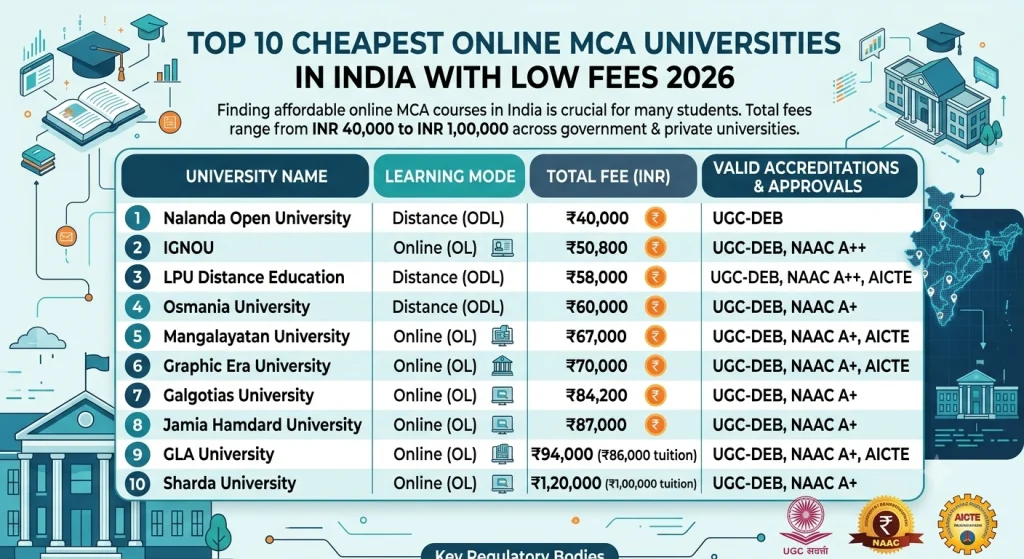
These institutions provide a range of affordable online MCA courses in India, with total fees varying significantly between government and private options, all under or around INR 1 lakh.
High-Demand Online MCA Specializations in 2026
General MCA degrees offer broad theoretical foundations, but specialized tracks allow working professionals and career changers to build target skill sets aligned with active tech hiring trends in 2026.
General MCA degrees offer broad theoretical foundations, but specialized tracks allow working professionals and career changers to build target skill sets aligned with active tech hiring trends in 2026.
1. Artificial Intelligence & Machine Learning (AI/ML)
Designed for software engineers and analysts looking to build intelligent systems, automated workflows, and generative models.
-
Core Curriculum: Neural Networks, Deep Learning Frameworks, Natural Language Processing (NLP), Computer Vision, Python, TensorFlow, PyTorch, and Large Language Model (LLM) Integration.
-
Target Roles: AI Engineer, Machine Learning Developer, Prompt Engineer, NLP Specialist.
-
Ideal Candidates: BCA/B.Sc CS graduates with strong mathematical aptitude and interest in algorithmic programming.
2. Data Science & Financial Analytics
Focuses on converting complex data streams into actionable business intelligence using statistical algorithms and predictive modeling.
-
Core Curriculum: Python/R for Data Science, SQL, Big Data Systems (Apache Spark, Hadoop), Predictive Analytics, Power BI, Tableau, and Machine Learning Algorithms.
-
Target Roles: Data Scientist, Data Engineer, Business Intelligence Architect, Quantitative Analyst.
-
Ideal Candidates: Working professionals with a background in mathematics, statistics, economics, or general computing.
3. Cloud Computing & DevOps Infrastructure
Prepares students to design, deploy, and manage scalable cloud systems and continuous integration pipelines for modern enterprise software.
-
Core Curriculum: Amazon Web Services (AWS), Microsoft Azure, Google Cloud Platform (GCP), Containerization (Docker, Kubernetes), Microservices, Infrastructure as Code (Terraform), and CI/CD Pipelines (Jenkins).
-
Target Roles: Cloud Solutions Architect, DevOps Engineer, Site Reliability Engineer (SRE), Cloud Security Specialist.
-
Ideal Candidates: IT support professionals, system administrators, and web developers seeking enterprise cloud infrastructure roles.
4. Cybersecurity & Cyber Defense
Addresses the rising demand for digital security, threat intelligence, and data protection across banking, enterprise, and public sector infrastructure.
-
Core Curriculum: Network Security, Cryptography, Penetration Testing, Ethical Hacking, Cyber Laws & Compliance, Security Operations Center (SOC) Analysis, and SIEM Tools.
-
Target Roles: Cybersecurity Analyst, Information Security Officer, Security Engineer, Ethical Hacker.
-
Ideal Candidates: Networking professionals, system engineers, and students interested in threat defense and system hardening.
5. Full Stack Software Engineering
Focuses on modern web application architectures, front-end design, back-end development, and cloud-native databases.
-
Core Curriculum: MERN/MEAN Stack (MongoDB, Express.js, React/Angular, Node.js), API Development, System Design, Git, Agile Methodologies, and Mobile App Development (Flutter/React Native).
-
Target Roles: Full Stack Developer, Software Development Engineer (SDE-I / SDE-II), Web Architect, Technical Lead.
-
Ideal Candidates: Coding enthusiasts, junior developers, and non-CS professionals transitioning into core software development.
Cheapest Online MCA Career Opportunities, Placement Support & Salary ROI
An Online Master of Computer Applications (MCA) serves as an effective lever for career transitions, salary hikes, and entry into enterprise software roles. Because the degree allows students to retain their full-time employment while studying, the financial return on investment (ROI) often exceeds that of traditional full-time, on-campus programs.
Target Career Roles & Salary Benchmarks (2026)
Salaries after completing an Online MCA vary depending on technical specializations, coding competence, prior work experience, and recruiter profile (service-based IT firms vs. product-based tech companies).
| Experience Tier | Typical Annual Package (₹) | Monthly Take-Home (Approx. ₹) | Target Roles |
| Fresher (0–2 Years) | ₹3.5 LPA – ₹7.0 LPA | ₹28,000 – ₹55,000 | Junior Software Engineer, QA Automation Tester, Web Developer, IT Analyst Trainee |
| Mid-Level (3–5 Years) | ₹8.0 LPA – ₹15.0 LPA | ₹65,000 – ₹1,20,000 | Full Stack Developer, Data Scientist, DevOps Engineer, Cloud Specialist |
| Senior Level (6–10 Years) | ₹15.0 LPA – ₹28.0 LPA | ₹1,20,000 – ₹2,10,000 | Solutions Architect, Cybersecurity Manager, Tech Lead, Engineering Manager |
| Leadership (10+ Years) | ₹30.0 LPA – ₹45.0+ LPA | ₹2,30,000+ | Chief Technology Officer (CTO), Principal Architect, Enterprise IT Director |
Domain Specialization Pay Multipliers
Choosing a high-demand tech specialization directly impacts starting salary offers and long-term earning potential.
-
Artificial Intelligence & Machine Learning: Freshers earn between ₹5.0 LPA and ₹8.5 LPA, while experienced AI/LLM engineers can reach ₹20.0 LPA+ within 4 years.
-
Cloud Computing & DevOps: Certified AWS/Azure specialists start around ₹5.0 LPA – ₹8.0 LPA, with mid-level architects commanding ₹14.0 LPA – ₹22.0 LPA.
-
Cybersecurity & Threat Intelligence: Entry-level analysts receive ₹5.0 LPA – ₹8.5 LPA, scaling to ₹15.0 LPA – ₹25.0 LPA in enterprise banking and fintech security operations.
Institutional Placement Support Mechanisms
While online universities do not offer physical, on-campus recruitment drives, accredited institutions deliver career support through specialized digital channels:
-
Virtual Placement Drives & Recruiter Portals: Access to exclusive job boards partnered with top recruiters such as TCS, Wipro, Infosys, Accenture, Cognizant, Tech Mahindra, and mid-tier SaaS startups.
-
Career Readiness Bootcamps: Live workshops covering technical interview prep, HackerRank/LeetCode coding assessments, and system design mock interviews.
-
Portfolio & GitHub Optimization: Academic assistance in building public code repositories, cloud-hosted projects, and verified LinkedIn profiles to showcase practical skills to hiring managers.
-
Resume AI Analysis & Mock Interviews: Automated ATS-resume scanning and 1-on-1 feedback sessions with senior IT industry mentors.
Financial Return on Investment (ROI) & Payback Analysis
The primary advantage of an Online MCA is its zero foregone income model—students continue earning their regular salary while completing the degree.
Payback Timelines by Tuition Tier
-
Ultra-Budget Tier (IGNOU, State Universities — Total Fee: ₹50,000 – ₹80,000):
-
Payback Period: 1 to 2 Months post-degree promotion or job switch.
-
Best For: Working professionals who need a recognized master’s degree to unlock corporate appraisal bands or eligibility for government IT roles.
-
-
Mid-Tier Private Universities (LPU, Chandigarh Univ, SMU — Total Fee: ₹1.10L – ₹1.50L):
-
Payback Period: 3 to 5 Months.
-
Best For: Non-CS graduates or junior developers seeking a combination of updated tech coursework, virtual job drives, and structured learning schedules.
-
-
Premier / Global Tier (Amity, Manipal Jaipur, Jain, UPES — Total Fee: ₹1.50L – ₹2.20L):
-
Payback Period: 5 to 8 Months.
-
Best For: Tech professionals targeting global credentials (WES evaluation), advanced cloud/AI labs, and premium corporate networks.
-
Kurukshetra University vs Uttaranchal Universitry vs Sikkim Manipal: Affordable Online MCA Fees, Placements, Cirrciculum Comparison
Choosing among low-cost to mid-tier online MCA programs requires balancing tuition fees against academic delivery, tech stack relevance, and placement support services. Here is a side-by-side comparative analysis of Kurukshetra University Online (Public State University), Uttaranchal University Online (Mid-Budget Private), and Sikkim Manipal University Online (Premier Private Network).
| Feature / Parameter | Kurukshetra University Online (KUK) | Uttaranchal University Online | Sikkim Manipal University (SMU Online) |
| Institution Type | Public State University (Est. 1956) | Private University | Deemed/Private University (Manipal Group) |
| Accreditation & Approvals | NAAC A++, UGC-DEB, AICTE, WES | NAAC A+, UGC-DEB, AICTE | NAAC A+, UGC-DEB, AICTE, WES |
| Total Program Fee | ₹76,647 (~₹18,900 – ₹19,947/semester) | ₹96,000 (After early-bird scholarship) | ₹1,10,000 (~₹24,500 – ₹27,500/semester) |
| LMS & Tech Infrastructure | Standard LMS with recorded video modules, e-books, & live Q&A. | Interactive LMS, recorded lectures, digital library, & weekend live sessions. | Advanced LMS integrated with tech industry masterclasses & cloud labs. |
| Curriculum Focus | Strong core computer science theory, OS, DBMS, Java, & Big Data. | Applied software development, Web Tech, Python, & AI fundamentals. | Enterprise-level software engineering, Cloud, & Applied Analytics. |
| Examination Mode | Remote AI-Proctored Exams (MCQ + Subjective split). | Remote AI-Proctored Online Examinations. | 100% Remote AI-Proctored Exams with slot booking. |
| Placement & Career Support | Resume building, basic interview guidance, & virtual job notifications. | Placement support portal, soft skills training, & interview preparation. | Dedicated placement portal (Online Manipal platform), mock interviews, & recruiter drives. |
Final Decision Matrix: Which Should You Choose?
-
Choose Kurukshetra University (KUK) if: You require the highest NAAC grade (A++) and public state university backing at the lowest overall cost, primarily for government/PSU recruitment, Ph.D. eligibility, or WES evaluation.
-
Choose Uttaranchal University if: You prefer a private university structure under ₹1.0 Lakh with flexible payment plans and recorded/live class options.
-
Choose Sikkim Manipal University (SMU) if: You can stretch your budget to ₹1.10 Lakh and want corporate brand equity, enterprise LMS technology, and access to job placement portals across IT MNCs.
Online MCA Admissions 2026: Important Admission Dates & Process
Admissions for UGC-DEB-approved online MCA programs in India operate under strict regulatory timelines set by the Distance Education Bureau. Unlike traditional campus admissions that occur once a year, online programs feature two admission cycles annually, allowing working professionals and fresh graduates to enroll without waiting an entire academic year.
| Admission Session | Application Window | UGC-DEB Registration Deadline | Ideal Target Applicant |
| January Cycle (Winter) | December 15 – February 28 | March 15 – March 30 | Working professionals planning early-year skill upgrades or career changes. |
| July/August Cycle (Monsoon) | June 1 – August 31 | September 15 (Extended to October 13) | Recent BCA/B.Sc graduates and mid-year applicants. |
Step-by-Step Admission Workflow for 2026
-
Check Eligibility & Bridge Course: Confirm a minimum 50% aggregate in graduation. Non-math or non-CS graduates must ensure the university offers an integrated Semester 1 bridge module.
-
Generate ABC ID: Log into DigiLocker, navigate to the Academic Bank of Credits, and create your 12-digit ABC ID using Aadhaar verification.
-
Generate DEB ID: Visit
deb.ugc.ac.in, enter your ABC ID, and complete Aadhaar OTP authentication to obtain your mandatory DEB ID. -
Apply on Official Portal: Complete the application on the university’s official domain (
.ac.in), uploading academic transcripts and your DEB ID. -
Fee Payment / EMI Activation: Pay the semester tuition fee or set up a No-Cost EMI plan through official payment channels.
-
LMS Onboarding: Receive your enrollment number, student ID, and LMS access details once your DEB ID is validated against the UGC portal.
How to Choose the Best Affordable Online MCA Program in India 2026
Choosing the best affordable online MCA courses in India requires careful consideration of several factors to ensure a valid and career-aligned degree. Key steps involve verifying accreditations, evaluating curriculum, checking faculty, and prioritizing financial flexibility, all crucial for making an informed decision about your future.
- Step 1: Accreditations: Choose UGC-entitled, AICTE-approved universities with UGC-DEB, AIU, NAAC recognition.
- Step 2: Curriculum: Assess depth, covering core technical subjects and emerging fields like AI, cloud computing.
- Step 3: Faculty & Support: Investigate faculty expertise and ensure comprehensive learning support via LMS.
- Step 4: Affordability: Compare tuition fees, looking for competitive structures and accessible loan/EMI options.
- Step 5: Reputation & Career: Review alumni feedback, program rankings, and strong placement support.
- Step 6: Eligibility & Admission: Confirm 10+2+3 eligibility; many online MCA programs do not require an entrance exam.
- Step 7: Use online platforms to compare 100+ universities based on 30x comparison factors.
Frequently Asked Questions
1. Is an entrance exam required for admission to an Online MCA in 2026?
No national entrance exam like NIMCET or CUET is mandatory for most online MCA programs. Admissions are granted directly based on graduation merit, provided you satisfy the baseline eligibility standards established by UGC-DEB and AICTE regulations.
2. Can non-mathematics or non-CS students apply for an Online MCA program?
Yes. Non-CS and non-math graduates (such as B.Com, B.A., or general B.Sc holders) can enroll by completing an integrated Semester 1 Bridge Course in introductory mathematics and computer programming fundamentals mandated under AICTE guidelines.
3. Are Online MCA degrees recognized by AICTE and UGC for government jobs?
Yes. Under UGC Regulation 22, online MCA degrees from recognized universities hold 100% legal parity with conventional on-campus degrees. They are completely valid for central and state government jobs, PSU recruitment, GATE/Ph.D. eligibility, and private sector IT roles.
4. What is the typical fee range for affordable Online MCA colleges in India?
Total tuition fees range from ₹50,000 to ₹90,000 for public open universities (such as IGNOU or Kurukshetra University) and between ₹1.0 Lakh and ₹1.6 Lakhs for mid-tier private institutions offering flexible No-Cost EMI plans.
5. How are practical coding labs and semester examinations conducted online?
Universities deliver practical training through cloud-based virtual coding labs and project repositories. Semester examinations are conducted via 100% remote AI-proctored online tests with flexible weekend slot-booking options, allowing working professionals to take exams from home.
6. Why are ABC ID and DEB ID mandatory for Online MCA admissions in 2026?
Generated via DigiLocker and the UGC-DEB portal (deb.ugc.ac.in), these 12-digit digital IDs log your academic credits and validate your registration against central government databases. Admissions completed without linked DEB IDs are legally invalid.
7. Which Online MCA specializations offer the highest salary ROI in 2026?
Specializations in AI & Machine Learning, Data Science Analytics, Cloud Computing & DevOps, and Cybersecurity deliver the highest career returns, helping mid-level IT professionals command 30% to 60% lateral salary hikes upon graduation.