In this article
- 01UGC & NAAC Accreditation: Essential Checks for Online Universities 2026
- 02Online University Selection: 7-Point Checklist for Indian Students 2026
- 03Online University Fees & EMI Options: Budgeting for Your Degree 2026
- 04Choosing the Best Online University in India with ROI
- 05Choosing the Best Online University in India: Complete Flowchart
- 06Frequently Asked Questions
Choosing the best online university in India in 2026 requires looking beyond billboards and marketing promises. With over 100 UGC-DEB-approved institutions offering online degrees, finding the right fit means evaluating regulatory compliance, academic depth, and total return on investment.
Under current UGC guidelines, an online degree from a recognized institution holds equal legal validity as a traditional on-campus degree for government jobs, UPSC exams, and higher studies. This guide breaks down essential accreditation checks, mandatory digital registrations like ABC and DEB IDs, fee benchmarks, and key evaluation frameworks to help you choose the right university for your career goals.
UGC & NAAC Accreditation: Essential Checks for Online Universities 2026
When you choose an online university in India, ensure it has UGC-DEB approval, as degrees without it could be invalid. Currently, 105 UGC-DEB-approved universities offer online programs, with degrees equivalent to regular mode degrees, valid for government jobs, UPSC, and higher studies.
| S.No. | University Name | Accreditations | Courses |
| 1. | Manipal University Online | NAAC A+, UGC, AICTE, IIRF ranking 1 | MBA, MA, MCOM, MCA |
| 2. | Amity University Online | UGC, AICTE, DEC, WASC, WES, NCHE | MCA, Mcom, MA, MBA, Msc. |
| 3. | Lovely Professional University | UGC-DEB,NAAC A++, WES, ISO, AICTE, SACSCOC | MBA, MCA, MA, MCom, MSc. |
| 4. | UPES Online | UGC-DEB,AICTE,NAAC A+,NIRF,QS World Ranking | MBA, MCA |
| 5. | Sharda University | NAAC, UGC, WES, AIU | MBA, MCA |
| 6. | GLA online | NAAC A+, UGC, WES, AIU | MBA, MCA |
| 7. | Chandigarh University Online | NAAC A+, UGC, NBA, IAU, AIU, AICTE, COA, PCI, BCI | MBA, MSc. , MA, MCA |
| 8. | Uttaranchal University | UGC, NAAC A+, WES, AICTE, AIU | MBA, MCA, Executive MBA |
| 9. | DY Patil University | NAAC, UGC, WES, AIU | MBA |
| 10. | Jain university | NAAC A++, UGC, AICTE, AUAP, WES | MBA, MCA, MCom, MA |
Online University Selection: 7-Point Checklist for Indian Students 2026
Choosing the right online university requires looking beyond billboard advertisements and glossy brochure promises. With over 100 higher education institutions (HEIs) offering online programs in India, applying a rigorous evaluation framework ensures your degree is legally valid, academically sound, and aligned with your career goals.
Use this 7-point framework to evaluate any UGC-DEB-approved online university before submitting your application.
1. Degree & Specialization Validity
While a university might hold overall UGC-DEB approval, approvals are given on a course-by-course basis. A university approved to offer an Online B.Com may not have entitlement for its Online MCA or BBA in Business Analytics.
- Course-Level Verification: Always verify that the exact specialization (e.g., Data Science, Financial Risk Management, HR Management) is explicitly listed in the university’s UGC-DEB entitlement letter for the current academic session.
- Duration & Credit Equivalence: Ensure the program matches the standard credit structure mandated by the UGC (e.g., 3-year undergraduate degrees or 4-year UG honors degrees under NEP 2020, and 2-year postgraduate degrees).
- Global Recognition (WES & AIU): If you plan to work abroad or pursue higher studies overseas, check if the university is recognized by World Education Services (WES) or the Association of Indian Universities (AIU).
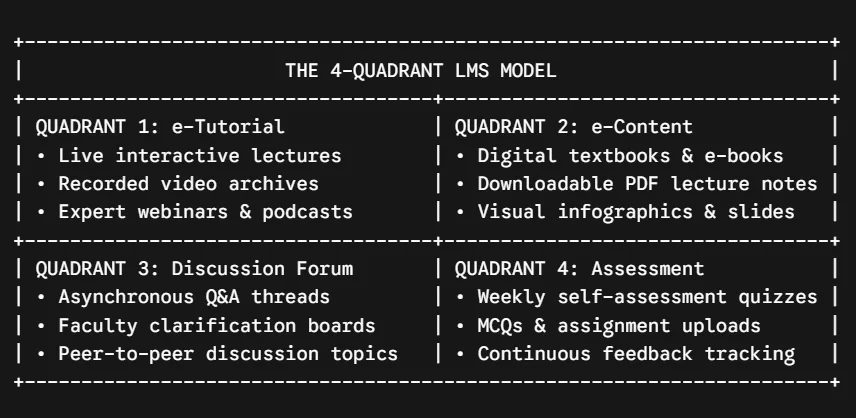
2. Learning Platform (LMS) & The 4-Quadrant Model
Under UGC regulations for Online Learning (OL), every recognized university must deliver its courses through a structured Learning Management System (LMS) adhering to the 4-Quadrant Pedagogical Model:
Mobile Accessibility: Test if the LMS offers a functional mobile app with offline downloading options for study material, accommodating students in lower-bandwidth areas.
Bandwidth Efficiency: Evaluate whether live lectures are recorded and optimized for low data consumption.
3. Examination & Assessment Methodologies
- Exam Format: Confirm whether exams are 100% Remote AI-Proctored (from home) or require visits to physical test centers.
- Weightage Split: Standard programs split marks 30:70 between Continuous Internal Assessments (assignments/quizzes) and End-Term Exams.
4. Faculty Quality & Mentorship
- Look for programs led by core Ph.D. faculty supplemented by corporate guest lectures and masterclasses.
- Verify if dedicated academic tutors are available for timely doubt resolution.
5. Authentic Placement Support
- Legitimate Services: Look for virtual job fairs, AI resume scoring, mock interviews, and dedicated career portals.
- Red Flag: Avoid institutions claiming “100% Guaranteed Placements” or unverified salary stats.
6. Administrative & Student Support
- Check for a transparent online portal to track admit cards, marksheets, and fee receipts.
- Ensure clear grievance redressal systems and access to regional learner support centers if needed.
7. Verified Student & Alumni Outcomes
- Connect with current online students on LinkedIn to ask about exam flexibility and support responsiveness.
- Research independent discussion forums (Reddit, Quora) to catch hidden fees or administrative delays early.
Online University Fees & EMI Options: Budgeting for Your Degree 2026
Online degrees in India offer substantial cost benefits compared to traditional on-campus programs, often saving students 40% to 70% in tuition while eliminating hostel and commuting expenses. However, understanding fee structures and hidden costs is essential before enrolling.
Estimated Price Benchmarks by Program Type
| Degree Program | Typical Annual / Semester Fee | Total Estimated Program Fee |
| Online B.A. / B.Com | ₹12,000 – ₹25,000 / year | ₹36,000 – ₹75,000 |
| Online BBA / BCA | ₹25,000 – ₹50,000 / year | ₹75,000 – ₹1,50,000 |
| Online M.A. / M.Com | ₹15,000 – ₹30,000 / year | ₹30,000 – ₹60,000 |
| Online MCA | ₹25,000 – ₹60,000 / year | ₹50,000 – ₹1,20,000 |
| Online MBA (Standard Private/State) | ₹30,000 – ₹75,000 / semester | ₹1,20,000 – ₹3,00,000 |
| Online MBA (Premier / Top-Tier) | ₹75,000 – ₹1,50,000 / semester | ₹3,00,000 – ₹6,00,000+ |
Hidden Costs & Fee Checklist
Before signing an admission agreement, calculate the Total Cost of Education (TCE) by asking the admissions advisor about these common extra charges:
- Examination Fees: Are exam charges included in the semester fee, or billed separately at ₹1,500–₹2,500 per semester?
- Alumni & Degree Certificate Charges: One-time charges (~₹2,000–₹5,000) collected during the final semester for degree printing and alumni network access.
- Proctoring Fees: Some universities charge external fees if exams are scheduled through specialized third-party online proctoring portals.
- LMS Access & Digital Content Charges: Verify whether digital study materials and library databases are included in tuition.
Understanding Financing & Payment Options
No-Cost EMI Schemes: Most major universities partner with NBFCs (e.g., Bajaj Finserv, Propelld, LiquiLoans) to offer 0%-interest monthly EMI payments (ranging between ₹4,000 and ₹12,000 per month).
- Caution: Check for non-refundable processing fees (1%–2%) charged by loan providers during setup.
Scholarship Validity: Universities frequently offer merit-based, defense personnel, or early-bird fee concessions. Always confirm that scholarships apply across all semesters and aren’t restricted to Year 1.
Choosing the Best Online University in India with ROI
Evaluating an online university purely on fee structures or brand prestige overlooks the core objective for most candidates: maximizing long-term career returns relative to financial and time investments. Calculating the Return on Investment (ROI) for an online degree requires evaluating total tuition outlay, opportunity costs, immediate salary hikes, and lifetime career mobility.
The Online MBA ROI Architecture
Unlike full-time residential degrees, which require leaving your job and foregoing 2 years of salary, an online degree allows working professionals to maintain a continuous income stream while pursuing higher education.
| Institutional Tier | Representative Universities | Total Tuition Range | Average Post-Degree Hike | Estimated Payback Period |
| Public Open Tier | IGNOU, TNOU | ₹25,000 – ₹66,000 | 15% – 25% (Govt/PSU Scale Hikes) | 1 to 3 Months |
| Private Budget Tier | Chandigarh University, Uttaranchal Univ, Jain | ₹1.50L – ₹1.96L | 25% – 45% (Corporate Hikes) | 3 to 6 Months |
| Premier / Global Tier | Amity Online, MAHE, Manipal Jaipur | ₹2.00L – ₹2.92L | 35% – 60%+ (Global/MNC Transitions) | 6 to 9 Months |
Strategic Steps to Maximize Your Degree ROI
1. Prioritize Practical Tool Accreditation Over Pure Theory
To convert an online degree into an immediate salary increase, choose programs that incorporate real-world corporate frameworks:
- Business & Analytics: Look for tracks that teach Power BI, SQL, Python, or Tableau, or those bundling Harvard Business Publishing (HBP) cases.
- Finance: Choose tracks aligned with professional exemptions (e.g., ACCA UK) or corporate masterclasses (e.g., PwC modules).
2. Leverage Internal Lateral Mobility Early
Don’t wait until graduation to utilize your learning. Use your enrollment in an online master’s program to negotiate internal transfers or promotions within your current organization after completing Year 1. Demonstrating updated skills in project management, digital marketing, or business analytics frequently leads to early internal pay adjustments.
3. Factor in Total Cost of Ownership (TCO)
A program that appears cheap can lose its ROI advantage if it carries hidden costs. Ensure your ROI calculations include:
- Semester examination fees (typically ₹1,000–₹2,500/term).
- One-time convocation, degree issuance, and alumni network fees.
- Interest charges on NBFC loan financing (if non-zero EMI processing fees apply).
ROI Decision Verdict
- Highest Financial ROI (Public Tier): Best for PSU/Government employees or candidates who only need a degree credential to unlock structured promotions.
- Balanced Career & Placement ROI (Private Budget Tier): Best for mid-level corporate professionals seeking new domain skills, resume building, and virtual placement portal access under a ₹1.80 Lakh budget.
- Brand & Global ROI (Premier Tier): Best for candidates targeting multinational corporate transitions, foreign credential evaluations (WES), or global charter exemptions.
Choosing the Best Online University in India: Complete Flowchart
Navigating the admission process for a recognized online degree in India involves specific mandatory compliance steps. Follow this streamlined 6-step roadmap to complete your application correctly:
1. Verify Entitlement: UGC-DEB Portal Check.
Visit deb.ugc.ac.in to confirm that your target university and exact program specialization are eligible for the current session.
2. Generate ABC ID: DigiLocker Integration.
Log in to DigiLocker, select the Academic Bank of Credits (ABC) option, and generate your 12-digit ABC ID using Aadhaar OTP verification.
3. Generate DEB ID: Government Student Registration.
Go to the official UGC-DEB portal, enter your ABC ID, verify your identity via Aadhaar OTP, and create your mandatory DEB ID.
4. Submit University Application: Official Admission Portal.
Complete the application on the university’s official web portal. Upload academic transcripts, ID proof, and enter your generated DEB ID.
5. Fee Payment: Official Banking Channels.
Pay the semester or annual tuition fee exclusively through the university’s official payment gateway or via flexible No-Cost EMI options.
6. Confirmation & LMS Onboarding: Enrollment Verification.
Receive your official university enrollment number, student portal credentials, and verify that your profile reflects your linked ABC/DEB registration.
Frequently Asked Questions
1. Are online degrees valid for government jobs and UPSC exams in India?
Yes. As per UGC regulations, online degrees earned from UGC-DEB-approved universities are fully equivalent to conventional on-campus degrees. They are valid for all central/state government recruitment, public sector unit (PSU) roles, and UPSC exams.
2. How can I check if an online university is officially UGC-DEB approved?
Visit the official Distance Education Bureau portal at deb.ugc.ac.in. Search for your target university in the current academic year’s list and verify that your specific degree and specialization are explicitly listed under entitled programs.
3. What degrees are strictly prohibited from being offered online in India?
UGC prohibits professional and practical disciplines in online mode. These include Engineering (B.Tech/M.Tech), Medicine, Pharmacy, Nursing, Law, Architecture, Agriculture, Dental, Physiotherapy, and research-based degrees like M.Phil and Ph.D.
4. What is the difference between Distance Learning (ODL) and Online Learning (OL)?
Open & Distance Learning (ODL) primarily relies on physical printed study materials and offline exam centers. Online Learning (OL) is completely digital—featuring live webinars, LMS e-content, continuous internal assessments, and remote AI-proctored online examinations.
5. Is it mandatory to generate an ABC ID and DEB ID for online admissions?
Yes, creating both digital IDs is a mandatory prerequisite. Your ABC ID tracks your academic credit repository via DigiLocker, while your DEB ID validates your student registration directly on the central UGC portal for legal degree recognition.
6. Can I pursue an online degree and a regular degree at the same time?
Yes. Under UGC guidelines, students can pursue two academic degrees simultaneously. You can enroll in one full-time physical on-campus program and one online/distance program from a recognized university without violating any academic regulations.
7. Do online degree marksheets mention the word “Online” or carry less value?
UGC mandates that degrees earned through online mode hold equal status, standard nomenclature, and academic value as conventional degrees. While certificates may mention the delivery mode as required by compliance, employer validity remains identical.
8. What are the official admission cycles for online universities in India?
Online admissions across recognized Indian universities are conducted in two primary academic sessions annually: the July/August intake (calendar year mid-session) and the January/February intake (calendar year beginning session).